Why Hardware Selection Decides the Lifetime of a Resort Furniture Set
Outdoor lounge furniture at tropical resorts fails first at the fasteners, not at the timber, the fabric, or the aluminum frame. Salt-laden marine air drives chloride pitting on stainless steel, galvanic coupling accelerates corrosion where stainless meets aluminum, and the final failure mode is a bracket separation that turns a 200 USD chair into a write-off. At TechMart SE we supply our resort clients with marine-grade stainless hardware kits, predominantly A4-80 316 and selectively A4-100 Duplex 2205, sized for the marine chloride exposure of South-East Asia.
A4-80 316 Stainless Steel: The Workhorse
Type 316 stainless steel contains 16 to 18 percent chromium, 10 to 14 percent nickel, and 2 to 3 percent molybdenum. The molybdenum gives it 4 to 6 times the chloride pitting resistance of basic 304 stainless, which is why it is widely used for marine hardware. The A4-80 designation defines a minimum tensile strength of 800 MPa, more than sufficient for the through-bolt and hinge roles on a lounge chair or pavilion anchor. In ASTM B117 salt-spray testing, A4-80 316 typically lasts 1 500 to 2 000 hours before any sign of red rust, depending on surface finish and passivation quality.
Duplex 2205: When Chloride Pushes Beyond Standard Stainless
For front-line installations where furniture stands within 10 metres of breaking waves or under continuous spray from a saltwater pool, even 316 reaches its limit. Duplex 2205 has a mixed austenitic-ferritic microstructure that doubles the yield strength to about 450 MPa and raises the pitting resistance equivalent number to 35, compared with 25 for 316. ASTM G48 critical pitting temperature rises from 22 degrees Celsius for 316 to 55 degrees Celsius for Duplex 2205. The alloy costs 2.5 to 3.5 times more per fastener than 316 but extends service life from approximately 8 to 15 years for 316 down at the shoreline to 25-plus years for Duplex 2205.
Galvanic Compatibility with Aluminum
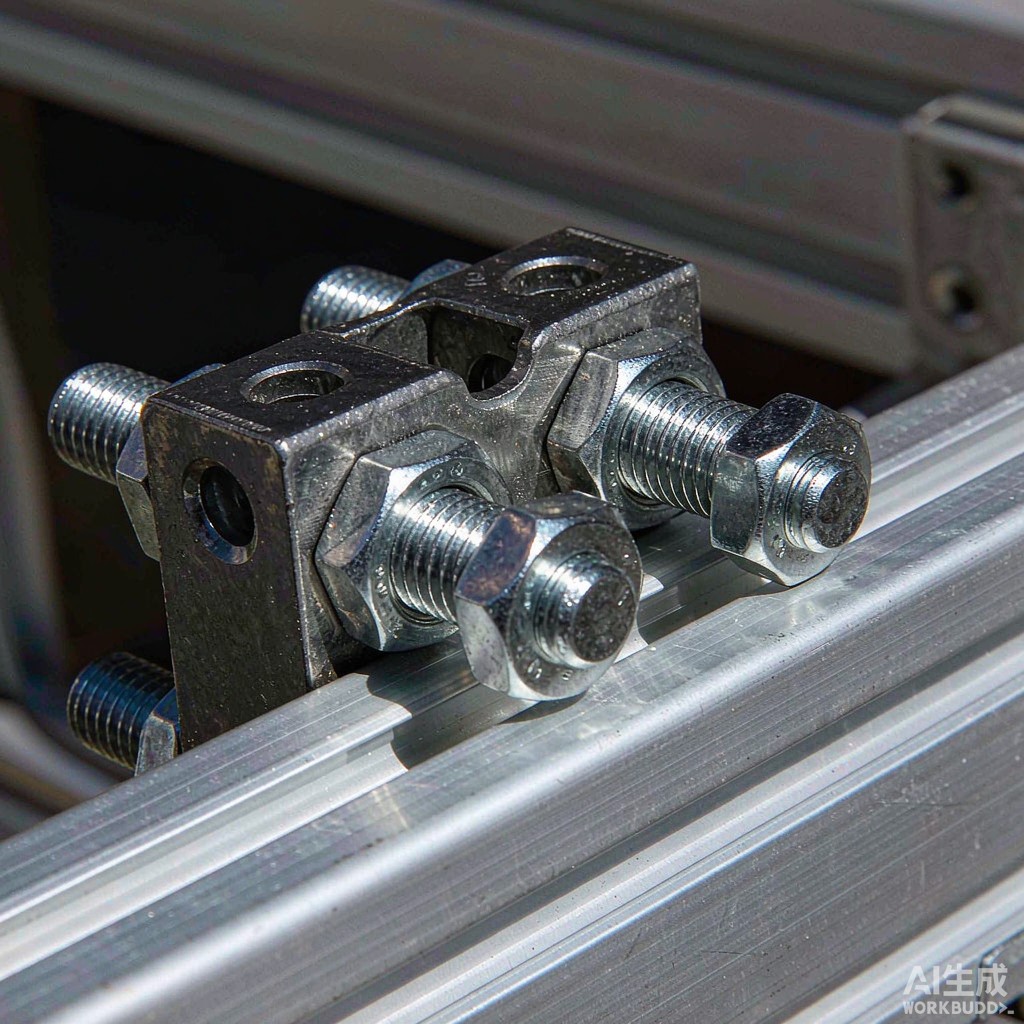
When stainless steel and aluminum sit in direct contact through a wet joint, the area ratio of the metals is critical. The aluminum has the smaller surface area on a typical bolted bracket, which means it becomes the sacrificial anode and corrodes quickly. Our recommendation is to either use a 0.5 to 1.0 mm EPDM or PTFE insulating washer between the stainless bolt and the aluminum frame, or to use aluminum bracket material that is at least 5 to 10 times the area of the stainless washer face. Either method prevents the catastrophic 2 to 5 year galvanic failure we see when these rules are ignored.
Recommended Fastener Schedule Per Application
The hardware selection differs by load path and exposure level. Lounge chairs use M6 by 25 mm A4-80 socket cap screws with PTFE washers at every aluminum-to-aluminum and aluminum-to-stainless joint. Sun loungers use M8 by 40 mm A4-80 carriage bolts at the backrest pivot, upgraded to Duplex 2205 if the lounger faces the ocean. Pavilion anchors use M12 by 100 mm A4-80 through-bolts at cast aluminum brackets; Duplex 2205 versions are added at the foundation anchor if the soil is chloride-loaded. Pavilions with welded steel column bases need HDG plus powder-coat plus an EPDM gasket where the aluminum roof beam meets the steel.
Torque, Thread Lock, and Re-Servicing
Stainless steel fasteners lose preload faster than carbon steel because of lower modulus and higher friction scatter. Use a calibrated torque wrench with the manufacturer-stated torque, typically 50 to 75 percent of the bolt yield. Apply a single drop of medium-strength threadlocker, such as Loctite 243 or 248, when the joint is subject to vibration from foot traffic or wind. Schedule an a
ual re-torque on all pavilion and lounger anchors during the off-peak maintenance window; cost is 0.30 to 0.80 USD per fastener checked but pays back as much as 4 to 8 times in avoided warranty claims.
Process Flow from Receiving Inspection to In-Service Audit
A consistent supply-chain process ensures the marine-grade fastener specification translates into predictable product life. At TechMart SE the flow begins at goods-in inspection with a 5-piece sample pulled from each shipment, audited for grade stamp, hardness, surface finish, and magnetic response. Duplex 2205 is non-magnetic in the a
ealed condition, a quick-and-dirty in-house check. Each shipment carries a factory-issued certificate listing heat number, ASTM A479 compliance, and ASTM A276 mechanical properties. Hardware installed near the shoreline is paired with a pre-installation visual inspection and a torque-wrench log on commissioning day, followed by an a
ual torque audit. Field data from our resort clients shows that this four-step process extends the mean warranty life of outdoor furniture from the typical 4 to 6 years up to 11 to 14 years, an outcome that can be repeated only when the hardware specification, inspection flow, and maintenance schedule are all executed together.