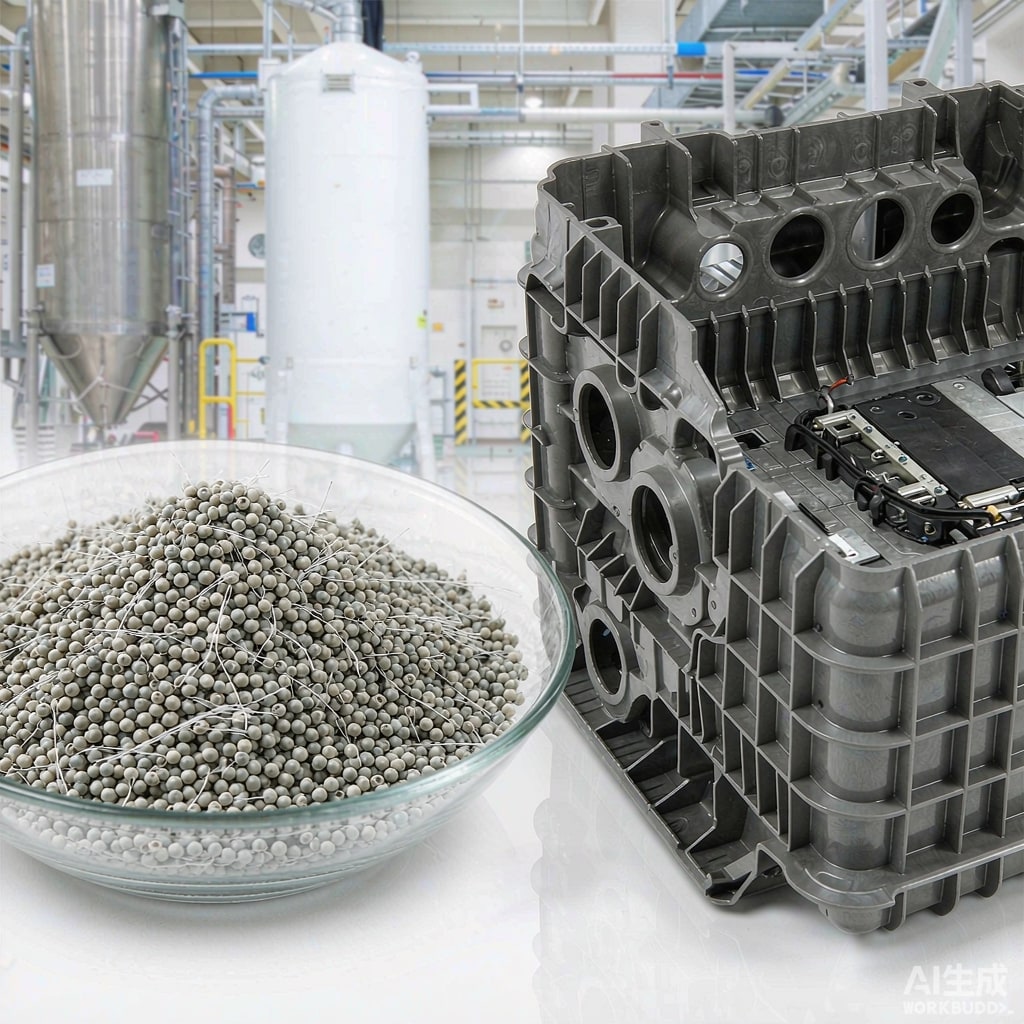
Most glass-filled polypropylene in electronics is short glass fiber (SGF) compound — 10–30% fibers chopped to a fraction of a millimeter during compounding. Long glass fiber PP (LGF-PP) is different: pellets contain fibers as long as the pellet itself (10–25 mm), and if molding preserves that length, the part gains a leap in stiffness, impact strength, and creep resistance that short-fiber grades ca
ot match. For structural electronics components — battery trays, inverter housings, mounting frames, equipment chassis, large covers that must carry load — LGF-PP often replaces metal or glass-filled nylon at lower cost and weight.
What Long Fiber Changes Mechanically
Stiffness and strength
With comparable glass content (typically 20–40% by weight), LGF-PP delivers roughly 20–40% higher flexural modulus and tensile strength than the equivalent SGF-PP, because longer fibers transfer load far more efficiently across the matrix. Typical LGF-PP with 30% glass reaches flexural modulus around 6,000–7,500 MPa versus 4,000–4,500 MPa for SGF30, and notched impact strength can be two to three times higher — long fibers bridge cracks and pull out rather than acting as stress concentrators the way short fiber ends do. Crucially for structural parts, LGF-PP retains useful toughness at low temperature, where unreinforced PP becomes brittle.
Creep and fatigue
The decisive advantage for load-bearing electronics structures is creep resistance. A boss carrying a threaded insert, a battery tray shelf, a snap arm that must hold a cover closed for years — these fail in SGF compounds by slow cold flow under sustained load. LGF-PP’s continuous-fiber skeleton dramatically reduces creep deflection and improves fatigue life under vibration, which matters for equipment mounted on vehicles, machinery, or in telecom outdoor cabinets subject to wind and transport vibration.
The Molding Challenge: Preserving Fiber Length
LGF-PP’s properties exist only if the fiber survives processing. Every aggressive shear event breaks fiber, and broken fiber means short-fiber performance at long-fiber material prices.
Machine and process guidelines
- Use a general-purpose screw with a moderate compression ratio; avoid high-shear mixing screws and barrier screws designed for dispersion, which shatter fiber bundles.
- Check ring check-valves and nozzle geometry — restrictively small flow paths are the main fiber-breakage sites. Use generous bore non-return valves and large-gate hot ru
ers.
- Keep melt temperature at the low end of the grade’s window (typically 200–230°C for PP): higher temperatures lower viscosity but do not compensate for shear damage.
- Use moderate injection speed and avoid excessive packing pressure, which drives fiber orientation and jetting rather than helping filling.
- Gate generously — a 1 mm pin gate can destroy the fiber structure of an entire part. Edge gates 1.5–3 mm, fan gates, or multiple large gates preserve length at the cost of some gate-mark management.
Shrinkage, warpage, and anisotropy
Long fibers amplify anisotropic shrinkage: flow-direction shrinkage can be half of cross-flow shrinkage, and the fiber orientation field follows the fill pattern. For flat structural parts this is the main warpage driver. Countermeasures include symmetric gating, balanced rib layout, larger radii, and — where the application tolerates it — longer glass content chosen so fewer, more orientable fibers fill uniformly. Simulation with fiber-orientation modeling is worth the effort for large LGF parts; shrinkage inputs taken from short-fiber data sheets will mislead.
Where LGF-PP Fits in Electronics
- Battery and power module trays: creep resistance under sustained load plus electrical insulation and PP’s chemical resistance.
- Inverter and drive enclosures: stiffness at elevated temperature, weight reduction versus sheet metal, integrated bosses and clips.
- Equipment chassis and frames: replacing painted steel parts, consolidating fasteners and brackets into single moldings.
- Outdoor cabinet components: PP’s inherent moisture immunity versus nylon — no drying, no hydrolysis, stable dimensions in humidity.
Its limits: PP’s service ceiling (roughly 100–120°C continuous with heat-stabilized grades) rules out reflow-adjacent or high-temperature applications where PBT, PA66, or PPS compounds are needed, and surface aesthetics are harder — fibers can appear at the surface (fiber bloom) where melt fronts converge.
Conclusion
LGF-PP occupies a valuable middle ground: the stiffness, impact toughness, and creep resistance of engineering thermoplastics at commodity-PP economics, with moisture immunity nylon ca
ot offer. The catch is process discipline — the properties are bought at the pellet stage and can be destroyed at the gate. Specify fiber-length retention requirements to your molder, review gate and screw design early in tooling development, and long-fiber polypropylene will carry structural loads that designers once assumed required metal or high-end engineering polymers.



