Introduction: Door Seam Shielding Challenges in Military Electronics
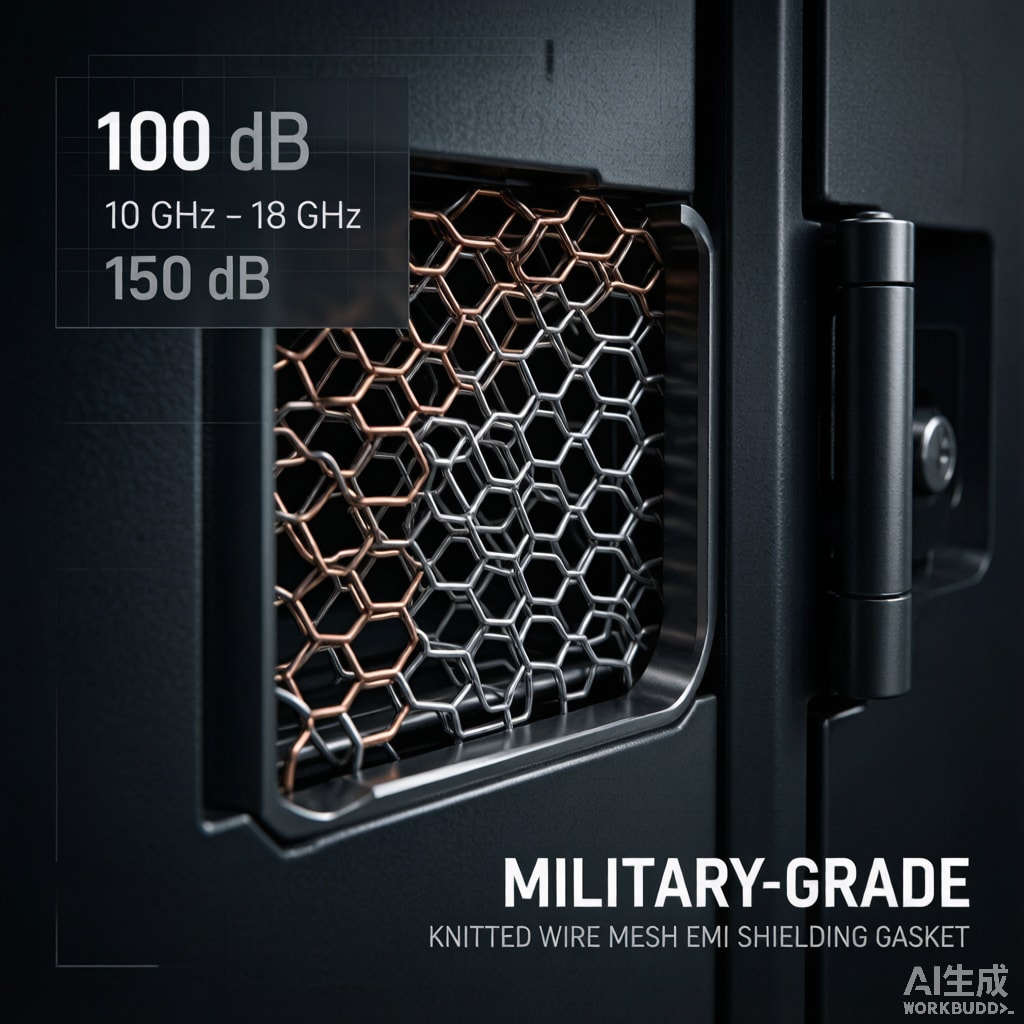
Military electronic enclosures must maintain electromagnetic shielding integrity across wide frequency bands while withstanding harsh environmental conditions. The door seam, with its removable gasket interface, represents the most vulnerable shielding discontinuity. Knitted wire mesh EMI gaskets have emerged as a proven solution for military enclosure door seams, offering high shielding effectiveness (SE), excellent compression recovery, and environmental resilience. This article examines the engineering principles, material selection, and performance characteristics of knitted wire mesh gaskets for MIL-DTL-83528 compliant applications.
Knitted Wire Mesh Manufacturing and Structure
Unlike woven wire cloth, knitted wire mesh is produced on circular knitting machines that interlock wire loops in a continuous tubular structure. This interlocking loop architecture provides unique mechanical properties:
- Compressibility: 30-70% compression range with elastic recovery
- Conformability: Adapts to surface irregularities up to 0.5mm gap variation
- Resilience: 10,000+ open-close cycles with <15% compression set
- Multi-wire options: Can knit multiple wire diameters or alloys simultaneously
The typical wire diameter ranges from 0.05mm to 0.15mm, with mesh density of 200-800 loops per square centimeter. The knitted tube can be compressed into rectangular, round, or P-profile cross-sections to match groove geometries in enclosure doors.
Material Selection: Monel vs Aluminum vs Stainless Steel
Monel 400 (Ni-Cu Alloy)
Monel 400 (approximately 67% nickel, 30% copper) is the most widely used wire material for military EMI gaskets. Its combination of corrosion resistance, conductivity, and mechanical durability makes it suitable for both indoor and outdoor enclosure applications.
- Electrical conductivity: 3.5% IACS (relatively low but compensated by high contact density)
- Corrosion resistance: Excellent in salt fog, H2S, and marine environments
- Tensile strength: 550-620 MPa (resists mechanical damage during door cycling)
- Temperature range: -60°C to +200°C continuous
- Cost: Moderate ($80-120/kg wire)
Aluminum Wire (5056 Alloy)
Aluminum 5056 (Al-Mg alloy) wire offers the lightest weight and highest conductivity among knitted mesh materials, making it ideal for aerospace enclosures where weight savings are critical.
- Electrical conductivity: 29% IACS (highest among common mesh materials)
- Density: 2.7 g/cm³ (one-third the weight of Monel)
- Corrosion resistance: Good in atmospheric conditions, but galvanic corrosion risk when coupled to steel enclosures
- Temperature range: -55°C to +150°C
- Cost: Low ($25-45/kg wire)
Stainless Steel 304/316
Stainless steel wire provides the highest mechanical strength and temperature resistance but the lowest conductivity. It is specified for extreme-environment military applications where corrosion and temperature are primary concerns.
- Electrical conductivity: 2.5% IACS
- Tensile strength: 700-900 MPa
- Corrosion resistance: Excellent (316 grade superior in chloride environments)
- Temperature range: -70°C to +400°C
- Cost: Moderate ($40-70/kg wire)
Bimetallic (Monel-Clad Aluminum)
Some advanced gaskets combine aluminum core wires with Monel cladding to achieve high conductivity (Al core) with corrosion resistance (Monel surface). This bimetallic approach delivers SE performance 5-8 dB higher than pure Monel at frequencies above 1 GHz.
Shielding Effectiveness Performance
The shielding effectiveness of knitted wire mesh gaskets depends on wire material, mesh density, compression level, and gasket cross-section. Testing per IEEE 299 and MIL-DTL-83528 transfer impedance methods yields the following performance ranges:
| Frequency | Monel 0.1mm | Aluminum 0.1mm | Stainless 316 0.1mm | Bimetallic |
|---|---|---|---|---|
| 30 MHz | 85-100 dB | 90-105 dB | 70-85 dB | 92-108 dB |
| 100 MHz | 80-95 dB | 85-100 dB | 65-80 dB | 88-102 dB |
| 1 GHz | 65-80 dB | 70-85 dB | 50-65 dB | 75-88 dB |
| 10 GHz | 45-60 dB | 50-65 dB | 35-50 dB | 55-70 dB |
The performance degradation at higher frequencies results from the mesh aperture acting as a waveguide-below-cutoff structure. The cutoff frequency depends on aperture size; denser meshes (more loops per cm²) maintain higher SE at millimeter-wave frequencies. For military applications requiring SE above 60 dB at 10 GHz, mesh densities exceeding 500 loops/cm² are recommended.
Compression-Deflection Characteristics
Knitted mesh gaskets require controlled compression to establish multi-point metallic contact between wire loops and the flange surface. The optimal compression range is 25-40% of the uncompressed gasket height:
- Below 15% compression: Insufficient contact points, SE drops 15-25 dB
- 15-25% compression: Acceptable for low-frequency shielding (below 500 MHz)
- 25-40% compression: Optimal range for full-band military shielding
- Above 50% compression: Wire deformation, compression set increases, cycle life reduced
The closure force required to achieve optimal compression depends on gasket cross-section area and wire material. A typical 6mm round Monel mesh gasket at 30% compression requires approximately 15-25 N/cm of closure force, which must be accommodated by the door fastener spacing and torque specification.
Environmental Sealing Integration
For outdoor military enclosures, knitted wire mesh is often combined with silicone elastomer to provide both EMI shielding and environmental sealing. Two common configurations exist:
Solid Silicone with Knitted Mesh Insert
The mesh is embedded within conductive silicone (filled with silver-plated copper or nickel-graphite particles), providing combined EMI and IP67 sealing. This configuration achieves 70-90 dB SE across 30 MHz to 10 GHz with salt fog resistance per MIL-STD-810G Method 509.
Multilayer Mesh-Elastomer Composite
An i
er knitted mesh layer provides primary EMI shielding, while outer silicone layers handle environmental sealing. This design allows independent optimization of each function and typically achieves higher SE (85-100 dB) with lower closure force (8-18 N/cm).
MIL-DTL-83528 Compliance Testing
Military EMI gaskets must satisfy MIL-DTL-83528 requirements, which specify shielding effectiveness, corrosion resistance, and durability testing:
- Transfer impedance test: Measures SE using a TEM cell or tri-plate line at 20 MHz to 10 GHz
- Compression set: After 1,000 cycles at 30% compression, set must not exceed 25%
- Salt spray exposure: 500 hours per ASTM B117 with <5 dB SE degradation
- Fluid immersion: 24-hour immersion in hydraulic fluid, jet fuel, and cleaning solvent
- Temperature cycling: -55°C to +125°C, 100 cycles, <3 dB SE change
Conclusion
Knitted wire mesh EMI gaskets provide robust shielding for military enclosure door seams across the full military frequency spectrum. Monel 400 remains the workhorse material for general-purpose applications, while aluminum 5056 is preferred for weight-critical aerospace enclosures. For extreme environments, stainless steel or bimetallic constructions offer superior durability. Engineers must carefully specify compression range, mesh density, and environmental sealing configuration to achieve the required SE, cycle life, and MIL-DTL-83528 compliance. Proper groove design, fastener spacing, and torque control during installation are equally critical to realizing the gasket’s full shielding potential throughout the enclosure lifecycle.