Why Air Filtration Defines an Indoor Smoking Booth
An indoor smoking booth is only as good as its air filtration system. Without proper filtration, smoke, particulate, and odors leak into adjacent spaces, create IAQ (indoor air quality) complaints, and violate occupational health codes. A well-engineered filtration train combines mechanical particulate removal with chemical adsorption to capture the wide range of pollutants generated by cigarette, cigar, and vape use.
This article explains the engineering behind effective indoor smoking booth filtration: HEPA and activated carbon selection, airflow sizing, filter layout, pressure drop management, and preventive maintenance.
Filtration Stages
Pre-Filter Stage
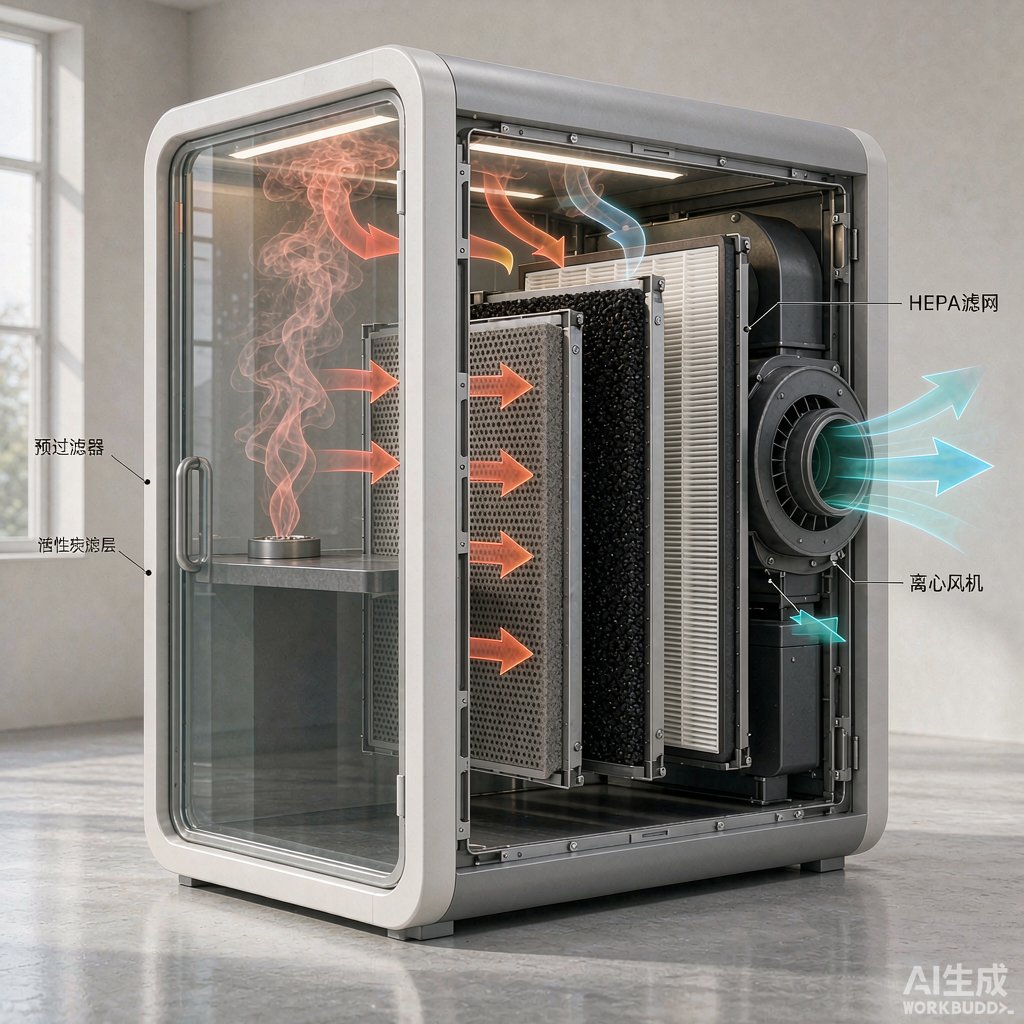
The first stage is a coarse pre-filter, typically G4-grade synthetic media with an arrestance of 90% on 10 micron particles. The pre-filter protects downstream stages by capturing larger ash, lint, and visible smoke particles. Pre-filters should be replaced every 4 to 8 weeks depending on usage.
HEPA Particulate Stage
A true HEPA filter (H13 or H14 grade) captures at least 99.95% of particles at 0.3 micron Most Penetrating Particle Size. In a smoking booth, the HEPA stage removes fine tar droplets, smoke residue, and any particulate submicron aerosol. H13 filters are sufficient for most commercial booths, while H14 is preferred in hospitals and clean-adjacent environments.
Activated Carbon Stage
Activated carbon removes volatile organic compounds (VOCs), gaseous odors, and the visible haze characteristic of cigarette smoke. Coal-, coconut-, or specially impregnated carbon can be used. For high odor load, specify carbon with a CTC adsorption value above 60%. Impregnated carbon with potassium permanganate or amine additives also removes acidic gases like hydrogen cyanide.
Sizing the Filtration System
Air Changes per Hour (ACH)
Smoking booths typically require 25 to 60 air changes per hour to keep visible smoke levels low. Multiply the booth volume in cubic meters by the target ACH to find the airflow in cubic meters per hour. A 2.5 m × 1.5 m × 2.5 m booth at 40 ACH needs 375 m³/h, equivalent to about 210 CFM.
Face Velocity and Filter Area
HEPA filter face velocity should stay between 0.45 and 2.5 m/s. For 375 m³/h at 1.5 m/s face velocity, the filter area required is about 0.07 m², easily satisfied by a standard 305 mm × 305 mm HEPA panel. Carbon filters run slower, between 0.2 and 0.5 m/s, to give adequate contact time.
Pressure Drop Budget
Total pressure drop across a new filter stack typically runs 250 to 400 Pa. Pre-filter 50 Pa, HEPA 120 to 200 Pa, carbon 80 to 150 Pa. Fan selection must overcome this resistance while delivering the target airflow. Specify fans with backward-curved blades for clean, low-noise operation.
Layout and Airflow Patterns
Inlet and Exhaust Placement
Effective smoke capture relies on a clear airflow path from inlet (low) to exhaust (high) inside the booth. Place the inlet grille near the floor to draw fresh air past the smoker’s face, and exhaust from the top of the booth to capture rising smoke. Avoid placing the inlet near the exhaust to prevent short-circuiting.
Push-Pull Configuration
For larger booths, a push-pull arrangement with supply air on one side and exhaust on the opposite side creates a curtain of clean air that helps push smoke toward the filters. This is especially effective in booths wider than 2 meters.
Capture Velocity at the Source
Capture velocity is the airflow speed at the point where smoke is generated. A capture velocity of 0.5 to 1.0 m/s at the cigarette tip captures most smoke before it disperses. This translates into specific grille sizing: a 0.3 m × 0.3 m exhaust grille near the smoker pulls about 540 m³/h to maintain 0.5 m/s capture velocity.
Filter Maintenance
Pressure Drop Monitoring
Install a differential pressure gauge across each filter stage. Replace pre-filters when pressure drop reaches 100 to 150 Pa. Replace HEPA filters at 250 Pa, and carbon filters when odor breakthrough is detected or pressure drop reaches 250 Pa. Tracking these metrics prevents sudden filter failure and keeps airflow stable.
Carbon Saturation and Odor Breakthrough
Activated carbon eventually saturates and no longer adsorbs odors. In high-use commercial booths, carbon life may be 6 to 12 months. Lower-odor duty cycles can extend life to 18 to 24 months. Schedule carbon replacement based on hours of operation and smoke density rather than calendar time.
Disposal and Hygiene
Used filters contain concentrated smoke residues classified as industrial hygiene waste. Wear gloves and a P3 respirator when changing filters. Seal used filters in plastic bags and dispose of them according to local regulations for tobacco-related waste.
Compliance and Certification
Indoor smoking booths often must satisfy standards such as EN 16139 (furniture strength), ASHRAE 62.1 (ventilation), or local occupational health codes. Some jurisdictions require smoke leakage testing, with particulate counts measured at the booth door at less than 35 micrograms per cubic meter. Document filter specifications, airflow design, and maintenance procedures for inspectors.
For facility managers and designers, the right combination of HEPA, activated carbon, and pre-filtration delivers a cleaner, more comfortable indoor smoking booth. Proper sizing, layout, and preventive maintenance keep the booth welcoming and compliant throughout its service life.