The Need for EMI Shielding Vents
Modern electronics enclosures must breathe. Power amplifiers, servers, telecom base stations, and EV chargers all generate heat that must escape, yet their RF circuits must remain protected from electromagnetic interference. A plain vent hole would act as an ante
a, letting EMI leak in and out. Honeycomb EMI shielding vents solve this by providing high airflow with controlled electromagnetic attenuation.
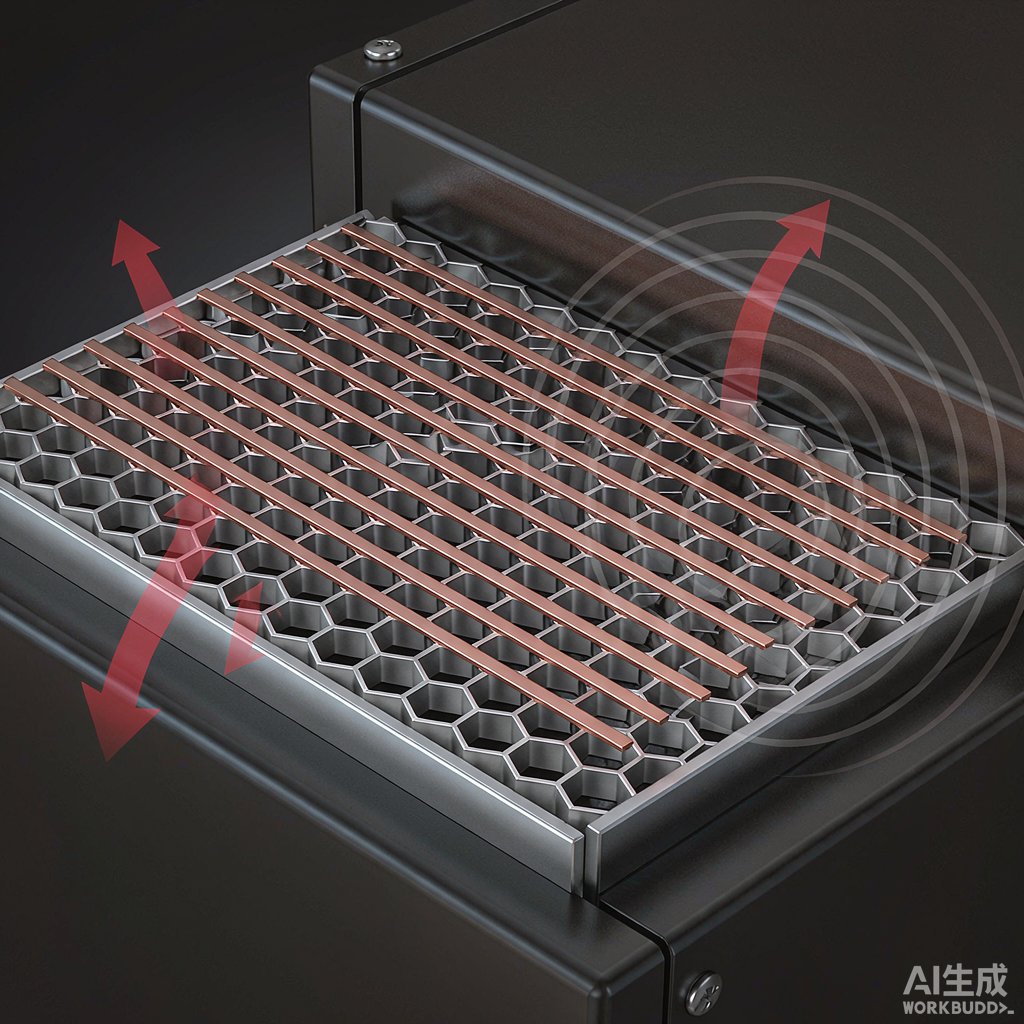
The honeycomb geometry works by guiding electromagnetic waves through long, narrow conducting cells. Each cell behaves like a waveguide below cutoff for frequencies whose wavelengths are large compared with the cell diameter, effectively blocking them while allowing air to pass.
How Honeycomb Vents Block EMI
Waveguide Below Cutoff
A honeycomb cell is essentially a small waveguide. When the cell diameter is small relative to the wavelength of an incoming electromagnetic wave, the waveguide attenuates the signal exponentially along its length. The attenuation increases with cell depth and decreases with cell diameter. Typical honeycomb vents use cells 3.2 to 6.4 millimeters across and depths from 6 to 25 millimeters.
Shielding Effectiveness Factors
Shielding effectiveness depends on cell size, wall thickness, material conductivity, plating, and the quality of electrical contact around the vent perimeter. Smaller cells and deeper honeycomb blocks provide higher attenuation, especially at lower frequencies. A vent with 3.2-millimeter cells and 12-millimeter depth can exceed 100 dB attenuation across a broad frequency range when properly mounted.
Honeycomb Materials
Aluminum Honeycomb
Aluminum is the most common honeycomb material because it is lightweight, corrosion-resistant, and cost-effective. Bare aluminum provides good shielding, but chem-film or nickel plating improves conductivity and durability in harsh environments. Aluminum honeycomb is widely used in aerospace, military, and telecom enclosures.
Steel Honeycomb
Steel honeycomb, often tin-plated or nickel-plated, offers higher magnetic shielding than aluminum due to its permeability. It is preferred when low-frequency magnetic fields from power transformers or high-current buses are a concern. The trade-off is higher weight and susceptibility to rust if the plating is damaged.
Brass and Copper Honeycomb
Brass and copper honeycomb provide the best electrical conductivity and corrosion resistance. They are chosen for high-performance shielded rooms, medical imaging equipment, and precision RF enclosures. Copper honeycomb is often soldered directly to the enclosure wall for a seamless, low-impedance bond.
Vent Frame and Gasket Design
The honeycomb block must make continuous electrical contact with the enclosure around its entire perimeter. A conductive gasket, finger stock, or soldered flange prevents leakage at the joint. Mounting screws should be spaced closely enough to maintain uniform pressure, typically every 50 to 75 millimeters. Avoid painted or anodized surfaces under the gasket; they must be masked or removed to expose bare metal.
Airflow and Pressure Drop
Honeycomb vents add flow resistance. Cell size, depth, and open-area percentage determine pressure drop at a given airflow. Engineers balance EMI performance against thermal requirements: deeper cells improve shielding but reduce airflow. Computational fluid dynamics and EMI simulations help optimize the vent geometry before prototypes are built.
Applications
Honeycomb vents appear in 5G base stations, data center racks, military shelters, MRI rooms, EMC test chambers, and EV charging cabinets. Any enclosure that must exchange air while preserving electromagnetic integrity is a candidate. Custom shapes, including round, rectangular, and curved vents, can be fabricated to fit specific panel geometries.
Design Checklist
When specifying a honeycomb EMI vent, define the frequency range to attenuate, required shielding effectiveness, maximum allowable airflow resistance, environmental exposure, and mounting method. Choose the cell size and depth based on the lowest frequency of concern, then verify with bench testing in a shielded enclosure. Proper installation is as important as the vent itself; a high-performance honeycomb block will fail if the perimeter gasket is compromised.
Honeycomb EMI shielding vents remain the standard solution for ventilated RF enclosures. With the right material, geometry, and mounting discipline, they deliver both cooling airflow and electromagnetic isolation in a single compact component.