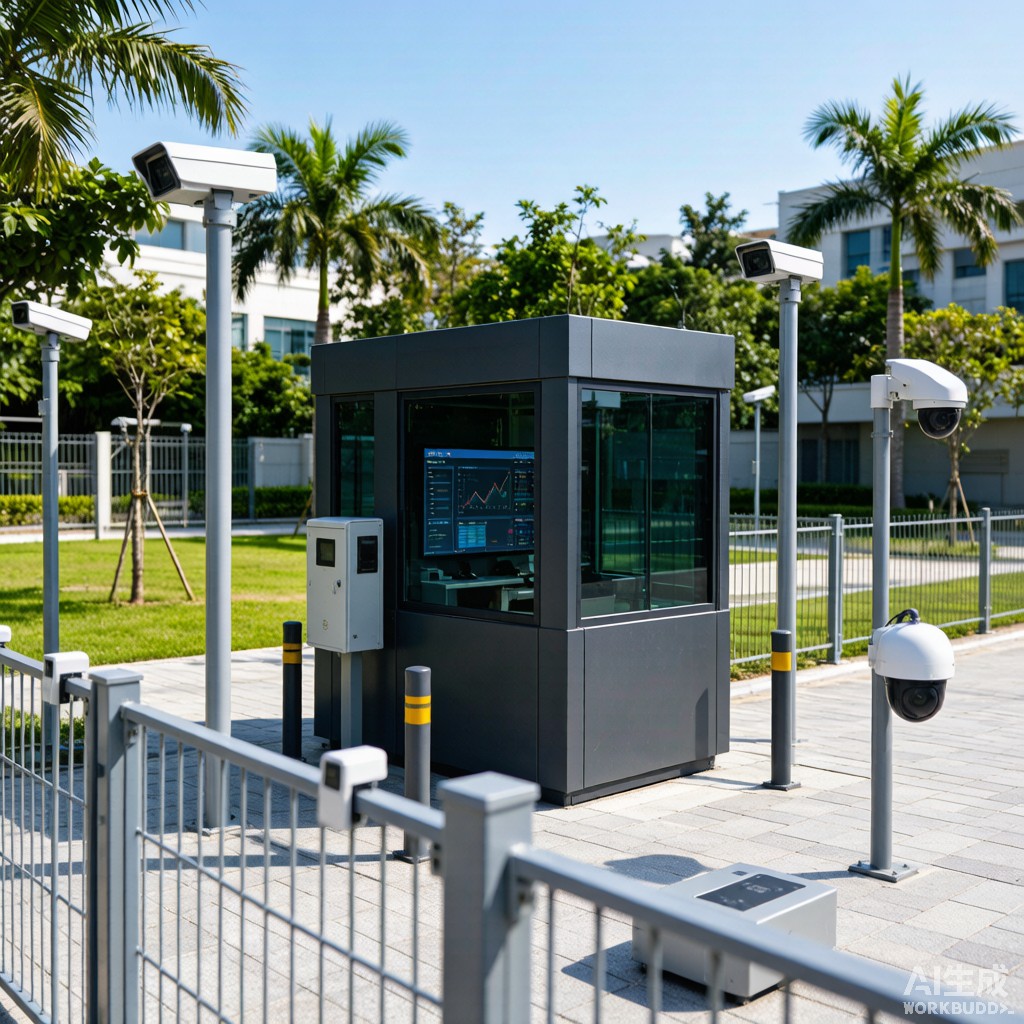
Modern perimeter security extends far beyond the physical walls of a guard booth. For industrial facilities, data centers, critical infrastructure, and high-value commercial properties across Southeast Asia, an integrated perimeter intrusion detection system (PIDS) serves as the first line of defense—detecting threats before they reach the guard booth or facility boundary. This article examines three primary PIDS technologies—fence-mounted sensors, ground-penetrating radar, and AI-enabled video analytics—evaluating their detection capabilities, false alarm rates, integration architectures, and suitability for tropical deployment environments.
Perimeter Security Architecture Overview
Defense-in-Depth Strategy
Effective perimeter security employs multiple detection layers with overlapping coverage:
- Outer layer (50–200 m beyond fence): Ground radar, long-range thermal cameras, and drone detection
- Middle layer (fence line): Fence-mounted vibration sensors, taut wire, and microwave barriers
- I
er layer (0–10 m inside fence):
Buried cable sensors, LiDAR, and short-range video analytics - Guard booth integration: Unified alarm display, PTZ auto-tracking, and intercom response
This layered approach ensures that no single technology failure creates a coverage gap while reducing nuisance alarms through cross-verification.
Fence-Mounted Sensor Systems
Taut Wire Systems
Taut wire PIDS consists of multiple strands of high-tensile steel wire (typically 2.0–2.5 mm diameter, 200–300 MPa yield strength) tensioned at 400–600 N between fence posts. Mechanical strain gauges or piezoelectric sensors at termination points detect wire displacement caused by climbing, cutting, or lifting:
- Detection capability: Climbing (≥15 kg force), cutting (wire breakage), lifting (≥50 mm displacement)
- Zone length: 100–300 m per processor zone
- Nuisance alarm rate: 1–5 per zone per day in high wind; <1 per day with environmental filtering
- Cost: $80–$150 per meter installed
Taut wire provides excellent detection of deliberate intrusion attempts but is susceptible to weather-induced nuisance alarms from thermal expansion, wind-induced vibration, and animal contact. Modern systems employ adaptive threshold algorithms that learn ambient vibration signatures and automatically adjust sensitivity.
Vibration Sensor Cables
Fiber optic or coaxial vibration sensor cables attach directly to existing chain-link or welded mesh fences. Microphonic coaxial cables detect mechanical vibrations through piezoelectric effects in the dielectric, while fiber optic systems use phase-sensitive optical time-domain reflectometry (φ-OTDR) to detect strain-induced phase shifts:
| Parameter | Microphonic Coaxial | Fiber Optic (φ-OTDR) |
|---|---|---|
| Detection range per processor | 300–600 m | Up to 40 km (single fiber) |
| Spatial resolution | 3–10 m zones | 1–5 m |
| Immunity to EMI | Moderate | Complete (dielectric) |
| Lightning susceptibility | Requires SPD protection | Immune |
| Environmental sensitivity | Moderate (wind, rain) | Low (mass-independent) |
| Cost per meter | $25–$50 | $15–$35 |
| Maintenance requirement | Medium (co
ector corrosion) |
Low (passive cable) |
Fiber optic systems have gained significant market share in Southeast Asian deployments due to their immunity to lightning strikes—a frequent cause of coaxial system damage during tropical thunderstorms—and their lower lifecycle cost in corrosive coastal environments.
Ground-Penetrating Radar (GPR) Systems
Principle of Operation
GPR-based perimeter systems emit ultra-wideband electromagnetic pulses (typically 100 MHz–2.6 GHz) into the ground and analyze reflected signals to detect subsurface and surface disturbances. Unlike fence-mounted sensors, GPR creates an invisible detection field extending 5–50 meters beyond the physical perimeter:
- Detection modes: Walking, ru
ing, crawling, tu
eling, and vehicle approach
- Detection range: 5–15 m for buried units; 20–50 m for elevated ante
as
- Update rate: 10–30 Hz (real-time tracking)
- Tracking accuracy: ±0.5 m in position, ±0.1 m/s in velocity
Tropical Soil Considerations
GPR performance is strongly influenced by soil electromagnetic properties:
| Soil Type | Relative Permittivity (εr) | Conductivity (mS/m) | Effective Range | SE Asia Prevalence |
|---|---|---|---|---|
| Dry sand | 3–6 | 0.1–1 | Maximum (50+ m) | Coastal dunes |
| Silty clay | 10–20 | 5–50 | Moderate (15–25 m) | Common (alluvial plains) |
| Lateritic clay | 15–30 | 10–100 | Reduced (10–15 m) | High (tropical weathering) |
| Water-saturated soil | 20–40 | 50–500 | Severely limited (5–8 m) | Monsoon season |
Lateritic soils common across Southeast Asia (Malaysia, Indonesia, Thailand, Vietnam) present challenges due to high iron oxide content and seasonal moisture variation. GPR systems deployed in these environments require site-specific calibration during both dry and wet seasons, with dynamic range adjustment to compensate for seasonal conductivity changes of 10–20 dB.
GPR Deployment Configurations
Two primary architectures serve guard booth perimeter applications:
- Buried linear arrays: Transceiver modules buried at 0.3–0.5 m depth along the perimeter, creating a vertical detection curtain. Suitable for greenfield installations with 5–10 year soil stability.
- Elevated bistatic radar: Separate transmit and receive ante
as mounted on poles at 2–3 m height, illuminating the ground surface at shallow grazing angles. Advantageous for retrofit applications and areas with underground utilities.
AI Video Analytics
Deep Learning Object Detection
Modern AI video analytics systems employ convolutional neural networks (CNNs)—typically YOLO, EfficientDet, or custom architectures—trained on millions of a
otated images to classify and track objects in real time:
- Detection classes: Person, vehicle, animal, drone, boat (for waterfront perimeters)
- Minimum detectable object: 10×10 pixels (typically 0.5×0.5 m at 50 m range with 4K camera)
- Processing latency: 50–200 ms (edge GPU) to 500 ms–2 s (cloud)
- False positive rate: <1 per camera per day (trained system) to 10–50 per day (untrained generic model)
Behavioral Analysis Capabilities
Beyond simple object detection, advanced AI systems analyze behavioral patterns to identify pre-intrusion indicators:
| Behavior | AI Detection Method | Pre-Intrusion Warning Time |
|---|---|---|
| Loitering near fence | Dwell time >threshold in restricted zone | 5–30 minutes |
| Perimeter reco
aissance |
Repeated passes along fence line | 10–60 minutes |
| Ladder/object placement | Object detection + proximity to fence | 1–5 minutes |
| Cutting tool use | Anomaly detection (unusual arm motion) | 0–2 minutes |
| Tu
eling activity |
Ground disturbance detection (thermal/GPR fusion) | Hours to days |
Tropical Climate Challenges for Video Analytics
Southeast Asian tropical environments present unique challenges for video analytics:
- Heavy rainfall: Reduces visibility by 50–90%; requires thermal camera fusion for continuous operation
- High humidity: Lens fogging and condensation; requires hydrophobic coatings and heated enclosures
- Intense sunlight: Overexposure and blooming during daytime; requires WDR >120 dB and automatic iris control
- Insect swarms: Seasonal termite and moth flights trigger motion detection; AI filtering essential
- Vegetation growth: Rapid plant growth (2–5 cm per week in rainy season) causes occlusion; requires monthly trimming or background model updates
Technology Comparison and Selection
| Criterion | Fence Sensors | GPR | AI Video |
|---|---|---|---|
| Detection range beyond fence | 0 m (fence only) | 5–50 m | 10–200 m (camera dependent) |
| Pre-intrusion warning | None | Excellent | Good (behavioral) |
| All-weather reliability | Good | Fair (soil dependent) | Poor–Fair (rain/fog) |
| Night operation | Excellent | Excellent | Requires thermal/IR |
| Nuisance alarm rate | Medium (wind/animals) | Low | Low–Medium (vegetation) |
| Installation complexity | Low | High (site calibration) | Medium |
| Lifecycle cost (10-year) | $150–$300/m | $200–$400/m | $100–$250/m |
| Tropical suitability | Good | Fair (seasonal variation) | Good (with thermal fusion) |
Guard Booth Integration Architecture
Unified Command and Control
Modern guard booths serve as the physical and logical hub for perimeter security. Integration requirements include:
- Physical security information management (PSIM): Software platform aggregating alarms from all PIDS sensors, access control, and video systems
- Alarm correlation engine: Rules-based or ML-based fusion reducing nuisance alarms by 70–90% through cross-sensor verification
- PTZ auto-tracking: Video analytics triggers automatically slew nearest PTZ camera to alarm coordinates
- Intercom integration: Two-way audio at fence line for challenge and response
- Mobile dispatch: Automated SMS/app alert to roving patrol with GPS coordinates and camera snapshot
Power and Communication Infrastructure
Perimeter sensor networks in tropical environments require robust infrastructure:
| Infrastructure Element | Specification | SE Asia Consideration |
|---|---|---|
| Power supply | 24 VDC PoE++ (90W) or 230 VAC with local PSU | Battery backup (4–8 hours) for grid instability |
| Communication | Fiber optic primary; wireless backup | Lightning protection (SPD Type 2) mandatory |
| Camera enclosure | IP66/IP67, IK10, −20°C to +60°C | Active cooling above 45°C ambient |
| Sensor housing | IP65, UV-stabilized polymer or 316 SS | Anti-corrosion coating for coastal sites |
| Grounding | ≤10 Ω independent earth | Chemical ground rods in high-resistivity laterite |
Conclusion
No single perimeter intrusion detection technology provides complete coverage in all conditions. For Southeast Asian guard booth deployments, the optimal strategy combines complementary technologies: fence-mounted fiber optic sensors for reliable fence-line detection, AI video analytics with thermal camera fusion for wide-area surveillance and behavioral early warning, and GPR for specialized applications requiring subsurface or pre-fence detection in suitable soil conditions.
The guard booth serves as the integration nexus where these disparate sensor streams converge into actionable intelligence. Investment in a unified PSIM platform with cross-sensor correlation delivers greater security value than any individual sensor technology alone—reducing nuisance alarms to manageable levels while ensuring that genuine intrusion attempts generate immediate, verified alerts with precise location data for guard response.
As AI video analytics continue to improve through larger training datasets and edge computing deployment, the cost-performance balance increasingly favors camera-centric perimeter systems supplemented by point sensors at critical zones. For new installations in Southeast Asia, a recommended baseline architecture comprises thermal-visible bispectral cameras at 100–150 m spacing, fiber optic fence sensors on the perimeter barrier, and AI analytics processing at the guard booth edge server—delivering comprehensive coverage at lifecycle costs of $150–$250 per meter over 10 years.