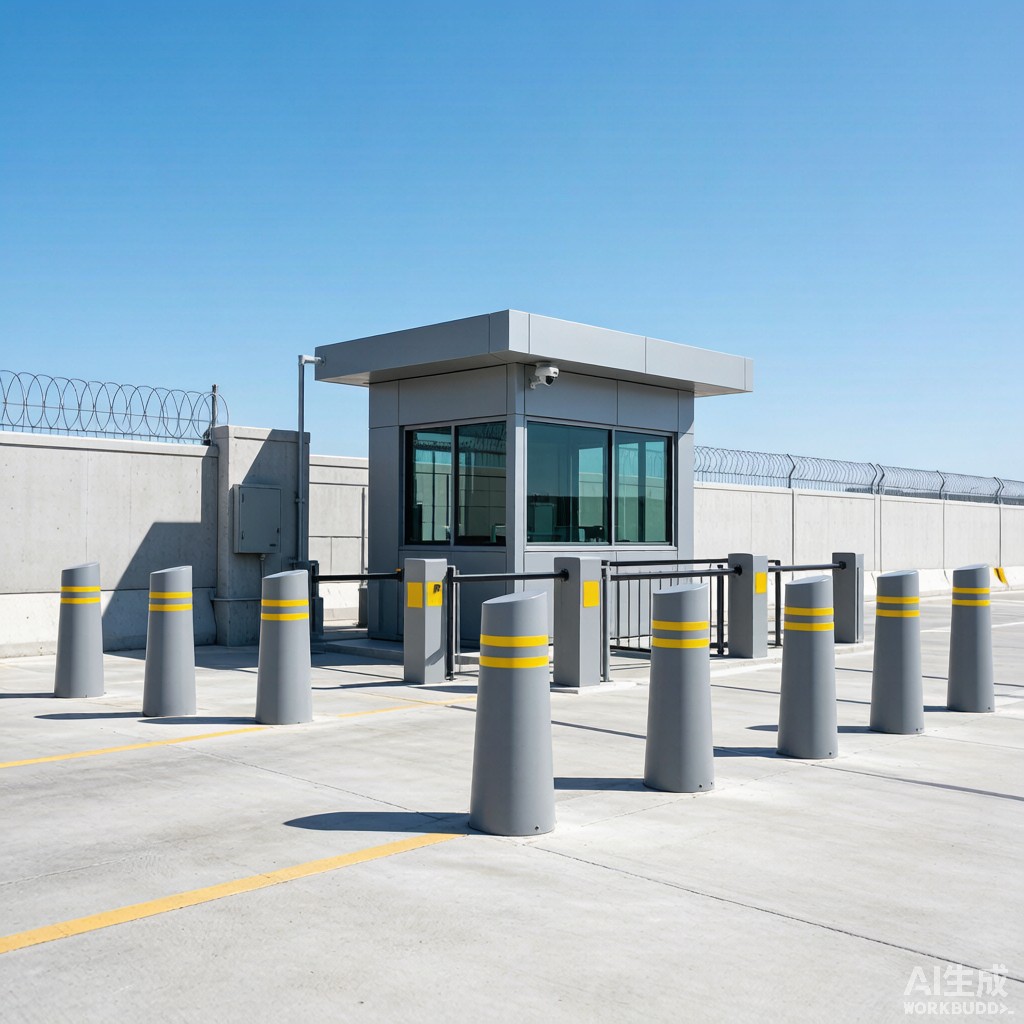
Guard booths at critical infrastructure sites, government buildings, embassies, and high-value industrial facilities are often the first point of contact between authorized perso
el and potential threats. While cameras, access control, and armed guards address many risks, a determined attacker using a vehicle as a weapon can overwhelm conventional perimeter defenses. Anti-ram bollards provide a physical barrier that stops or deflects hostile vehicles before they reach the guard booth or entry checkpoint. This article covers threat categories, bollard types, crash-test standards, standoff distances, foundation integration, and operational considerations for designing effective hostile vehicle mitigation (HVM) systems.
Hostile Vehicle Threat Categories
Hostile vehicle attacks generally fall into three categories:
- Penetrative attack: A vehicle attempts to breach the perimeter and enter a restricted area.
- Entry by deception: A vehicle that initially appears legitimate accelerates through a checkpoint after passing initial screening.
- Stationary or slow-speed attack: A vehicle stops near the guard booth and detonates an explosive or deploys weapons.
Each category requires different defensive geometry. Penetrative attacks demand high-energy impact resistance, while slow-speed threats emphasize standoff distance, surveillance, and blast-resistant booth design.
Bollard Types and Stopping Capacity
Anti-ram bollards are available in several forms, each suited to specific threat levels and site conditions.
| Bollard Type | Deployment | Typical Rating | Best Application |
|---|---|---|---|
| Fixed Shallow-Mount | Permanent, minimal excavation | K4–K12 (ASTM F2656) | Urban sites with utilities |
| Fixed Deep-Mount | Permanent, embedded in deep foundation | K12–K54 | High-threat checkpoints |
| Removable/Retractable | Manual or hydraulic operation | K4–K12 | Emergency and service access |
| Surface-Mounted | Bolted to existing concrete | K4–K8 | Temporary or retrofit installations |
The ASTM F2656 crash rating defines bollard performance by vehicle weight and impact speed. A K12 rating stops a 6,800 kg truck at 80 km/h with less than 1 m penetration. A K4 rating is tested at 48 km/h and is suitable for lower-speed sites.
Standoff Distance and Layout
Standoff distance is the distance between the bollard line and the asset being protected. Increasing standoff reduces blast effects and gives guards more reaction time. Layout guidelines include:
- Single row: Sufficient for low-speed penetrative threats; spacing typically 1.0–1.5 m center-to-center.
- Double row: Increases stopping redundancy for high-threat sites; rows offset to prevent vehicle threading.
- Curved or angled arrangements: Deflect vehicles away from the booth rather than absorbing full frontal impact.
- Approach cha
elization:
Fuel vehicles into a single controlled lane before the checkpoint.
For blast protection, standoff should be maximized within site constraints. Even an additional 5–10 m significantly reduces peak overpressure on the guard booth structure.
Integration with Guard Booth Foundation
Bollards and guard booths must act as a unified structural system. A common failure mode is foundation rotation or pull-out of the bollard array under impact load. Design considerations include:
- Shared foundation mat: Tie bollards and booth foundation together with a reinforced concrete slab sized for impact and blast loads.
- Reinforcement: Use Grade 60 or higher rebar with adequate development length into the mat.
- Soil bearing: Check bearing pressure under combined bollard overturning and blast uplift; poor soils may require piles or soil improvement.
- Underground obstructions: Coordinate with utility drawings to avoid water, sewer, and electrical conflicts.
- Drainage: Provide weep holes and drainage layers to prevent hydrostatic pressure behind foundations.
Crash Testing Standards
Specifying tested products is essential. The most widely referenced standards are:
- ASTM F2656 / F2656M: Standard test method for crash testing of vehicle perimeter barriers; rates barriers from K4 to K54.
- DOS K-ratings: Older U.S. Department of State ratings still referenced in some specifications.
- BSI PAS 68 / IWA 14-1: UK and international equivalents used in many Commonwealth and Asian markets.
- ASTM F3016: For lower-energy vehicle impact protection at speeds below 48 km/h.
A complete specification should state the rating, penetration distance, post-impact debris zone, and whether the bollard must remain operable after impact.
Operational Considerations
Physical security must not prevent normal operations. Practical issues include:
- Emergency vehicle access: Retractable or removable bollards should allow rapid opening for ambulances and fire trucks.
- Pedestrian flow: Bollards should not create pinch points; consider integrated handrails or signage.
- Lighting and visibility: Reflective strips, LED toplights, and bollard color contrast reduce accidental collisions.
- Maintenance: Hydraulic retractable systems require regular inspection of seals, fluid, and control circuits.
- Aesthetics: Decorative sleeves in stainless steel or powder-coated aluminum help bollards blend with architectural surroundings.
Conclusion
Anti-ram bollards are a critical layer of protection for guard booths and checkpoints facing hostile vehicle threats. Effective design begins with a realistic threat assessment, selects an appropriate crash-rated bollard system, integrates bollards with the booth foundation, and maintains operational flexibility for emergency access. When properly engineered, an HVM system can stop a high-energy vehicle attack while preserving the day-to-day function of the security checkpoint.