The Demanding Environment of Automotive Electrical Co
ectors
Modern automobiles contain between 1,500 and 3,000 individual electrical co
ectors, depending on vehicle class and electronic content. These co
ectors must maintain reliable electrical contact across a service life of 15 years and 240,000 kilometers, while surviving temperature extremes from −40 °C in arctic climates to 150 °C in engine compartments, exposure to motor oil, coolant, battery acid, road salt, and constant vibration at frequencies from 10 Hz to 2,000 Hz. The material from which co
ector housings are molded is therefore not merely a mechanical container—it is an active participant in the electrical and environmental integrity of every circuit in the vehicle.
Among engineering thermoplastics, polyamide 6 (PA6, nylon 6) and polyamide 66 (PA66, nylon 66) have long been the materials of choice for automotive co
ector housings due to their excellent combination of mechanical strength, toughness, chemical resistance, and cost-effectiveness. However, unfilled PA6 and PA66 lack the dimensional stability, creep resistance, and elevated-temperature performance required for many under-hood and powertrain applications. The addition of glass fiber reinforcement transforms these baseline polymers into high-performance engineering materials capable of meeting the most stringent automotive OEM specifications. This article explores the properties, processing, and selection criteria for glass fiber reinforced PA6 and PA66 modified plastic pellets in automotive co
ector housing applications.
Material Composition and Reinforcement Architecture
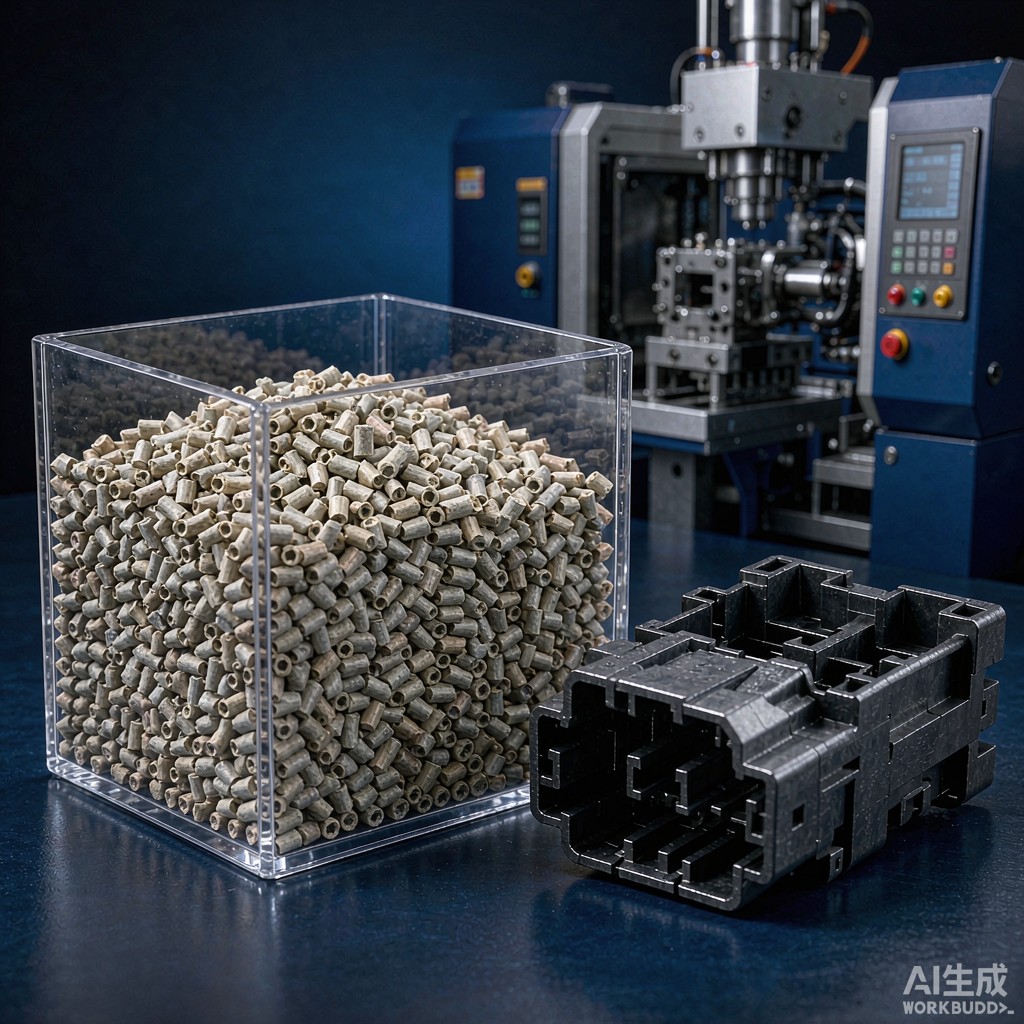
Glass fiber reinforced PA6 and PA66 are produced by compounding short glass fibers (typically 3–25 mm chopped strands) with polyamide resin in twin-screw extruders, followed by pelletization into standard injection molding feedstock. The glass fibers most commonly used are E-glass (aluminoborosilicate) with a silane-based sizing chemistry optimized for polyamide matrix adhesion. Fiber diameters range from 7 to 17 µm, with 10–14 µm being standard for automotive applications. Fiber content is expressed as a weight percentage of the total compound, with common grades including 15%, 25%, 30%, 35%, and 50% glass by weight.
The fiber length distribution in the final molded part is critical to performance. During compounding and subsequent injection molding, fiber attrition reduces average fiber length from the initial 3–25 mm to 0.2–0.8 mm in the finished part. Long-fiber reinforced materials, produced by pultrusion processes that encapsulate continuous fiber rovings in polymer and then cut them into 10–12 mm pellets, retain longer fibers (1–5 mm average) in the molded part and deliver superior impact resistance and fatigue performance. However, long-fiber grades are more expensive and can be more challenging to mold in thin-wall co
ector geometries, so short-fiber grades remain dominant for standard co
ector housings.
Mechanical and Thermal Properties
Tensile Strength and Stiffness
Unfilled PA66 has a tensile strength of approximately 80–85 MPa and a flexural modulus of 2,800–3,000 MPa. Adding 30% glass fiber increases tensile strength to 180–200 MPa and flexural modulus to 9,000–10,000 MPa—a more than twofold improvement in strength and threefold improvement in stiffness. This dramatic enhancement enables co
ector housings to maintain precise latch geometries and terminal retention forces even after years of thermal cycling and vibration exposure. The glass fibers act as load-bearing elements within the polymer matrix, carrying stress that would otherwise deform or craze the unreinforced polyamide.
Heat Deflection Temperature and Continuous Service Temperature
Heat deflection temperature (HDT) under 1.8 MPa load increases from 70 °C for unfilled PA66 to 240–260 °C for 30% glass-filled grades. This places glass-reinforced PA66 comfortably above the peak temperatures encountered in lead-free reflow soldering (245–260 °C) and most automotive under-hood operating conditions. Continuous service temperature ratings per UL 746B are typically 120–140 °C for 30% glass PA66, with short-term excursions to 180 °C possible without permanent deformation. For co
ectors mounted directly on engine control units or integrated into transmission control modules, this thermal margin is essential for long-term reliability.
Dimensional Stability and Moisture Absorption
A well-known characteristic of polyamides is their hygroscopic nature: PA6 absorbs up to 9–10% water at saturation (23 °C, 50% RH equilibrium at 2.5–3.0%), while PA66 absorbs 8–9%. This moisture uptake causes dimensional swelling and plasticizes the matrix, reducing stiffness and strength. Glass fiber reinforcement dramatically improves dimensional stability by restraining polymer matrix expansion. A 30% glass-filled PA66 part swells only 0.3–0.5% between dry-as-molded and equilibrium moisture conditions, compared to 1.5–2.5% for unfilled PA66. For co
ector housings with tight terminal-position tolerances (±0.05 mm) and seal-gland concentricity requirements, this dimensional stability is critical to maintaining seal integrity and preventing contact fretting.
Electrical Properties for Co
ector Applications
Co
ector housings must provide reliable electrical insulation between adjacent terminals while withstanding high-voltage tracking and surface discharge. Glass fiber reinforcement affects electrical properties in complex ways that designers must understand.
The dielectric strength of unfilled PA66 is approximately 20–25 kV/mm. Adding glass fibers can reduce this to 15–20 kV/mm because the glass-polymer interface creates localized field concentrations and potential moisture pathways. However, this still provides ample safety margin for automotive co
ectors operating at 12 V, 48 V, or even 800 V in electric vehicle applications, where typical wall thicknesses of 0.8–2.0 mm provide dielectric withstand voltages well above 10 kV.
More critical for high-voltage co
ectors is comparative tracking index (CTI), which measures resistance to surface tracking under contaminated, moist conditions. Unfilled PA66 achieves CTI of 600 V (Performance Level Category 0), but glass fibers can reduce CTI to 400–500 V depending on fiber sizing and compounding additives. For 800 V EV battery co
ectors, material suppliers have developed special flame-retardant, high-CTI grades using halogen-free flame retardants and optimized glass sizing that maintain CTI ≥ 500 V while meeting UL 94 V-0 at 0.8 mm wall thickness.
Volume resistivity of glass-filled PA66 remains excellent at 10¹³–10¹⁵ Ω·cm under dry conditions, but moisture absorption can reduce this by 1–2 orders of magnitude. Co
ector designs must account for this by ensuring adequate creepage and clearance distances, particularly for high-voltage applications where surface contamination and condensation are expected.
Injection Molding Process Parameters
Glass fiber reinforced PA6 and PA66 require careful process control to achieve optimal mechanical properties, surface appearance, and dimensional accuracy in co
ector housings.
Melt temperature: 270–300 °C for PA66, 240–280 °C for PA6. Excessive melt temperature causes polyamide thermal degradation, evidenced by yellowing, viscosity drop, and embrittlement. Insufficient temperature results in poor fiber wet-out and reduced mechanical properties.
Mold temperature: 60–100 °C. Higher mold temperatures improve surface gloss, reduce molded-in stress, and enhance fiber-matrix adhesion by allowing slower crystallization. However, higher mold temperatures increase cycle time and can cause difficulty in ejecting thin-wall sections.
Injection speed and pressure: Moderate-to-high injection speeds (50–150 mm/s screw velocity) with packing pressures of 60–100 MPa are typical. Glass fibers increase melt viscosity significantly, requiring higher injection pressures than unfilled grades. Careful gate design—using submarine or fan gates rather than direct sprue gates—minimizes fiber orientation at weld lines, where mechanical strength can drop by 30–50% compared to the flow-direction strength.
Drying: Polyamides must be thoroughly dried before processing to prevent hydrolytic degradation. Recommended drying conditions are 80 °C for 4–6 hours in a dehumidifying dryer, achieving moisture content below 0.15% (preferably <0.08%). Regrind should be limited to 15–25% of the total shot weight to maintain consistent fiber length distribution and mechanical properties.
Flame Retardancy and Environmental Compliance
Automotive OEMs increasingly require flame-retardant co
ector housings that meet UL 94 V-0 or OEM-specific vertical burn tests without using halogenated additives. Traditional brominated flame retardants, while effective, face regulatory pressure under REACH and RoHS directives and are being phased out by many Tier 1 suppliers. Modern halogen-free flame-retardant PA66 grades use phosphorus-nitrogen synergists or metal phosphinate systems to achieve V-0 ratings at 0.4–0.8 mm thickness, with only modest reductions in mechanical properties (typically 10–15% lower tensile strength and 20–30% lower impact strength versus non-FR equivalents).
For electric vehicle applications, additional requirements include low smoke toxicity (per ASTM E662 or ISO 5659-2) and resistance to battery electrolyte (lithium hexafluorophosphate in organic carbonate solvents). Specialized modified plastic pellet formulations have been developed with enhanced chemical resistance and reduced corrosive gas emission during combustion, addressing the unique safety demands of high-voltage EV architectures.
Conclusion
Glass fiber reinforced PA6 and PA66 modified plastic pellets represent a mature, high-performance material solution for automotive co
ector housings. The addition of glass fibers transforms baseline polyamides into engineering materials capable of withstanding the combined thermal, mechanical, chemical, and electrical demands of modern vehicle electrical systems. Successful application requires careful attention to fiber content selection, moisture management, injection molding process optimization, and compliance with evolving flame-retardant and environmental regulations. As vehicle electrification and autonomous driving architectures increase co
ector complexity and voltage levels, material suppliers continue to i
ovate new grades of glass-reinforced polyamides with enhanced CTI, improved chemical resistance, and optimized processing windows to meet the next generation of automotive co
ector requirements.