Introduction: EMI in Switching Power Supplies
Switching power supplies are essential for efficient power conversion in telecom equipment, industrial controls, LED drivers, and consumer electronics. However, the rapid switching of transistors and diodes generates high-frequency noise that can propagate along power lines and radiate from cables. This electromagnetic interference (EMI) can disrupt nearby circuits, fail regulatory compliance tests, and reduce system reliability.
Two of the most common passive components used to suppress switching power supply EMI are ferrite beads and common-mode chokes. Although both use ferrite materials, they address different noise mechanisms and are selected using different criteria. This article compares ferrite beads and common-mode chokes and explains how to choose the right component for each stage of a power supply design.
What Is a Ferrite Bead?
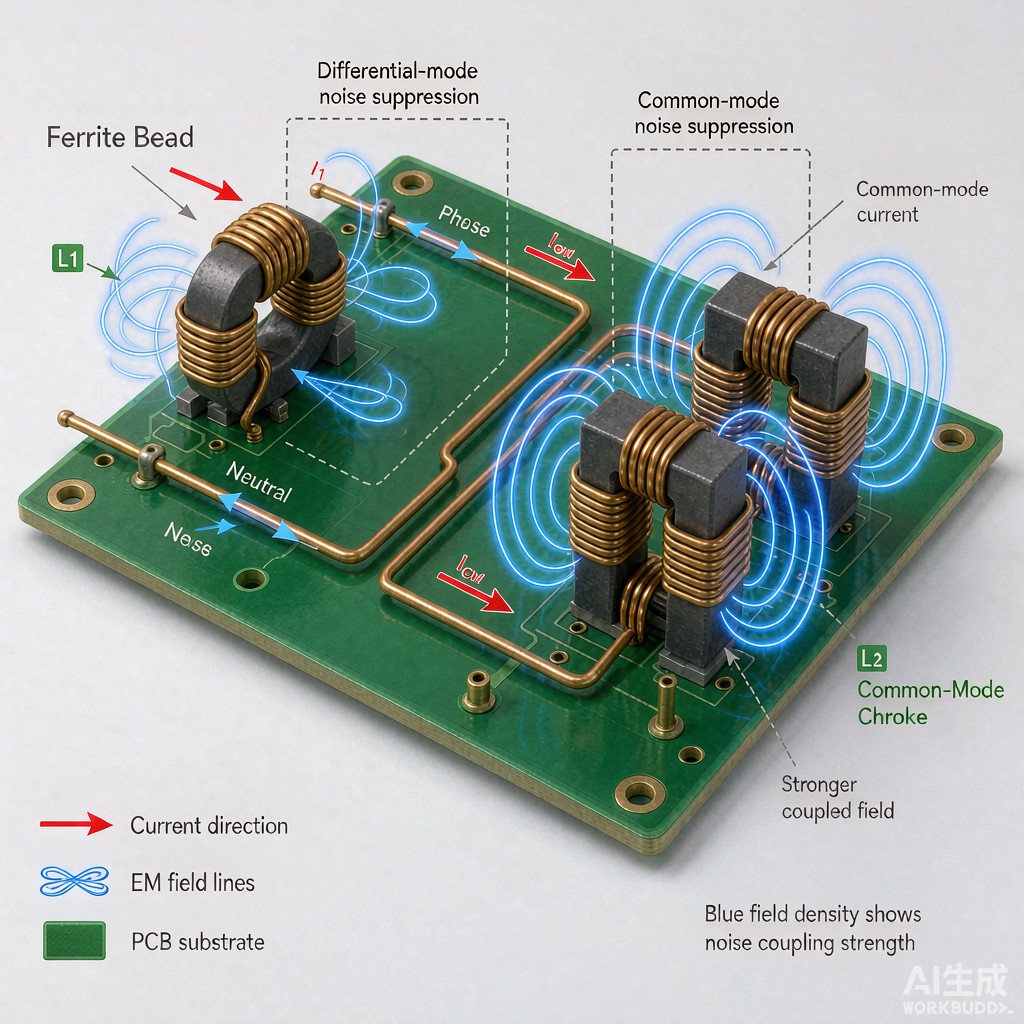
A ferrite bead is a passive component that provides frequency-dependent impedance. It consists of a ferrite cylinder or chip through which a conductor passes. At low frequencies, the bead behaves like a low-value resistor or inductor with minimal effect on the circuit. At high frequencies, the ferrite material becomes lossy, converting noise energy into heat through hysteresis and eddy-current losses.
Ferrite beads are most effective at suppressing differential-mode noise, where the unwanted current flows in one power conductor and returns through the other. They are commonly placed on DC power rails near sensitive loads, on clock lines, or on the inputs of analog circuits. The impedance curve of a ferrite bead typically peaks between 100 MHz and 1 GHz, making them ideal for conducted and radiated EMI in the higher frequency range.
What Is a Common-Mode Choke?
A common-mode choke consists of two or more windings on a shared ferrite core. When differential currents flow in opposite directions through the windings, their magnetic fields cancel, and the choke presents very low impedance to the intended signal or power current. When common-mode currents flow in the same direction on both conductors, their fields add, and the choke presents high impedance to the unwanted common-mode noise.
Common-mode chokes are designed to suppress common-mode noise, which typically arises from parasitic capacitive coupling between switching nodes and earth ground. This noise appears equally on both lines of a cable or trace pair and returns through ground. Common-mode chokes are widely used on AC input lines, DC output cables, and signal interfaces that co
ect to external equipment.
Key Differences and Selection Criteria
The first selection criterion is the type of noise. If the problem is high-frequency differential noise on a DC rail, a ferrite bead is usually the simpler and more cost-effective choice. If the problem is low-frequency common-mode noise coupling onto cables, a common-mode choke is more appropriate.
For ferrite beads, the key parameters are impedance at the target frequency, DC resistance, and rated current. The impedance should be high at the noise frequency but should not excessively attenuate wanted signals. DC resistance affects power loss and voltage drop, which matters in low-voltage, high-current rails. Rated current must include margin for peak currents, because ferrite beads can saturate, reducing impedance at high load.
For common-mode chokes, important parameters include common-mode impedance, differential-mode inductance, rated current, and saturation behavior. The core material must be chosen for the frequency band of interest. High-permeability manganese-zinc ferrites work well below a few megahertz, while nickel-zinc ferrites are better for higher frequencies.
Typical Applications
Ferrite beads are often found on internal power rails feeding sensitive SMT components such as RF transceivers, ADCs, and PLLs. They are also used on signal lines to dampen ringing and on reset lines to prevent noise-induced false triggers. Because of their small size, they fit easily into dense layouts.
Common-mode chokes are used on AC-DC adapter inputs, DC output leads of switching converters, USB and Ethernet interfaces, motor drive cables, and solar inverter communication lines. They are larger than ferrite beads but provide effective suppression of cable-borne common-mode noise.
Layout and Implementation Tips
Place ferrite beads as close as possible to the load or noise source, with short traces to minimize parasitic capacitance that could bypass the bead at high frequencies. Avoid placing ferrite beads on rails with large transient currents unless the bead has sufficient current rating and low DC resistance.
For common-mode chokes, keep the choke close to the co
ector or cable entry point to prevent noise from coupling onto the PCB before suppression. Maintain symmetry in the layout so that differential currents remain balanced and cancellation is effective. Use shielded or twisted cables downstream to preserve common-mode rejection.
Conclusion
Ferrite beads and common-mode chokes are complementary tools for switching power supply EMI suppression. Ferrite beads target high-frequency differential-mode noise in compact spaces, while common-mode chokes address cable-coupled common-mode noise at line frequencies. Understanding the noise mechanism, frequency content, and current requirements of each circuit node allows engineers to select the right component and pass EMI compliance with confidence.