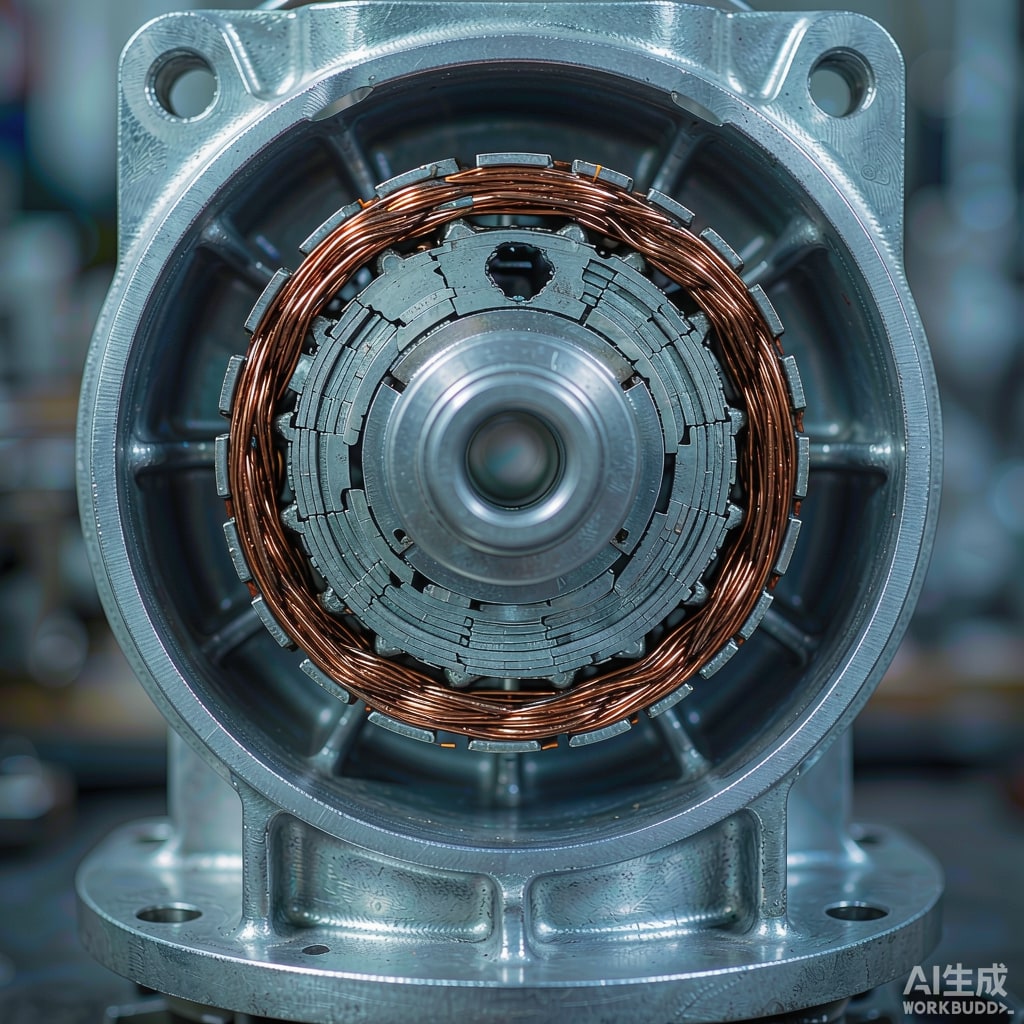
Every automated SMT line, conveyor, exhaust fan, and reflow blower sits on motors, and most of those motors sit inside some kind of housing. The material decision for that housing looks like a detail on a drawing, but it quietly sets the motor’s thermal limit, its service life in a humid factory, and the freight cost of every spare shipped to a plant in Southeast Asia. This article examines why die-cast aluminium has become the default for induction motor housings in electronics manufacturing, and where it still loses to cast iron.
Why the Housing Is Not Just a Cover
An induction motor housing does four jobs at once: it locates the stator core, it carries the bearing end shields, it conducts heat away from the windings, and it protects the internals from moisture and particulates. Cast iron dominated for a century because it is stiff, cheap, and forgiving. Die-cast aluminium has since taken the majority of low and medium power applications because it delivers acceptable stiffness at roughly a third of the mass, and because the thermal argument turned out to favour casting rather than billeting.
Alloy Selection for Die-Cast Housings
ADC12 and A380: the volume workhorses
ADC12 (Japanese standard, close to A383) and A380 are the default for high-pressure die casting. They pour well, fill thin sections, and tolerate the flow lengths needed for a motor barrel with integrated cooling fins. Copper content around 2 to 3 percent improves fluidity and reduces hot shortness, at the cost of slightly lower thermal conductivity, roughly 92 to 96 W/m·K.
When to specify A360 or A356-T6
A360 offers better corrosion resistance and pressure tightness for wet or coastal environments, useful for factories in Southeast Asian coastal areas where salt fog and humidity attack unpainted castings. A356-T6, a gravity or low-pressure casting alloy, delivers higher elongation and strength and is preferred when the housing also carries structural loads, such as a gearbox flange. The T6 temper roughly doubles yield strength versus as-cast condition.
Recycled content and traceability
Secondary aluminium now accounts for a large share of die-cast supply. Ask for certified composition per heat and check iron, zinc, and lead levels; elevated iron raises brittleness in thin fins, while zinc increases hot cracking. For a housing that vibrates for ten years, this matters more than a few percent on the invoice.
The Thermal Case for Aluminium
Aluminium conducts heat roughly three to four times better than grey iron. For a 4 kW motor ru
ing at 1,450 rpm, winding temperature often sets the insulation class limit, and a cooler winding buys either a smaller frame size or longer insulation life at the same size. Every 10 °C reduction in winding temperature roughly doubles insulation life under Arrhenius assumptions, which is why housing conductivity is not a secondary concern.
The fin geometry trap
Die-cast fins are usually 2 to 3 mm thick because thi
er sections do not fill reliably. That thickness is a thermal compromise: the fin is efficient at its root and wasteful at its tip. Optimal fin spacing for natural convection typically lands near 8 to 12 mm; tighter packing raises surface area but chokes the boundary layer and reduces total heat rejection. When a supplier proposes more fins, ask for the spacing, not the count.
Internal airflow and the rotor-stator path
Most of the heat leaves through the stator-to-housing interference fit, so the fit tolerance and contact area matter more than the exterior finish. A housing bored with 0.05 to 0.08 mm interference on a standard stator stack transfers heat far better than a loose fit with a thermal paste that was never specified for the temperature.
Porosity, Pressure Tightness, and Leak Testing
Die casting, by nature, traps gas. For a motor housing that is not water cooled, minor internal porosity is tolerable. For a water-jacketed or washdown-rated housing, it is a failure waiting to happen. Specify leak rate in standard terms, such as no bubble formation at 0.5 bar for 60 seconds, and require either vacuum impregnation or a controlled chill-vent die design. A supplier that quotes pressure tightness without a test method is quoting a hope.
Machining and Assembly Considerations
- Bearing bore tolerance: typically H7, machined after casting, not cast to size, because die draft and shrinkage make cast bores unsuitable for bearing fits.
- Datum strategy: establish the mounting face and the shaft axis from the same setup to avoid stack-up that shows up as vibration.
- Thread inserts: cast-in threads wear out; use helical inserts in aluminium for terminal box fixings and lifting points.
- Surface finish: a chromate conversion coating plus powder coat is the usual protection; bare castings corrode quickly in humid climates.
Vibration and Noise
Aluminium’s higher stiffness-to-mass ratio pushes the housing’s natural frequency up, which in most cases is helpful because it moves the resonance away from the 50 or 60 Hz electrical excitation and its harmonics. But die-cast aluminium damps less than grey iron internally. If the application has strong harmonic content, such as an inverter-driven motor with a switching frequency near a housing mode, the aluminium housing may need a stiffening rib pattern or a tuned mass damper. Model it before you commit; a housing that rings at 1,200 Hz will a
ounce itself at commissioning.
Cost per Kilowatt Installed
Comparing housings on price per kilogram is misleading. The real comparison is installed cost: tooling amortisation, machining time, leak test yield, protective coating, and freight. Aluminium wins on freight and on the ability to integrate cooling fins, terminal boxes, and mounting bosses into a single casting, eliminating several secondary parts. Cast iron wins on unit price at low volumes and on damping where noise is critical. For electronics manufacturing equipment built in Southeast Asia, aluminium die casting is usually the right default because the supply base is dense, the tooling lead time is short, and replacement parts ship cheaply.
A motor housing is quiet engineering, but it touches reliability, energy efficiency, and lifetime cost all at once. Choose the alloy for the environment, size the fins for the actual convection regime, and hold the stator fit tolerance as tightly as the bearing bore.



