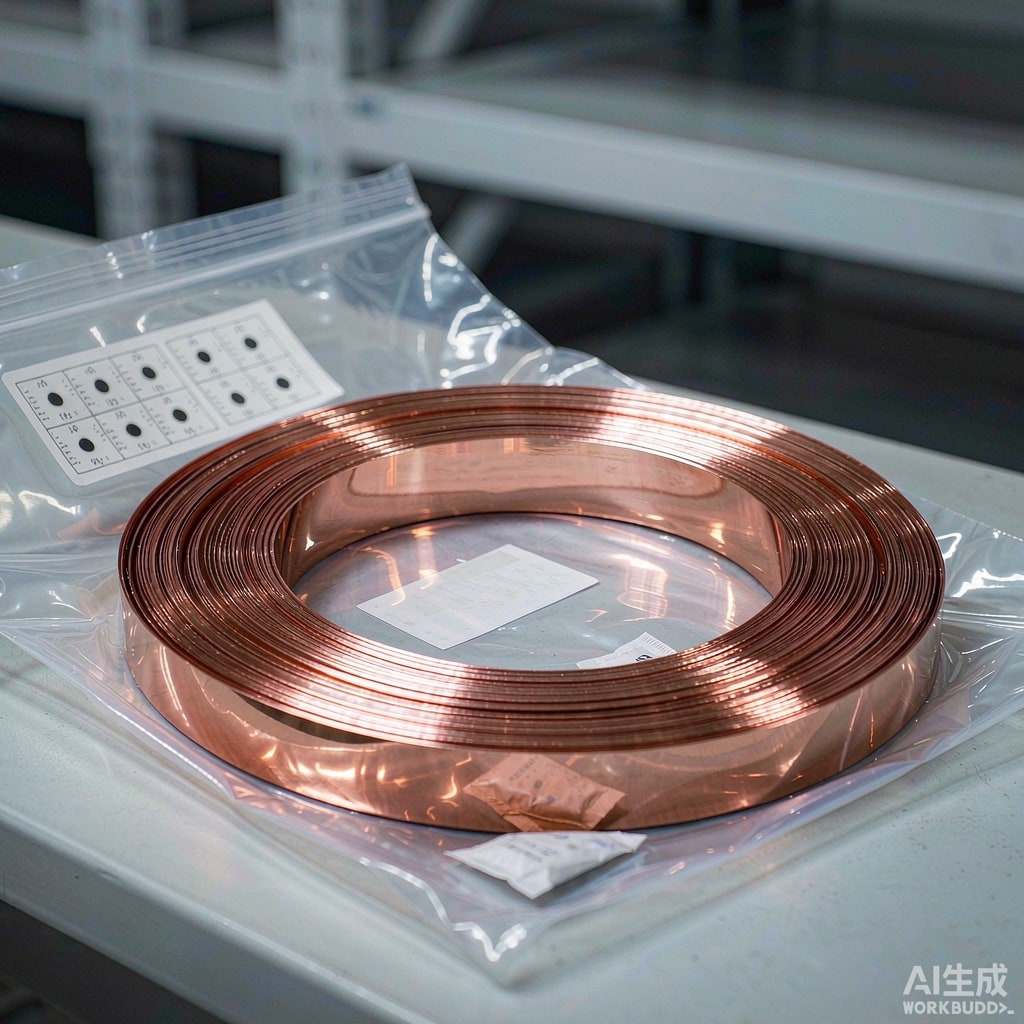
Tarnish Is a Solderability Problem, Not a Cosmetic One
A coil of bare copper strip that has been sitting in a warehouse for eight months rarely looks wrong. It looks slightly dull, maybe faintly brown at the edges. Production runs it anyway, the paste does most of the work, and everything passes. Then one lot produces cold joints across an entire panel and nobody can explain why.
The explanation is usually oxide thickness. Bare copper oxidizes the moment it meets air, forming a native Cu2O layer of roughly 2 to 4 nm within minutes. That layer is thin enough for a standard no-clean flux to displace. But oxide growth is not linear. Above roughly 30°C and 70% relative humidity it accelerates, and after a few weeks in a tropical warehouse the layer can reach 10 to 25 nm. At that point flux activation energy becomes marginal, wetting slows, and the process window collapses.
This matters more for Southeast Asian supply chains than for temperate ones. Ambient humidity of 75 to 85% is normal for most of the year, and a container sitting on a dock in April can cycle through 45°C days and 28°C nights, condensing moisture on cold metal every single morning.
The Four Drivers That Actually Cause Tarnish
1. Humidity and condensation cycling
Water is the transport medium. Without an adsorbed water layer of a few monolayers, sulfur and chlorine compounds ca
ot reach the copper surface. Every condensation cycle resets the reaction and deposits fresh dissolved contaminants.
2. Sulfur compounds
Rubber bands, vulcanized rubber mats, some corrugated cardboard adhesives, and foam packaging all release hydrogen sulfide and carbonyl sulfide. Copper reacts to form Cu2S, which is dark brown to black and considerably harder to remove than oxide.
3. Chlorides and organic acids
Wooden pallets outgas acetic and formic acid. PVC film and some foam release chlorides. The result is the familiar brown ring pattern around coil edges where moisture pools.
4. Temperature cycling and contact pressure
Coil wrap tension creates contact points where fresh metal touches fresh metal. Under vibration during transport, these points fret and cold-weld, then oxidize, leaving scuff marks that are often mistaken for handling damage.
How VCI Packaging Actually Works
Vapor corrosion inhibitor packaging does not seal metal from the atmosphere. It saturates the enclosed headspace with molecules that chemisorb onto the copper surface and build a barrier only a few nanometers thick.
The chemistry
For copper specifically, the workhorses are azole compounds, principally benzotriazole (BTA) and tolyltriazole (TTA). The molecule donates a lone pair from its nitrogen ring to the copper, forming a polymeric Cu(I)-BTA complex that is strongly bound and largely hydrophobic. Film thickness is typically 2 to 5 nm, which is thin enough that standard flux removes it during reflow but thick enough to block sulfur and water.
TTA is generally preferred for humid climates because the methyl group increases hydrophobicity and it works over a wider pH range. Amine carboxylate chemistry, common in ferrous VCI, is less effective on copper and can leave residues that interfere with some solder pastes.
Nitrite-free or nothing
Many cheap VCI films are built on sodium nitrite, which is effective for steel but is a known problem in electronics. Nitrite can promote amine blush, corrode tin and silver platings, and in sealed reels it has been linked to dendritic growth on fine-pitch parts. If a supplier ca
ot confirm nitrite-free formulation in writing, do not put the film in a reel with plated components.
Package design rules that get ignored
- Headspace volume. The inhibitor has to saturate the air in the bag. Keep headspace below about 20% of the sealed volume, or add emitters to compensate.
- Seal integrity. A single pinhole in the bag exchanges the entire headspace in hours. Test seals on a sample basis, not once per supplier qualification.
- Desiccant pairing. VCI films are not dryers. Add montmorillonite or silica gel at roughly one 33 g unit per 30 L of sealed volume to hold relative humidity under 40%.
- No absorbent contact. Cardboard, paper, and untreated foam soak up inhibitor vapor and starve the metal surface. Use VCI paper or plain polyethylene against the coil, never corrugated board.
- Compatibility with plating. VCI designed for bare copper is not automatically safe for silver or gold flash. Silver in particular can sulfide through some amine formulations.
Shelf Life: What You Can Honestly Promise
Published shelf life figures for VCI packaging assume ideal storage. Real numbers depend on the metal finish and the storage environment.
| Finish | Realistic sealed shelf life (25°C, <60% RH) | Tropical warehouse (30°C+, 80% RH) |
|---|---|---|
| Bare copper, VCI bag + desiccant | 9–12 months | 4–6 months |
| Bare copper, plain poly only | 2–3 months | 3–5 weeks |
| Electroplated tin 1–3 µm | 6–9 months | 3–4 months |
| Silver plating | 3–6 months | 6–10 weeks |
| Nickel underplate + gold flash | 12 months+ | 9–12 months |
The 10°C rule of thumb is a reasonable pla
ing tool: reaction rates roughly double for every 10°C rise, so a warehouse that runs 10°C hotter than the qualification condition halves the effective shelf life. If your qualification was done in an air-conditioned lab and your stock sits in a non-air-conditioned shed, the certificate means very little.
Storage Discipline That Costs Nothing
- Store coils on steel or plastic racking, never directly on wooden pallets.
- Keep away from rubber goods, lubricants, and cleaning chemicals. A shared wall with a solvent store is enough to cause problems.
- Do not stack sealed bags under heavy coils. Compressed seals leak.
- Rotate stock strictly first-in-first-out and print the seal date on the bag, not just the lot number.
- Open bags only in the production area, and re-seal partially used coils with fresh VCI film and a new desiccant unit the same shift.
Incoming Inspection Protocol
Visual inspection under normal lighting misses exactly the oxide thickness that matters. A workable three-step protocol:
- Humidity indicator card in every bag. Reject if the 40% spot has triggered.
- Coupon test. Include a polished copper coupon per pallet during packaging. At goods-in, dip the coupon in 10% sulfuric acid for 10 seconds; a coupon that brightens instantly is clean, one that stays dull or shows a brown film indicates the batch has aged.
- Solderability sampling. Per IPC J-STD-002, run a wetting balance or dip-and-look test on one sample per lot once stock exceeds 60 days. Wetting force below roughly 200 µN/mm on a fresh surface, or incomplete wetting coverage beyond 5%, means the lot should be re-cleaned or scrapped.
When Tarnish Has Already Happened
Light oxide responds well to a 5 to 10% sulfuric acid dip followed by thorough rinsing and drying. Sulfide films need a mechanical assist or a proprietary bright dip. What you ca
ot do is pickle a plated surface: acid will attack the plating edge and undercut it. For nickel-gold and silver parts, the only honest options are re-plating or scrapping the lot.
The cheapest fix remains packaging design. A few cents of nitrite-free VCI film and a desiccant unit per coil routinely buys three to six extra months of usable life in a tropical warehouse, which is usually the difference between a smooth SMT schedule and an emergency re-clean.



