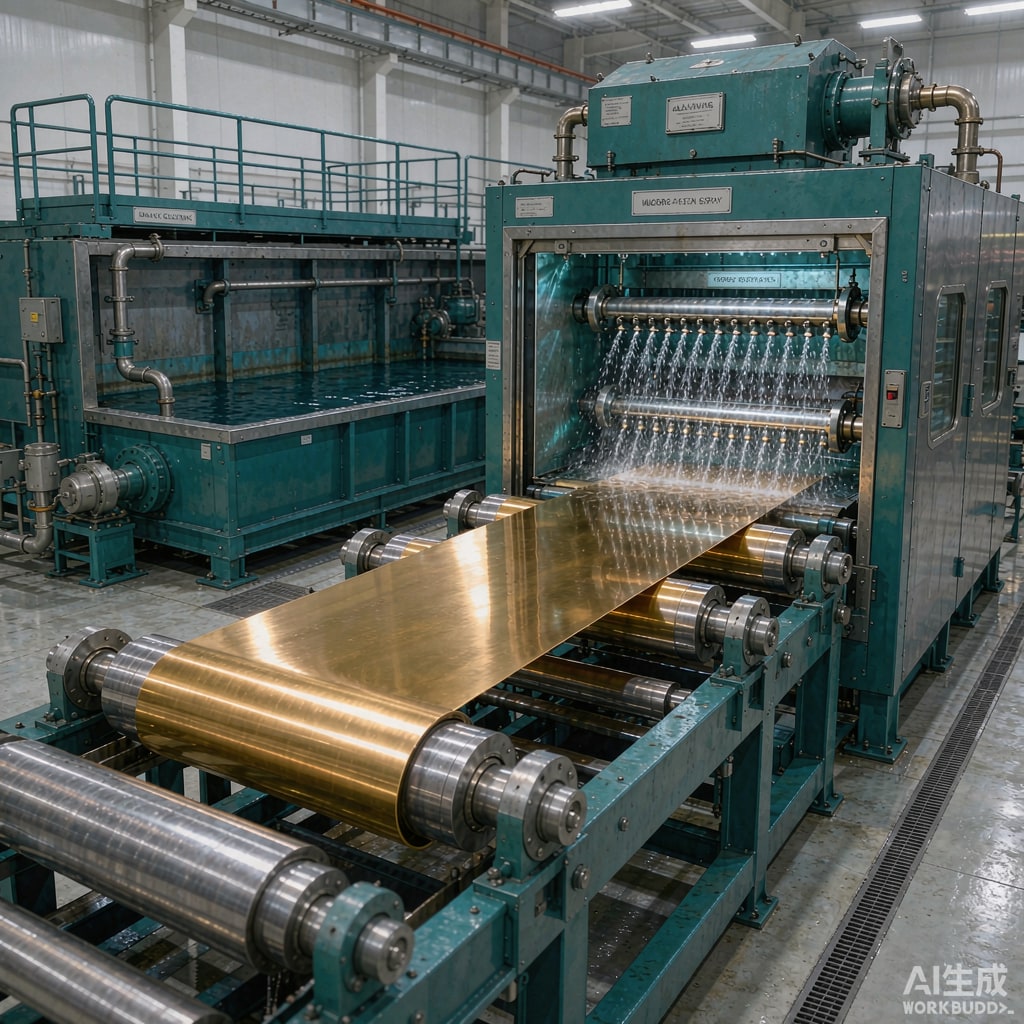
Plating adhesion on copper strip is rarely a problem with the plating chemistry itself. More often, it fails at the pretreatment step. A copper coil arrives with rolling oil, oxide, fingerprints, and intermetallic particles on the surface. If these contaminants are not removed and the surface properly activated, the plated layer — tin, nickel, or gold — will sit on top of a weak boundary rather than bonding to the copper lattice. In SMT contacts and busbars, that boundary becomes a failure plane during thermal cycling, bending, or co
ector mating. This guide walks through the pretreatment chain that turns raw copper strip into a reliable substrate for electroplating.
The Adhesion Chain: Clean, Etch, Activate
Pretreatment is usually a three-stage process: alkaline clean, micro-etch, and activation. Each stage has a specific job, and skipping one is the most common root cause of blistering, peeling, or poor solderability after plating.
Alkaline Cleaning
The first step removes organic soils: rolling lubricants, anti-oxidation oils, and handling residues. A typical alkaline cleaner for copper operates at 50–70°C with pH 10–13 and contains surfactants, chelants, and mild inhibitors to prevent base-metal attack. Spray or immersion time is 30–120 seconds. If oil remains, the micro-etch bath will not wet the surface uniformly, leaving patches of low adhesion. A simple water-break test after cleaning confirms complete wetting; if water beads, the strip must be recleaned.
Micro-Etching
After cleaning, a controlled etch roughens the copper surface and removes oxide. Common chemistries include sodium persulfate, ammonium persulfate, or dilute sulfuric acid with hydrogen peroxide. Etch depth is usually 0.5–2.0 µm, enough to create mechanical anchor points without altering strip thickness tolerance. Too aggressive an etch can create smut or leave residues that weaken the interface. The strip must be thoroughly rinsed after etching; persulfate residues are a known cause of plating blisters during reflow.
Activation
For nickel or gold plating, an acid activation dip removes the thin oxide that reforms during rinsing and primes the surface. Dilute sulfuric or hydrochloric acid activators are common. The strip should enter the plating bath while still active; long air exposure lets oxide regrow, especially on high-phosphorus deoxidized grades like C12200.
Process Control Parameters
Repeatable adhesion requires controlling more than chemistry. Pay attention to bath temperature, concentration, immersion time, agitation, and rinse water conductivity. DI water rinses are preferred between the etch and plating steps because tap-water minerals deposit on the active surface and act as adhesion blockers. A typical line monitors:
- Cleaner concentration by titration every shift
- Etch rate by weight loss on sample coupons
- Rinse conductivity below 20 µS/cm
- Bath temperature within ±3°C of setpoint
Testing Plating Adhesion
Several tests validate adhesion after plating. Tape testing per ASTM D3359 is the simplest: score a cross-hatch through the plated layer, apply pressure-sensitive tape, and pull. For hard gold or nickel, a bend test around a mandrel reveals cracks or flaking. Thermal cycling — for example, 1,000 cycles from −40°C to +125°C — accelerates stress caused by coefficient-of-thermal-expansion mismatch between copper and the plated layer. Solderability tests per IPC J-STD-002B confirm that tin or tin-alloy plating remains wettable after aging.
Specifying Pretreatment When You Buy Strip
If you purchase pre-plated copper strip, ask the supplier to document pretreatment. A useful specification includes base alloy, incoming surface cleanliness, etch depth range, plating thickness, adhesion test method, and storage conditions. Strip should be shipped with a volatile corrosion inhibitor or protective film, and used within the supplier’s shelf life. Even the best plating will fail if the surface underneath was not prepared with discipline.



