Two Roads from Coil to Contact
Every stamped SMT contact — a spring finger, a fuse clip, a battery tab, a shield can frame — starts as copper strip from a coil. Getting from coil to finished blank happens one of two ways: progressive die stamping or laser cutting. For production volumes the answer is almost always stamping, but the decision is genuinely open for prototypes, pilot builds, bridge tooling, and low-volume medical or industrial products. Choosing correctly saves weeks of lead time on one end and avoids ruinous per-piece costs on the other.
Fiber Laser Cutting Copper Strip: Capabilities and Limits
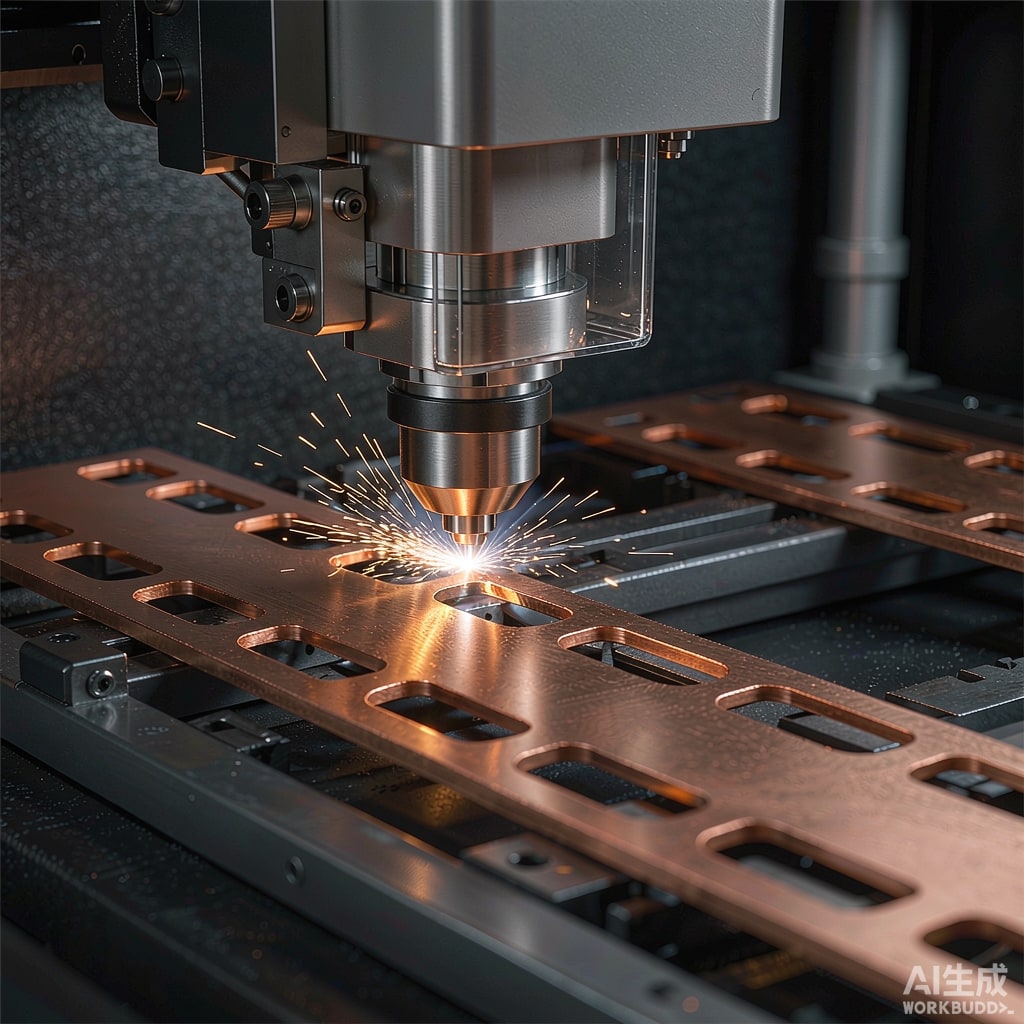
Modern fiber lasers cut copper strip cleanly in thicknesses up to about 1.0–1.5 mm, which covers the majority of stamped contact materials (0.1–0.8 mm). The appeal is obvious for development work: no tooling, lead times measured in days, and geometry freedom — you can cut shapes a punch ca
ot economically produce, including irregular outlines, slots mid-blank, and draft-free profiles. Design revisions cost nothing but a file change.
Copper is, however, one of the harder metals to laser cut. Its high reflectivity at the 1 µm wavelength of fiber lasers and its high thermal conductivity (which drains heat away from the cutting front) both work against the process. Modern fiber sources with beam shaping manage this well, but two process realities remain. First, cutting speed is lower than for steel — expect roughly half to a third of the linear speed on 0.5 mm copper compared with mild steel of the same thickness. Second, the heat-affected zone (HAZ) is real: near the cut edge, the strip experiences a thermal cycle that can locally a
eal hard-temper material, reducing yield strength in a band perhaps 0.05–0.2 mm wide. For a spring contact whose function depends on temper, an a
ealed edge band means the outermost fibers of the material relax more under load. On a 0.3 mm thick contact the HAZ can touch a meaningful fraction of the cross section.
Edge Quality After Laser Cutting
A good fiber laser cut on thin copper delivers a burr-free edge with slight striations and a taper of roughly 1–3 degrees across the thickness. Contrast this with a stamped edge: stamping produces a sheared band with roll-over, burnish, fracture, and burr — but it is fast (milliseconds per hit), perfectly repeatable, and leaves the temper untouched. If your contact has a bend close to a cut edge, laser-cut material may form slightly differently at that edge than stamped material will, because the local hardness profile differs. Prototype results that depend on sharp edge behavior — such as burr-side orientation in bends — will not transfer one-to-one to stamped production.
Progressive Die Stamping: The Production Benchmark
A progressive die feeds the strip through a series of stations, each performing a cut or form, until finished parts exit every stroke. Once ru
ing, it produces tens of thousands of contacts per day at per-piece costs measured in fractions of a cent. The temper, grain direction, and surface finish of the strip pass through the process essentially unchanged — critical for spring performance. Tooling is the catch: a simple single-out progressive die might cost $8,000–15,000 and take 4–8 weeks; a multi-out high-speed die with in-die plating fixtures can exceed $40,000.
Tolerance Reality Check
Well-maintained progressive tooling holds ±0.02–0.05 mm on cut features for thin copper, comparable to or better than laser cutting on thin stock. Stamping also delivers sharper inside corners (limited only by punch nose radius) than laser cutting, which struggles with corner rounding at small radii. Where stamping wins most decisively is consistency across millions of pieces — laser cut quality drifts with nozzle wear, lens condition, and sheet position in the nest.
The Cost Crossover
The economics reduce to a simple comparison: amortized tooling plus stamping piece-price versus laser piece-price. For a small contact in 0.3 mm C5191 phosphor bronze, laser cutting might cost $0.50–2.00 per piece in small quantities, while stamped piece-price lands near $0.005–0.02. The crossover — where accumulated stamping piece savings repay the tooling — typically falls between 20,000 and 100,000 pieces depending on part complexity and die cost. Below that range, cut with a laser; above it, build a die. Between 10,000 and 50,000 pieces, request quotes both ways.
Practical Decision Rules
Use laser cutting when: the design is still evolving, quantities stay under ~20,000 pieces, the contact carries low spring force so the HAZ matters little, or the geometry is unproducible in a die (very deep narrow slots, irregular outlines). Use stamping when: volumes justify tooling, the part is a spring with temper-critical performance, edge quality must be uniform across millions of cycles, or the product needs in-die tap, plating, or carrier-strip features for reel-to-reel plating and SMT presentation.
And design for the transition: keep wall thickness uniform, respect bend radii of R at least 1×T for hard tempers, avoid features that require wire EDM in the die, and locate your pilot-hole datums where a laser nest and a die strip layout can both reach them. A contact prototyped on the laser and released to stamping without redesign is the mark of a well-pla
ed program.



