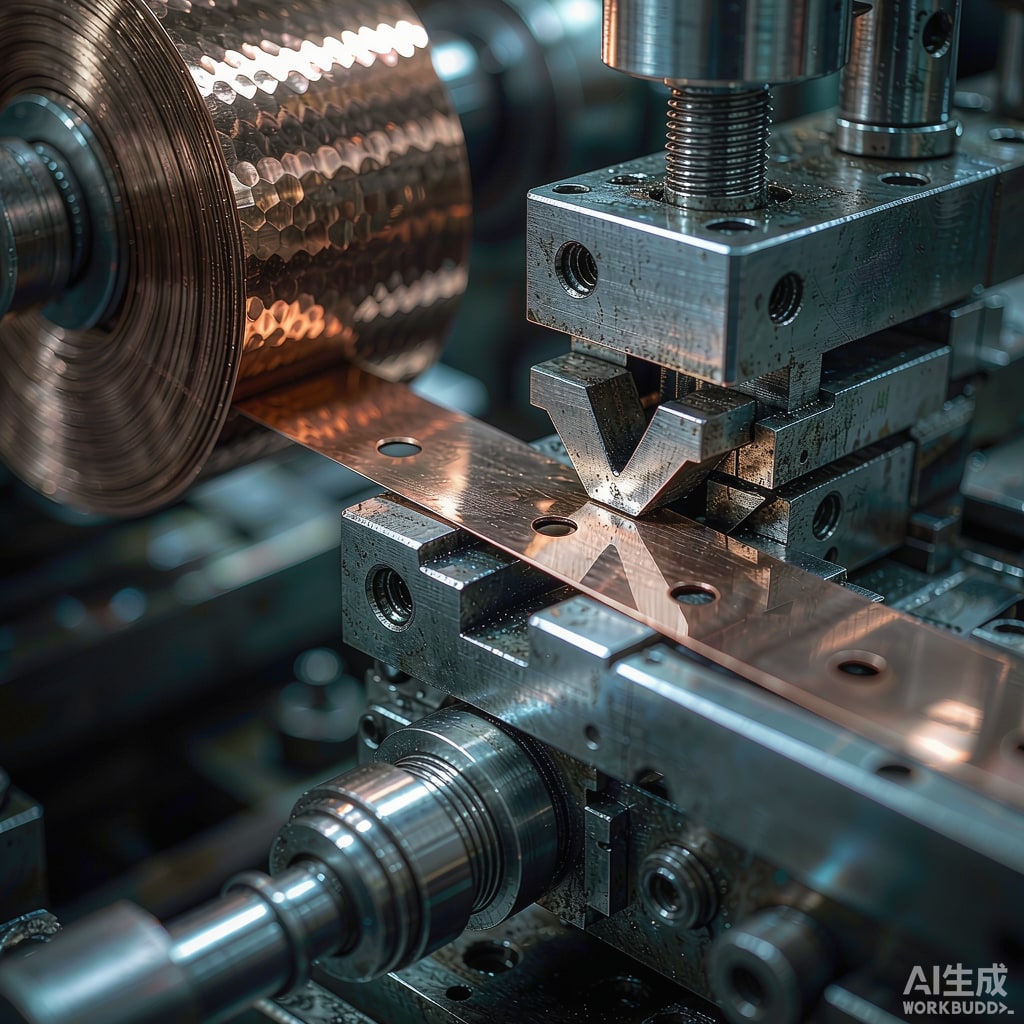
High-speed progressive dies for SMT terminals, contacts, and lead frames can only run as well as the strip that feeds them. While most buyers focus on alloy and thickness, flatness errors — camber, crossbow, and twist — are a leading cause of misfeeds, burr variation, and unpla
ed die maintenance. This guide explains what those terms mean, where the errors come from, and how to specify copper strip that feeds cleanly at 300+ strokes per minute.
Camber, Crossbow, and Twist: Three Different Defects
Strip flatness problems are often lumped together, but they fail the press in different ways:
- Edge camber is a lateral curvature along the strip length, measured as arc height over a 1 m straightedge. A typical precision stamping spec is 1.0–2.0 mm per meter maximum. Severe camber makes the strip walk sideways relative to the pilots.
- Crossbow (transverse bow) is a bow across the strip width, lifting the center or edges off the die surface. It causes uneven piercing clearance and inconsistent burr height.
- Twist is rotation of the strip around its longitudinal axis. Twist over 1 mm per meter is enough to jam a tight feed pass or mis-seat a pilot.
How Camber Is Measured
Camber = (arc height ÷ measured length) × 100%. Place the strip concave side down on a flat surface, lay a straightedge against the concave edge, and measure the maximum gap. Repeat on both edges — differential camber between edges indicates wedge-shaped stock that will track unpredictably. Reputable mills certify camber per ASTM B601 or EN 1652 condition designations.
Where Non-Flatness Comes From
Virtually all flatness error is residual stress locked in during rolling, a
ealing, slitting, and coiling:
- Rolling deformation: thickness variations across the width create uneven elongation. The longer, thi
er zones bow when the strip is freed from tension.
- Slitting: when a wide master coil is slit into your width, the released edges contract and the slit strip springs open or closed. Narrow widths slit from the coil edge show the worst camber.
- Temper: harder tempers (half-hard, full-hard) carry more residual stress and spring back more than a
ealed or stress-relieved material.
- Coiling and handling: tight coiling, dented coil edges, or improper storage transfer set into the strip permanently.
Why Progressive Dies Are So Sensitive
A progressive die relies on the strip being located by pilots in each station. Camber causes the pilot holes to drift laterally, so pilots enter off-center, wear, and eventually break. Crossbow changes the punch-to-die clearance piercing happens at, which shows up first as burr height variation across the strip width — a reliability risk for stamped contacts where burrs can pierce insulation or bridge fine pitch. Twist prevents the strip from seating on the die surface, and a part blanked from a twisted strip may need straightening or scrapping.
Specifying Flatness to Your Supplier
Put flatness in the purchase spec, not just in an email thread. A practical spec for SMT stamping strip includes:
| Parameter | Typical Requirement |
|---|---|
| Edge camber | ≤ 1.0 mm/m (precision), ≤ 2.0 mm/m (general) |
| Crossbow | ≤ 1% of width, or flat within 0.5 mm on a flat plate |
| Twist | ≤ 1 mm per meter of length |
| Thickness tolerance | ±0.005–0.01 mm depending on gauge |
| Edge condition | Slitted or drawn edge; drawn edges feed straighter |
Also ask about tension leveling or stress-relief a
ealing. Tension leveling stretches the strip slightly beyond yield under controlled tension, equalizing residual stresses and dramatically improving flatness. For hard tempers such as half-hard C11000 or spring tempers of C17200, a mill that offers stress-relief a
ealed tempers solves flatness and stress relaxation at the same time.
The Temper Trade-Off
Softer tempers are flatter but lack the yield strength that spring contacts need. The usual compromise is: a
eal or 1/4-hard for deep-drawn and coiled contact geometries, half-hard for terminals with moderate form requirements, full-hard only where spring performance demands it and the die can tolerate the extra camber. If your springback calculations say you need a hard temper, budget for tension-leveled material.
In-House Controls That Protect Flatness
Even well-specified strip can be ruined before it reaches the die:
- Store coils on edge, like tires, never stacked flat on the face. Weight on a coiled face prints a set into the wraps.
- Keep decoiler, straightener, and press aligned on a common centerline; a misaligned pilot or feed pitch converts good strip into cambered strip in one pass.
- Use the straightener — set roller penetration per the gauge chart, typically 60–80% of strip thickness on the entry side, and never let the strip run through a straightener set to the wrong gauge.
- Control loop tension. Excessive tension between feeder and die stretches thin strip and exaggerates camber after release.
Key Takeaways
Camber, crossbow, and twist are residual-stress problems, and they are predictable, measurable, and avoidable. Specify camber limits and edge condition on the PO, ask for tension-leveled or stress-relieved stock for hard tempers, and protect the strip in storage and feeding. A flat strip is the cheapest die insurance you can buy — misfeeds and pilot breakage cost far more than a slightly better material spec.