## Introduction
The transition to electric vehicles has made the battery cell tab one of the most critical current-carrying interfaces in automotive electronics. Cell tabs must carry hundreds of amps, survive vibration and thermal cycling, and be welded at high speed during module assembly. Copper strip is the preferred tab material for the negative terminal of most lithium-ion cells because of its high conductivity, ductility, and compatibility with laser welding.
Two common grades dominate the market: C11000 (electrolytic tough pitch, ETP) and C10200 (oxygen-free electronic, OFE). While both offer excellent conductivity, their behavior in high-speed laser welding and long-term module reliability differs. This article explains why C11000 copper strip is often the better choice for EV battery cell tabs, and when C10200 still makes sense.
## The Role of the Cell Tab in Battery Modules
### Current Carrying and Heat Generation
A cylindrical 21700 cell can deliver continuous currents of 15–35 A. The tab must carry that current with minimal resistive heating. A 0.2 mm thick copper strip tab with a 5 mm width has a cross-section of 1 mm² and a resistance of roughly 17 µΩ per meter. At 30 A, the I²R loss is only about 15 mW per meter, which is negligible compared to the cell’s internal losses. The real thermal concern is the weld joint, where surface oxidation, porosity, or misalignment can create hot spots.
### Mechanical Fatigue and Vibration
Battery modules experience vibration, shock, and thermal expansion. The tab must remain intact after hundreds of thousands of vehicle kilometers. A ductile copper strip absorbs some of the strain through bending, while a brittle weld or work-hardened tab can crack. The tab material must therefore balance strength, fatigue resistance, and the ability to form tight bends without cracking.
## C11000 vs C10200: What Separates Them
### Oxygen Content and Oxide Distribution
C11000 contains 0.02–0.05% oxygen, present as discrete copper-oxide particles dispersed through the copper matrix. These oxides pin grain boundaries and slightly strengthen the material compared to pure copper. C10200 is oxygen-free, with oxygen below 0.001%, and is valued for applications where hydrogen embrittlement is a concern, such as brazing in hydrogen atmospheres.
For laser welding, the key difference is how the two grades interact with the intense, localized heat input. C11000’s oxide particles provide nucleation sites that stabilize the melt pool and reduce spatter. C10200, being exceptionally pure, can produce a more turbulent melt pool and slightly higher spatter during high-speed welding.
### Electrical Conductivity
Both grades offer conductivity above 100% IACS in the a
ealed condition. C10200 can reach 101% IACS, while C11000 is typically 100–101% IACS. The difference is irrelevant for battery tabs, where joint resistance and weld quality matter far more than a 1% conductivity delta.
## Why C11000 Wins for Laser-Welded Tabs
### Better Weld Pool Stability
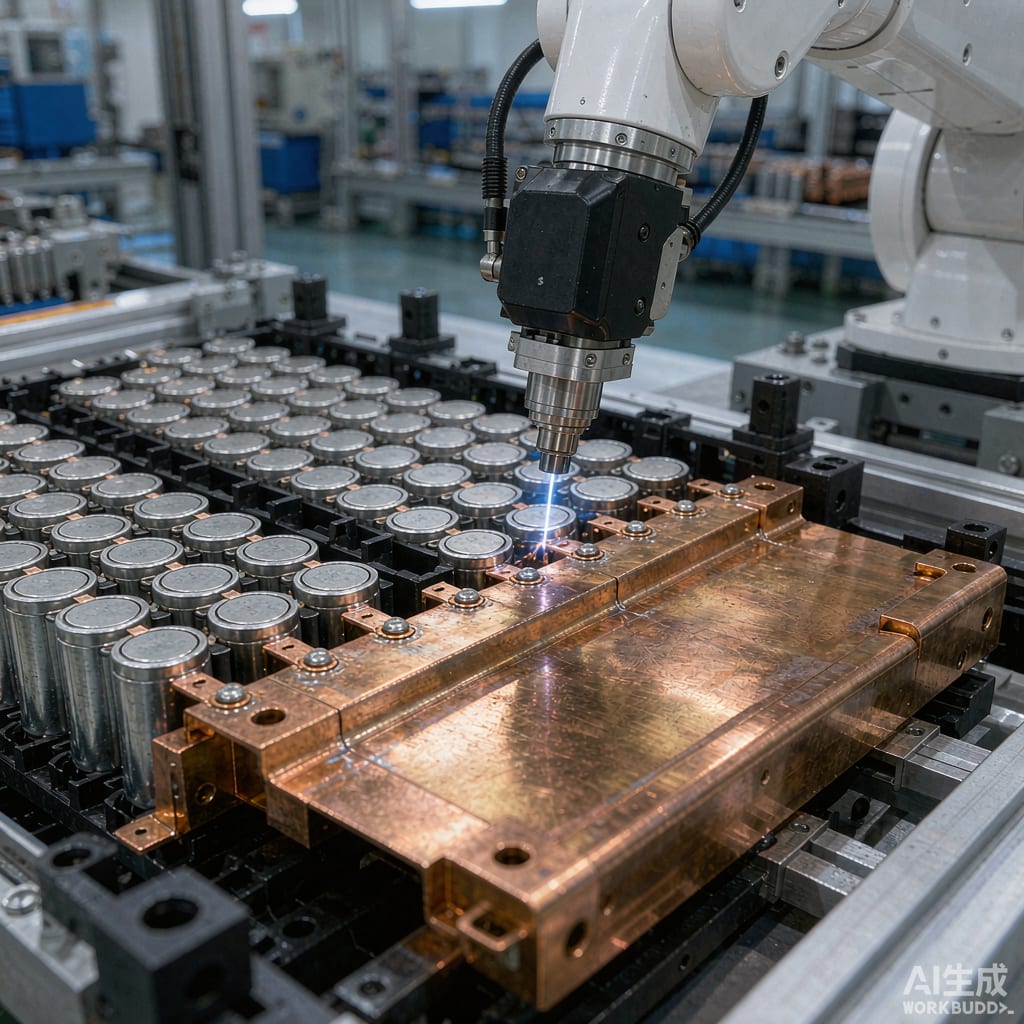
Laser welding of copper is challenging because copper reflects most infrared laser light and has high thermal conductivity. Fiber lasers in the green or infrared range are used, often with wobble or oscillation techniques to control the keyhole. C11000’s fine oxide dispersion stabilizes the keyhole and reduces porosity, giving more consistent weld penetration and fewer voids in cross-sections.
### Lower Spatter and Contamination
Spatter from the weld zone can land on the cell’s polymer separator or vent cap, creating a short-circuit or corrosion risk. Production data from automotive tab welding lines shows that C11000 generates measurably less spatter than C10200 at the same laser power and speed, reducing the need for protective films and post-process cleaning.
### Cost and Availability
C11000 is produced in larger volumes and is more widely available in thin strip form from 0.1 mm to 0.5 mm thickness. For EV battery programs that consume hundreds of kilometers of strip per month, supply security and price stability favor C11000.
## When C10200 Is the Right Choice
C10200 remains the better option when the tab will be brazed or sintered in a reducing atmosphere, or when the end use requires maximum conductivity with zero risk of hydrogen embrittlement. Some solid-state battery designs and high-frequency power electronics modules specify OFE copper for these reasons.
## Specification Checklist for Battery Tab Copper Strip
When sourcing copper strip for EV battery tabs, request the following:
– Alloy and temper: C11000 H02 or H04, depending on whether the tab is pre-formed or welded flat.
– Thickness tolerance: ±0.01 mm or better to maintain consistent laser focus.
– Surface finish: Clean, oil-free, with controlled oxide below 50 nm for reliable welding.
– Edge conditioning: Burr-free slit edges to avoid separator damage during cell stacking.
– Conductivity: Minimum 100% IACS.
– Certification: IATF 16949 traceability and RoHS/REACH compliance.
## Conclusion
For high-volume EV battery cell tabs welded by fiber laser, C11000 copper strip offers the best combination of weldability, conductivity, cost, and supply availability. Its controlled oxygen content stabilizes the melt pool and reduces spatter, while its conductivity is essentially identical to C10200 for this application. C10200 remains a niche choice for brazing or ultra-high-purity requirements, but C11000 is the practical standard for modern battery module assembly.