## Introduction
In SMT electronics equipment — from base station enclosures to industrial control cabinets — removable access panels are a necessity for maintenance and field service. However, every removable panel introduces an EMI shielding discontinuity at the seam. The choice of gasket material at that seam determines whether the enclosure meets CISPR 32 Class B or MIL-STD-461 radiated emission limits.
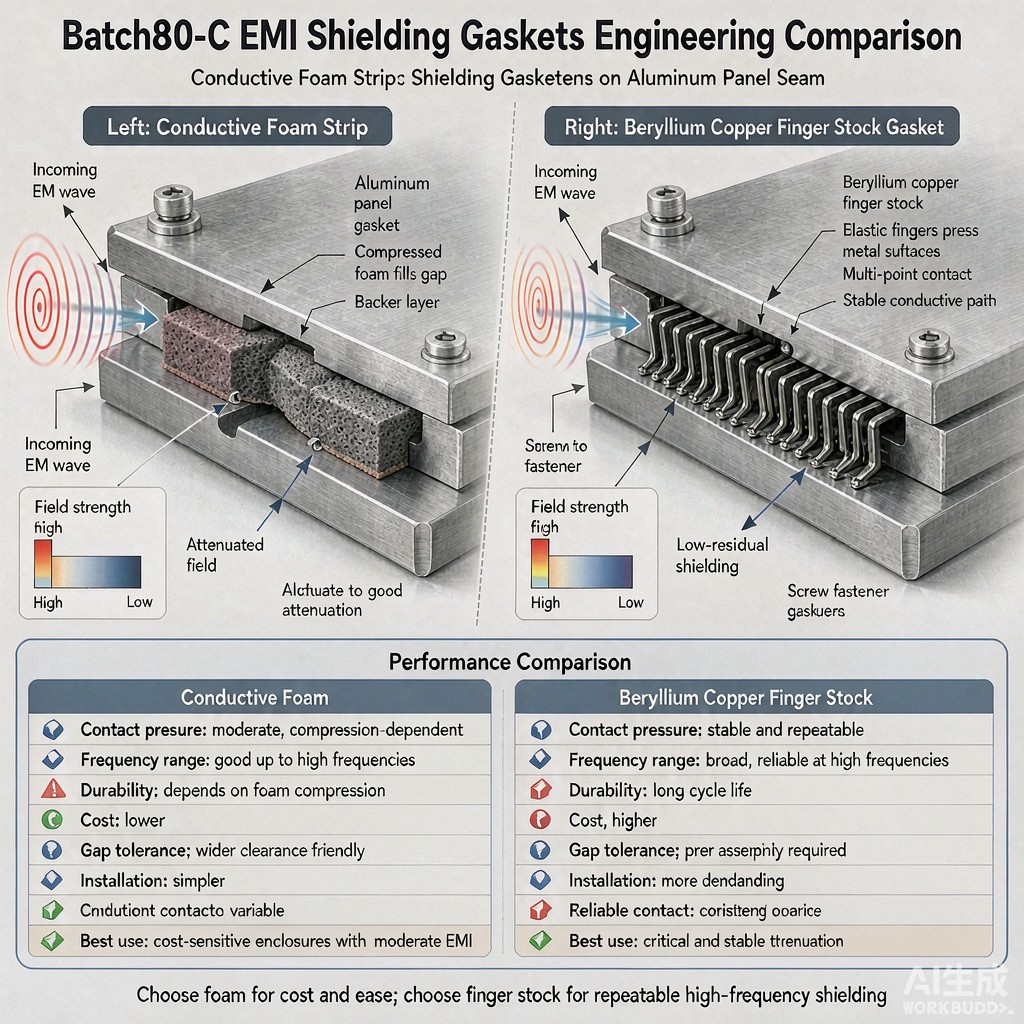
The two most common gasket types for removable panels are conductive foam gaskets and beryllium copper (BeCu) finger stock gaskets. Each has distinct advantages in shielding effectiveness, mechanical durability, compression force, and environmental resilience. This article provides a comparative engineering framework for selecting between them.
## Conductive Foam EMI Gaskets
### Construction and Materials
Conductive foam gaskets are typically fabricated from polyurethane or silicone sponge foam, coated or filled with conductive particles. The most common constructions are:
– Nickel-copper plated polyurethane foam: A reticulated polyurethane foam (density 30–80 kg/m3) with a galvanic plating of nickel-copper, providing volumetric conductivity of 0.05–0.5 ohm-cm. This is the most cost-effective option, suitable for frequencies up to 1 GHz with typical shielding effectiveness of 60–80 dB.
– Silver-plated silicone elastomer foam: A silicone sponge matrix loaded with silver-plated aluminum or silver-plated copper particles. Conductivity is lower (0.1–1.0 ohm-cm) but the elastomer provides environmental sealing against dust and moisture. Shielding effectiveness at 1 GHz is 70–90 dB.
– Graphene-loaded polyurethane foam: An emerging option using graphene nanoplatelets as the conductive filler. Currently offers 40–60 dB at 1 GHz but with the advantage of no galvanic corrosion concerns.
### Compression and Deflection Characteristics
Conductive foam gaskets require 15–30% compression to achieve full conductivity. For a 3 mm thick gasket, this means compressing to 2.1–2.6 mm. The compression force is typically 5–15 N per linear centimeter at 20% deflection. This low force allows the use of standard panel fasteners without heavy-duty latches.
### Shielding Performance
Shielding effectiveness varies with frequency and gasket thickness. At 100 MHz, a 3 mm conductive foam gasket provides 50–70 dB. At 1 GHz, performance is 60–80 dB. Above 10 GHz, performance degrades to 30–50 dB due to aperture leakage effects at the gasket-to-flange interface.
### Environmental Limitations
The primary environmental limitation of conductive foam is galvanic corrosion. When a nickel-copper plated foam is in contact with an aluminum flange in a humid environment, the galvanic couple drives corrosion of the aluminum. This degrades contact resistance over time. For tropical applications with 85%+ relative humidity, specify silver-aluminum filled silicone foam on aluminum flanges, or use a corrosion-inhibiting gasket joint compound.
## Beryllium Copper Finger Stock Gaskets
### Construction and Design
Finger stock gaskets are precision-stamped from beryllium copper (C17200) strip, typically 0.10–0.25 mm thick, in profiles ranging from simple U-fingers to complex multidirectional contact configurations. The beryllium copper is heat-treated to precipitation-hardened temper (ASTM B534, H temper) with a yield strength of 1100–1400 MPa and excellent spring properties.
### Contact Force and Wiping Action
Each finger provides a contact force of 0.5–2.0 N, depending on finger geometry and deflection. The fingers are designed to wipe along the mating surface during panel closure, breaking through oxide films and establishing a gas-tight metal-to-metal contact. This wiping action is the key advantage of finger stock — it provides a self-renewing contact that does not degrade with repeated open-close cycles.
### Shielding Performance
Finger stock gaskets provide superior high-frequency shielding compared to conductive foam. At 1 GHz, a well-designed finger stock gasket achieves 80–100 dB. At 10 GHz, performance is 60–80 dB. At 40 GHz, performance is still 40–60 dB, far exceeding foam gaskets. This makes finger stock the preferred choice for 5G mmWave and military applications.
### Mechanical Durability
Finger stock gaskets are rated for 1,000–10,000 open-close cycles without significant degradation. The beryllium copper spring temper maintains contact force over the full cycle life. In contrast, conductive foam gaskets typically degrade after 100–500 cycles due to set (permanent compression deformation) and conductive particle wear.
### Environmental Resilience
BeCu finger stock is inherently corrosion-resistant (comparable to phosphor bronze) and does not suffer from the galvanic corrosion issues of metal-plated foams. For marine environments, BeCu can be plated with nickel or tin for additional protection. The operating temperature range is -55 to 200 degrees C, far exceeding foam gaskets which typically degrade above 125 degrees C.
## Comparative Selection Matrix
| Parameter | Conductive Foam | BeCu Finger Stock |
|—|—|—|
| Shielding at 1 GHz | 60–80 dB | 80–100 dB |
| Shielding at 10 GHz | 30–50 dB | 60–80 dB |
| Compression force | 5–15 N/cm | 0.5–2.0 N per finger |
| Cycle life | 100–500 cycles | 1,000–10,000 cycles |
| Operating temperature | -40 to 125 C | -55 to 200 C |
| Environmental seal | Yes (if silicone-based) | No |
| Cost per linear meter | $3–8 | $15–40 |
| Galvanic corrosion risk | Moderate to high | Low |
| Installation complexity | Low (adhesive backing) | Moderate (clip-in or bonded) |
## Application Recommendations
### When to Choose Conductive Foam
Conductive foam is the right choice for:
– Access panels opened less than 100 times over equipment life.
– Enclosures requiring combined EMI and environmental sealing.
– Applications below 1 GHz where 60–70 dB shielding is sufficient.
– Cost-sensitive consumer electronics and industrial equipment.
– Non-planar or irregular flange surfaces where gasket conformability is important.
### When to Choose Finger Stock
Finger stock is the right choice for:
– Frequently accessed panels (service panels, hot-swappable modules).
– High-frequency applications above 1 GHz, especially 5G mmWave.
– Military and aerospace applications requiring 80+ dB shielding.
– High-temperature environments above 125 degrees C.
– Environments with high humidity where galvanic corrosion is a concern.
– Applications requiring long service life (10+ years) without gasket replacement.
## Hybrid Approaches
For applications requiring both environmental sealing and high-frequency shielding, a hybrid approach using conductive foam for environmental sealing and a secondary finger stock for high-frequency shielding can be effective. The foam is installed inboard of the finger stock, with the foam providing moisture and dust sealing and the finger stock providing the primary EMI shield.
## Conclusion
The choice between conductive foam and beryllium copper finger stock gaskets depends on frequency, cycle life, environment, and cost. For SMT equipment enclosures in tropical Southeast Asian markets, the decision often comes down to access frequency: panels opened rarely can use foam, while frequently serviced panels demand the durability and wiping action of finger stock. By understanding the performance trade-offs outlined in this article, engineers can specify the right gasket for each panel, optimizing both shielding performance and total cost of ownership.