## Introduction
Every electronic enclosure with digital circuits emits some level of electromagnetic energy. Without proper shielding, that energy can interfere with nearby equipment or fail regulatory emission tests. The seam between a metal chassis and its cover is one of the most common leakage paths. To block it, designers use EMI gaskets that maintain electrical continuity across the joint while accommodating manufacturing tolerances and repeated assembly.
Two of the most popular gasket technologies are conductive foam gaskets and metal finger stock. Each has distinct advantages in shielding effectiveness, compression behavior, durability, and cost. This article compares them and offers selection guidance for enclosure designers.
## Conductive Foam Gaskets
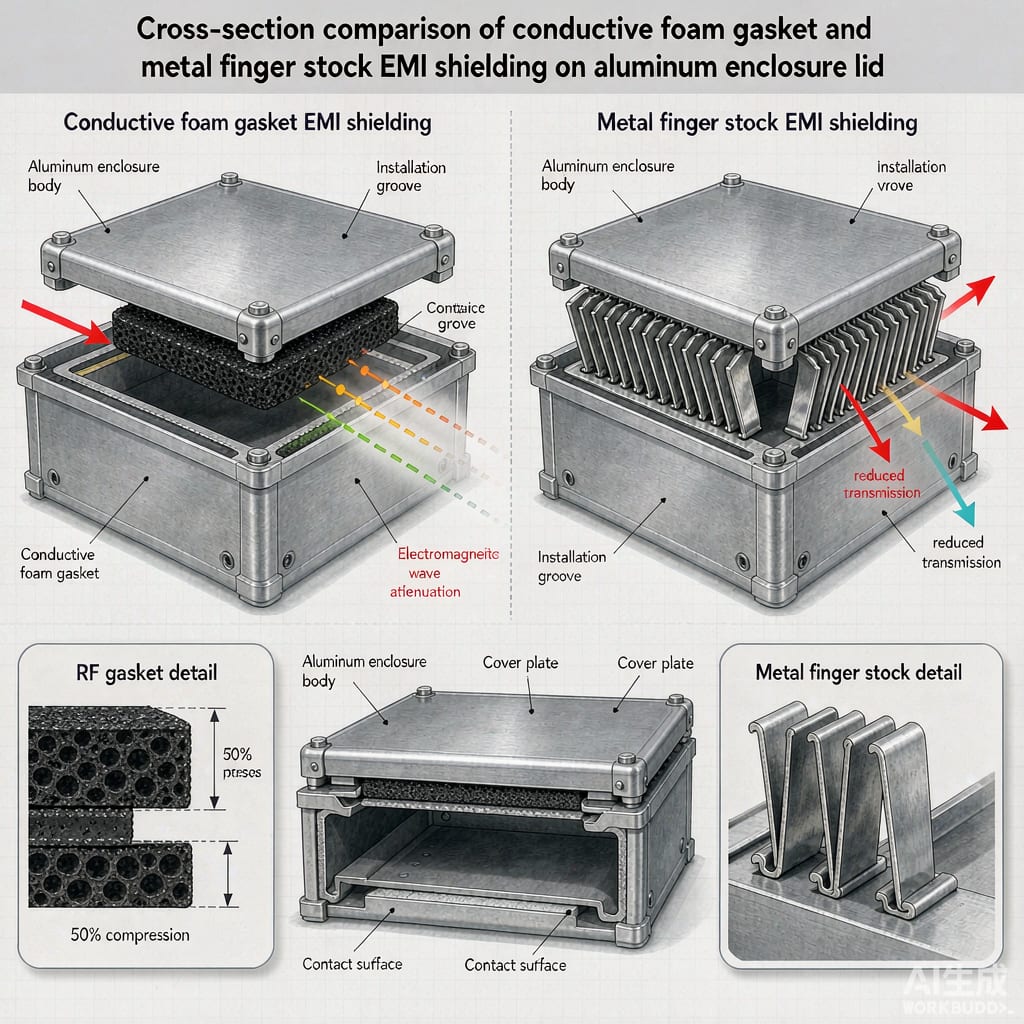
Conductive foam gaskets consist of a soft polyurethane or silicone foam core plated with nickel-copper, silver, or graphite. The foam is compressible and conforms to uneven surfaces, making it ideal for large, irregular seams.
### Advantages
– Conformability: Foam compresses to fill gaps caused by bowed covers or casting irregularities.
– Low closure force: Suitable for enclosures with thin sheet-metal lids or plastic frames.
– Wide cross-sections available: Can be supplied as sheets, extruded profiles, or die-cut shapes.
– Galvanic compatibility: Nickel-graphite foams are compatible with aluminum and reduce corrosion risk.
### Disadvantages
– Limited shielding at high frequencies: Foam gaskets typically provide 60–100 dB of attenuation up to several gigahertz, but performance can drop above 10 GHz due to contact impedance.
– Compression set: After long-term compression, some foams lose resilience and shielding effectiveness declines.
– Wear during cycling: Foam can tear or crumble if covers are removed frequently.
## Metal Finger Stock
Metal finger stock, also called beryllium-copper finger strip or EMI shielding fingers, is made from thin spring metal fingers that press against the mating surface. Common materials are beryllium-copper, stainless steel, and tin-plated phosphor bronze.
### Advantages
– High shielding effectiveness: Properly designed finger stock can exceed 120 dB of attenuation across a broad frequency range, including millimeter-wave bands.
– Long cycle life: Spring metal can survive thousands of mating cycles without significant degradation.
– Low contact resistance: The metal-to-metal wiping action cuts through oxide films and maintains a stable electrical path.
– Wide temperature range: Metal gaskets operate from cryogenic temperatures to over 200 °C.
### Disadvantages
– Higher closure force: Each finger exerts a small force, but hundreds of fingers can add up to a significant load on thin covers.
– Less conformable: Finger stock does not fill large gaps or conform to severely uneven surfaces.
– Galvanic corrosion risk: Beryllium-copper or nickel-silver fingers against aluminum can create a galvanic couple in humid or salt-laden environments unless plated for compatibility.
## Shielding Effectiveness Comparison
Shielding effectiveness depends on seam length, contact impedance, and frequency. At frequencies below 1 GHz, a well-installed foam gasket can match finger stock. At 5 GHz and above, finger stock generally outperforms foam because its many parallel metal paths lower the transfer impedance of the seam.
For 5G base stations, automotive radar modules, and millimeter-wave equipment, finger stock is usually preferred. For consumer electronics, IoT devices, and industrial controllers below 3 GHz, conductive foam is often sufficient and more cost-effective.
## Environmental and Mechanical Considerations
### Compression Set and Aging
If the enclosure will remain closed for years, compression set becomes a concern. Silicone-based conductive foams generally resist compression set better than polyurethane foams. Metal finger stock does not suffer from compression set, although fatigue can reduce finger force over very high cycle counts.
### Galvanic Compatibility
In coastal Southeast Asia or tropical environments, galvanic corrosion between dissimilar metals is a real risk. Pair aluminum enclosures with nickel-graphite foam or tin-plated finger stock to minimize the galvanic potential. Avoid bare beryllium-copper against bare aluminum in outdoor applications.
### Assembly and Serviceability
Foam gaskets can be supplied with pressure-sensitive adhesive for fast assembly. Finger stock is typically screwed, clipped, or soldered to the chassis. For products that require frequent access, finger stock is easier to clean and more durable.
## Cost
Conductive foam is usually less expensive per meter than beryllium-copper finger stock, especially for complex die-cut shapes. However, finger stock can be more economical over the product lifecycle if the enclosure is opened and closed repeatedly, because foam replacements add service cost.
## Conclusion
Conductive foam gaskets and metal finger stock both solve the same EMI problem but serve different design priorities. Foam gaskets offer conformability, low closure force, and low cost for static, moderate-frequency applications. Metal finger stock provides superior shielding, cycle life, and high-frequency performance for demanding RF and military-grade enclosures. The best choice depends on frequency range, environmental exposure, assembly method, and lifecycle requirements.