Enclosure seams are where RF leaks first. A metal box with perfect panels still radiates through every unsealed joint, and adding a fan opening, a display window, or an access door multiplies the problem. Conductive elastomer gaskets solve two problems in one part: they seal the seam against dust and water like a normal rubber gasket, and they make the joint electrically continuous so the enclosure behaves as one shield. The performance and cost of these gaskets are dominated by one decision: the conductive filler system loaded into the silicone or fluorosilicone base. This guide compares the main filler families and summarizes the mechanical rules that keep a gasket working for years.
How Conductive Elastomers Shield
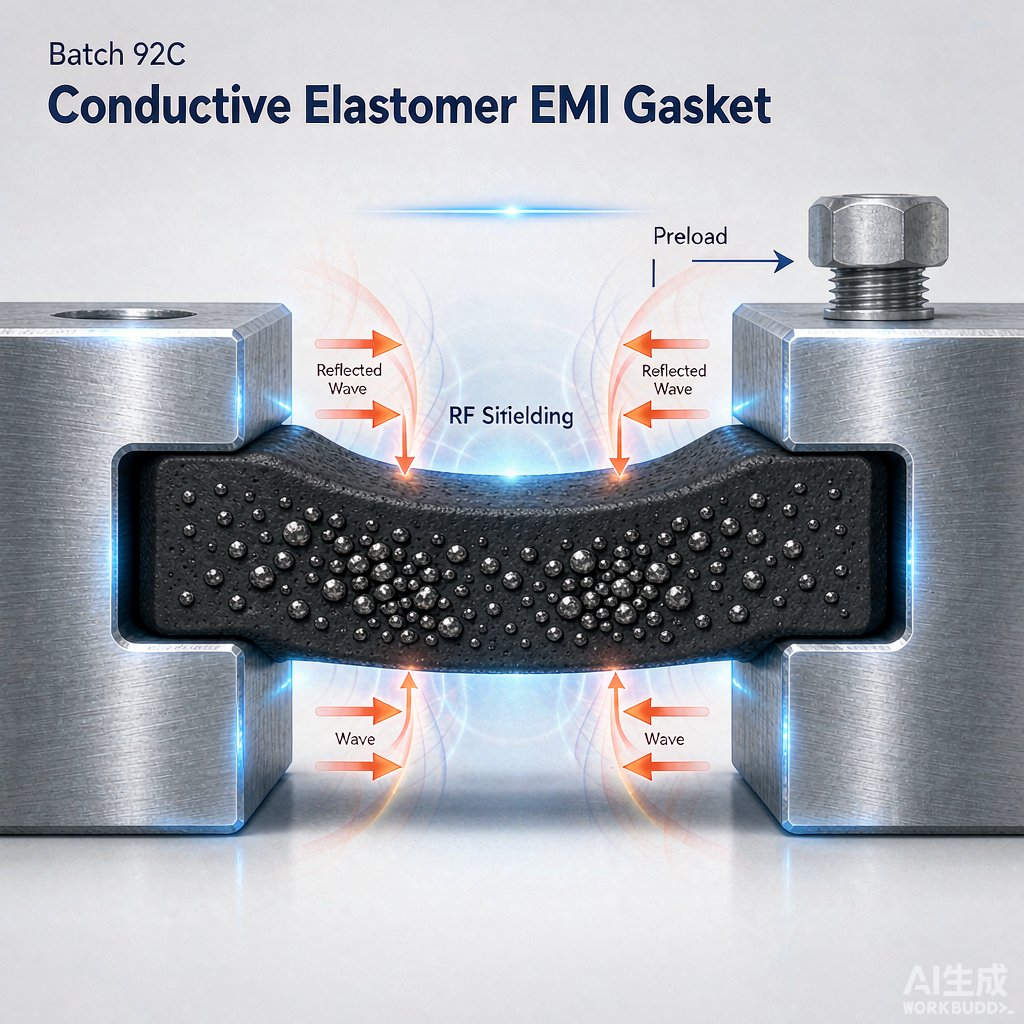
A conductive elastomer is a rubber loaded with metal particles well past the percolation threshold, so particle-to-particle contact forms continuous conductive paths through the material. Compressed across a flange, the gasket bridges the joint with low impedance, closing the slot ante
a that an open seam would otherwise form. Typical shielding effectiveness for a well-designed joint ranges from about 60 to 120 dB depending on frequency and filler, which is ample for commercial electronics and most industrial and aerospace needs. Because the rubber matrix remains elastomeric, the same gasket also delivers an environmental seal, often to IP67, without a second gasket.
Filler Systems Compared
Silver-Plated Glass and Silver-Plated Aluminum Spheres
Silver-plated particles are the standard choice for demanding programs. Silver-plated aluminum spheres combine good conductivity with low weight and, critically, galvanic compatibility with aluminum housings, which is why they dominate aerospace and defense enclosures. Silver-plated glass microspheres offer slightly higher conductivity and dimensional stability at similar cost. Both families deliver roughly 90 to 110 dB of shielding across 100 MHz to several GHz and are covered by military gasket specifications such as MIL-DTL-83528.
Silver-Copper
Silver-filled or silver-copper-filled compounds give the lowest volume resistivity and the best shielding in severe environments, including salt fog and fuel exposure. The trade-offs are the highest cost of the common fillers and higher density. They are specified where signal integrity is exceptional, such as RF test fixtures, radar units, and high-end communications gear, rather than where cost matters.
Nickel-Graphite and Nickel-Coated Particles
Nickel-graphite compounds trade some conductivity for a large cost reduction. Expect roughly 60 to 80 dB of shielding, which covers most commercial and industrial enclosures, network hardware, and ESD-conscious assemblies. Nickel does oxidize slowly, so contact resistance management and flange finish matter more than with silver systems. Nickel-graphite pairs well with painted or plated steel housings and stainless flanges. Nickel-coated graphite or nickel-coated aluminum variants tune the balance between cost, weight, and corrosion behavior.
Quick Comparison
- Shielding performance: silver-copper highest, silver-plated spheres close behind, nickel-graphite adequate for commercial levels.
- Cost: nickel-graphite lowest by a wide margin, silver-plated spheres mid, silver-copper highest.
- Galvanic fit: silver-aluminum with aluminum housings; nickel-graphite with steel and stainless; silver-copper with compatible plated flanges.
- Weight: silver-aluminum lightest of the metal-filled options, silver-copper heaviest.
Galvanic Compatibility and Corrosion
When the gasket filler and the flange metal are far apart in the galvanic series and moisture is present, the joint corrodes and contact resistance climbs, quietly degrading shielding. The rule is to keep filler and flange within a narrow electrochemical window: silver-plated aluminum filler for bare or conversion-coated aluminum, nickel-graphite for steel and stainless, and avoid placing silver-rich fillers against bare aluminum in wet environments. Flange finish matters as much as filler choice: conductive conversion coatings or bare metal under the gasket line work, while paint or anodizing under the gasket forces all current through the fasteners and defeats the gasket.
Mechanical Design Rules
Conductive elastomers behave like precision rubbers, and most field failures are mechanical rather than electrical:
- Compression: design for about 15 to 25 percent compression for silicone-based strips and O-rings. Under-compressed gaskets leak; over-compressed ones take a compression set and lose force.
- Groove fill: for O-ring style grooves keep total fill near 75 to 85 percent including tolerances.
- Cross-section choice: extruded strip and die-cut shapes suit flat flanges with fastener clamping; molded O-rings suit grooved lids; form-in-place dispensed beads suit small, densely packed enclosures where machining a groove is impractical.
- Flange stiffness and fastener spacing: the gasket can only shield what the flange compresses evenly; wide panels need closer fastener spacing or stiffening to avoid gaps between screws.
Environmental Sealing in the Same Part
The elastomer base determines fluid and temperature capability. General-purpose silicone covers roughly minus 55 to plus 160 degrees C with excellent compression set behavior. Fluorosilicone is the choice where fuels, oils, or phosphate-ester hydraulic fluids are present, common in aerospace and transportation. With correct compression design, conductive elastomer joints routinely achieve IP66 and IP67 ratings alongside their shielding duty, which is why outdoor base station and industrial enclosure designers specify them instead of separate sealing and shielding systems.
Testing and Acceptance
Meaningful verification combines electrical and mechanical checks: shielding effectiveness measured on a standard window or junction fixture across the frequency range of interest; volume resistivity against the material datasheet; compression set after aging per ASTM-style methods; and, for corrosive environments, salt spray exposure followed by contact resistance measurement. Gaskets qualified to MIL-DTL-83528 come with most of this data by default, which shortens design-in time for high-reliability projects.
Conclusion
Filler selection is a three-way optimization of conductivity, galvanic compatibility, and cost. Silver-plated aluminum covers most aerospace-grade requirements, nickel-graphite covers commercial and industrial budgets, and silver-copper is reserved for the most demanding RF environments. Around the filler, the mechanical details of compression, groove fill, and flange finish decide whether the datasheet shielding survives real assembly. TechMartSe supplies EMI shielding components and gasket materials for electronics manufacturers across Southeast Asia, and can help match filler systems to enclosure metals, environmental ratings, and cost targets.