Introduction
SMT copper strip plating plays a crucial role in determining the performance, durability, and cost-effectiveness of your electronic assemblies. Whether you choose tin plating, nickel plating, or gold plating, each finish offers distinct advantages for specific applications. This complete guide explains the technical differences to help you make informed purchasing decisions.
Understanding SMT Copper Strip Plating Options
Base copper strips offer excellent electrical conductivity, but unprotected copper is susceptible to oxidation and corrosion. Surface plating provides:
- Oxidation resistance
- Improved solderability
- Enhanced electrical conductivity at contact points
- Barrier layer protection
- Wear resistance for mating surfaces
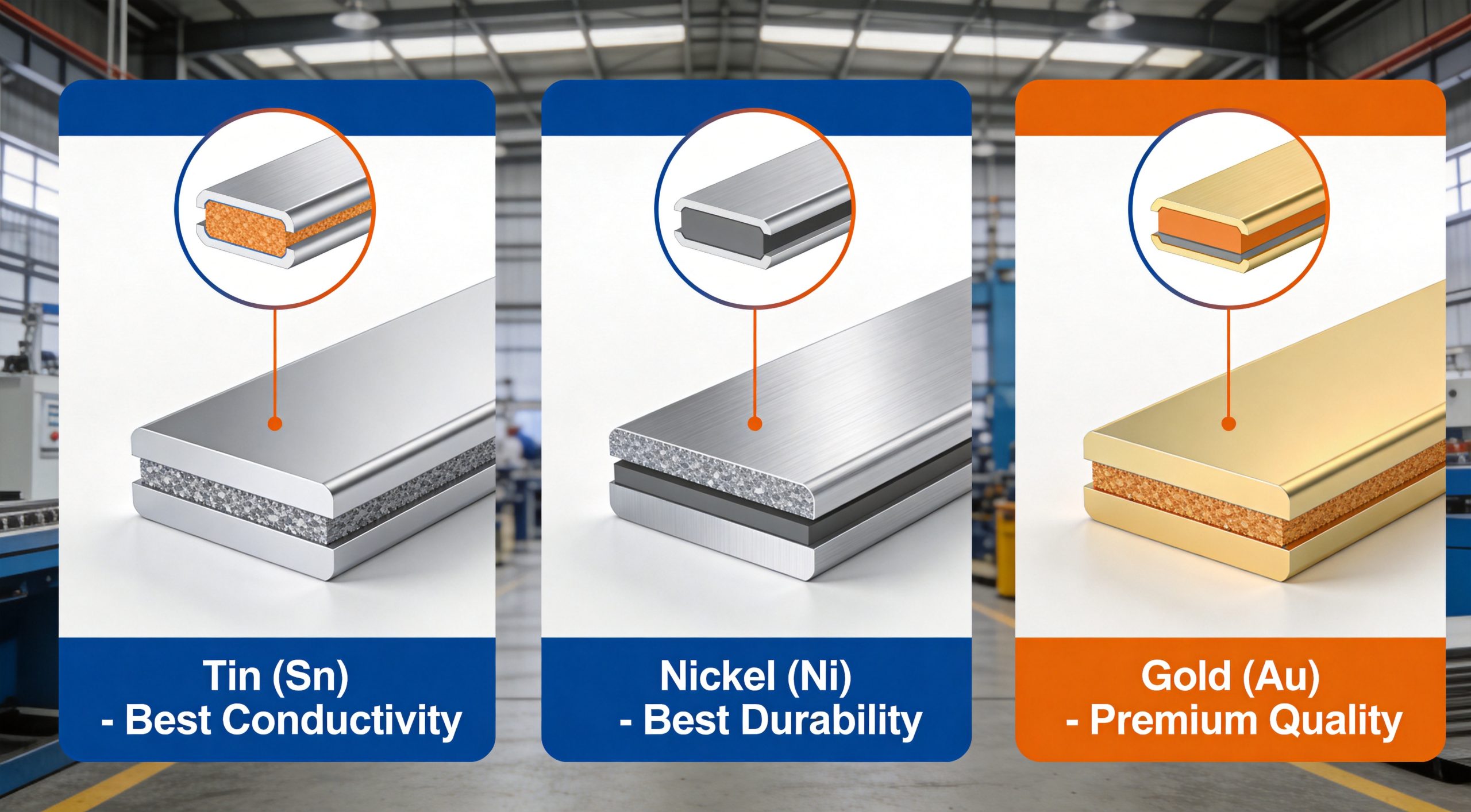
Tin Plating: The Best Conductor
Technical Specifications
Tin-plated copper strips provide the best electrical conductivity among plated options, with contact resistance typically below 1mΩ. Tin coatings range from 2-25 microns depending on application requirements.
Advantages
- Excellent solderability – Tin forms reliable intermetallic bonds with lead-free and leaded solders
- Lowest contact resistance among plating options
- Cost-effective solution for most applications
- Good corrosion resistance when properly applied
- Lead-free compliant (SAC305 compatible)
Recommended Applications
Tin-plated strips are ideal for:
- General SMT applications requiring reliable solder joints
- High-frequency signal applications where conductivity matters
- Consumer electronics assembly
- Cost-sensitive projects without extreme environmental requirements
Product Recommendation
Explore our Tin-Plated Copper Strip collection for standard applications requiring excellent conductivity and solderability.
Nickel Plating: The Durable Choice
Technical Specifications
Nickel-plated copper strips offer superior hardness (Vickers hardness 200-400 HV) and create an effective diffusion barrier. Typical nickel thickness ranges from 1-10 microns.
Advantages
- Excellent diffusion barrier – Prevents copper migration into solder joints
- Superior wear resistance for mating surfaces
- Good corrosion resistance in harsh environments
- High-temperature stability
- Excellent adhesion for subsequent plating processes
Recommended Applications
Nickel plating excels in:
- Automotive electronics requiring high reliability
- High-temperature operating environments
- Applications with frequent mating cycles
- LED lighting with thermal cycling requirements
- Industrial control systems
Product Recommendation
Check our Nickel-Plated Copper Strip options for demanding applications requiring maximum durability.
Gold Plating: Premium Quality Solution
Technical Specifications
Gold-plated copper strips represent the premium finish option, with typical gold thickness of 0.5-3 microns over nickel underlayer. Gold provides unmatched surface properties for critical applications.
Advantages
- Superior corrosion resistance – Gold does not oxidize
- Extremely low, stable contact resistance
- Excellent wire bonding compatibility
- Ideal for high-reliability military and aerospace applications
- Aesthetic appeal for visible applications
Recommended Applications
Gold plating is specified for:
- Military and aerospace electronics
- Medical device manufacturing
- High-frequency RF co
ectors
- Edge card co
ectors
- Any application requiring maximum reliability
Product Recommendation
Browse our Gold-Plated Copper Strip range for premium applications demanding the highest quality finish.
Plating Comparison Summary
| Property | Tin Plating | Nickel Plating | Gold Plating |
|---|---|---|---|
| Electrical Conductivity | Excellent | Good | Very Good |
| Corrosion Resistance | Good | Excellent | Outstanding |
| Durability | Good | Excellent | Very Good |
| Solderability | Excellent | Good | Excellent |
| Cost | Low | Medium | High |
| Best For | General SMT | Automotive/Industrial | High-Reliability |
Making Your Selection
Choosing the right SMT copper strip plating depends on your specific requirements:
- For general electronics with budget considerations: Choose tin plating for best conductivity and solderability at reasonable cost
- For automotive and industrial applications: Select nickel plating for superior durability and thermal stability
- For high-reliability military/medical applications: Specify gold plating for uncompromising performance
At TechMart SE, we stock all three plating types in various dimensions to meet your manufacturing needs. Our technical team can advise on the optimal plating choice based on your application environment and performance requirements.
Conclusion
Understanding the differences between tin, nickel, and gold plating enables you to select the optimal finish for your SMT copper strip requirements. Each option offers distinct advantages – from cost-effective tin for general applications to premium gold for mission-critical systems. Evaluate your specific needs regarding conductivity, durability, and environmental conditions to make the best choice. Contact TechMart SE today to discuss your plating requirements and access our full range of plated copper strip products.
n