## Introduction
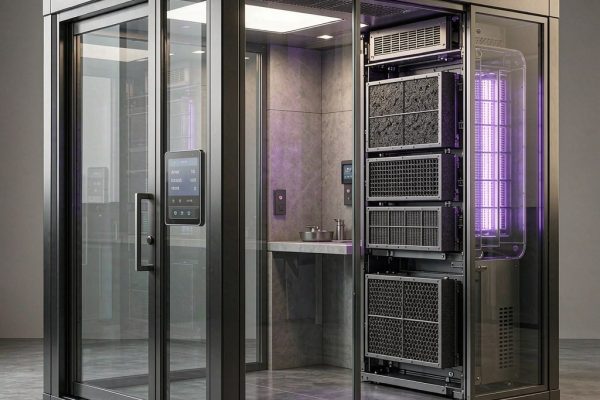
As urban regulations across Southeast Asia increasingly restrict indoor smoking, commercial smoking booths have become essential infrastructure in airports, office complexes, shopping malls, and hospitality venues. The core challenge is not merely enclosing smoke — it is engineering a ventilation system that prevents secondhand smoke escape, maintains occupant comfort, and complies with ASHRAE 62.1 ventilation standards while operating efficiently in tropical climates where ambient humidity regularly exceeds 80%.
This guide examines the technical design parameters for smoking booth ventilation, from HEPA filtration selection to airflow rate calculations and exhaust system architecture.
## ASHRAE 62.1 Ventilation Rate Requirements for Smoking Areas
ASHRAE Standard 62.1 categorizes smoking lounges under the “Smoking Lounge” space type with a minimum outdoor airflow rate of 25 CFM per person (approximately 12 L/s per person) — significantly higher than the 5 CFM/person baseline for general office spaces. However, this minimum addresses only fresh air dilution; effective smoke containment requires additional exhaust capacity.
### Airflow Rate Calculation
The total ventilation rate for a smoking booth is determined by:
V_total = V_people × P + V_area × A + V_excess
Where:
– V_people = 25 CFM/person (ASHRAE 62.1 minimum)
– P = maximum occupant count
– V_area = 0.06 CFM/ft² (area-based component)
– A = booth floor area in ft²
– V_excess = additional exhaust for smoke containment (typically 50-100 CFM per booth)
For a standard 1.5m × 1.5m smoking booth (≈7.5 ft², capacity 1-2 persons), the calculation yields approximately 75-150 CFM total ventilation, with the excess component ensuring negative pressure containment.
### Negative Pressure Containment Principle
Effective smoking booths maintain -0.02 to -0.05 inches of water gauge (in. wg) negative pressure relative to adjacent spaces. This pressure differential ensures that when the booth door opens, air flows inward — preventing smoke leakage. The exhaust fan must deliver at least 10-20% more airflow than the supply to maintain this negative offset.
## HEPA Filtration System Design
### Filter Selection Parameters
HEPA (High-Efficiency Particulate Air) filters rated H13/H14 per EN 1822 capture 99.95%-99.995% of particles at 0.3 μm MPPS (Most Penetrating Particle Size). Tobacco smoke particles range from 0.1-1.0 μm with a mass median diameter of approximately 0.3-0.5 μm — squarely in the HEPA filter’s most challenging size range.
| Parameter | H13 Filter | H14 Filter |
|———–|———–|———–|
| Efficiency at MPPS | 99.95% | 99.995% |
| Initial Resistance | 200-250 Pa | 250-300 Pa |
| Final Resistance (replace) | 600 Pa | 600 Pa |
| Service Life (smoking booth) | 6-9 months | 8-12 months |
| Cost Index | 1.0 | 1.4 |
For standard commercial smoking booths, H13 filters provide sufficient particle capture. H14 filters are recommended for healthcare facility or airport installations where air quality perception is critical.
### Pre-Filter Stage
A MERV 8-13 pre-filter extends HEPA life by capturing larger particles (1-10 μm range including ash and larger tar droplets). Two-stage filtration reduces HEPA replacement frequency by 40-60%, lowering maintenance cost in high-traffic installations.
| Filter Stage | MERV Rating | Target Particle Size | Replacement Cycle |
|————-|————|———————|——————|
| Stage 1: Pre-filter | MERV 8-13 | >1 μm | 3-6 months |
| Stage 2: HEPA | H13/H14 | 0.1-1.0 μm | 6-12 months |
| Optional: Activated carbon | – | VOC/gas phase | 6-9 months |
### Activated Carbon for Gas-Phase Odor Removal
HEPA filtration addresses particulate matter but ca
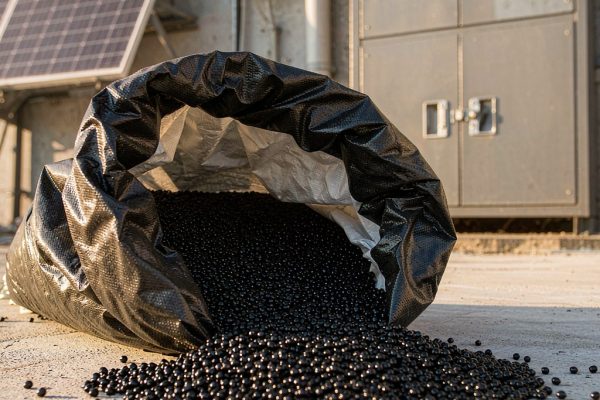
ot capture gas-phase compounds (nicotine, acrolein, formaldehyde, benzene). An activated carbon adsorption layer with 4-8 mm pellet diameter and 3-5 kg carbon mass per booth provides 60-80% removal of volatile organic compounds (VOCs) characteristic of tobacco smoke. Carbon impregnated with potassium hydroxide (KOH) enhances acidic gas (formaldehyde, acrolein) capture by 30-50%.
## Exhaust Fan Sizing and Motor Selection
### Fan Capacity Calculation
The exhaust fan must deliver the total calculated CFM while overcoming system static pressure:
Fan CFM = V_total × 1.15 (safety margin)
System static pressure = Filter resistance + Duct resistance + Grille resistance + Damper resistance
For a typical booth:
– HEPA filter: 200-300 Pa (initial)
– Pre-filter: 30-50 Pa
– Duct (3m, 100mm Ø): 20-40 Pa
– Grille/damper: 10-20 Pa
– Total: 260-410 Pa (≈1.0-1.6 in. wg)
### Motor Type Comparison
| Motor Type | Efficiency | Speed Control | Noise Level | Cost |
|———–|———–|————–|————|——|
| AC induction (standard) | 65-75% | None or stepped | 45-55 dBA | Low |
| EC (brushless DC) | 85-92% | Continuous PWM | 35-45 dBA | Medium |
| AC with VFD | 75-85% | Variable frequency | 40-50 dBA | Medium-High |
EC motors are strongly recommended for smoking booths due to their superior efficiency (reducing operating cost by 15-25%), continuous speed control (enabling demand-based ventilation), and lower acoustic output — critical for installations in quiet commercial environments.
## Airflow Distribution Design
### Ceiling Exhaust vs Wall-Mounted Exhaust
Two primary airflow configurations exist:
1. Ceiling Exhaust (Top-Down)
– Supply air enters through low-wall diffusers at 0.3-0.5 m/s
– Exhaust grille mounted at ceiling center
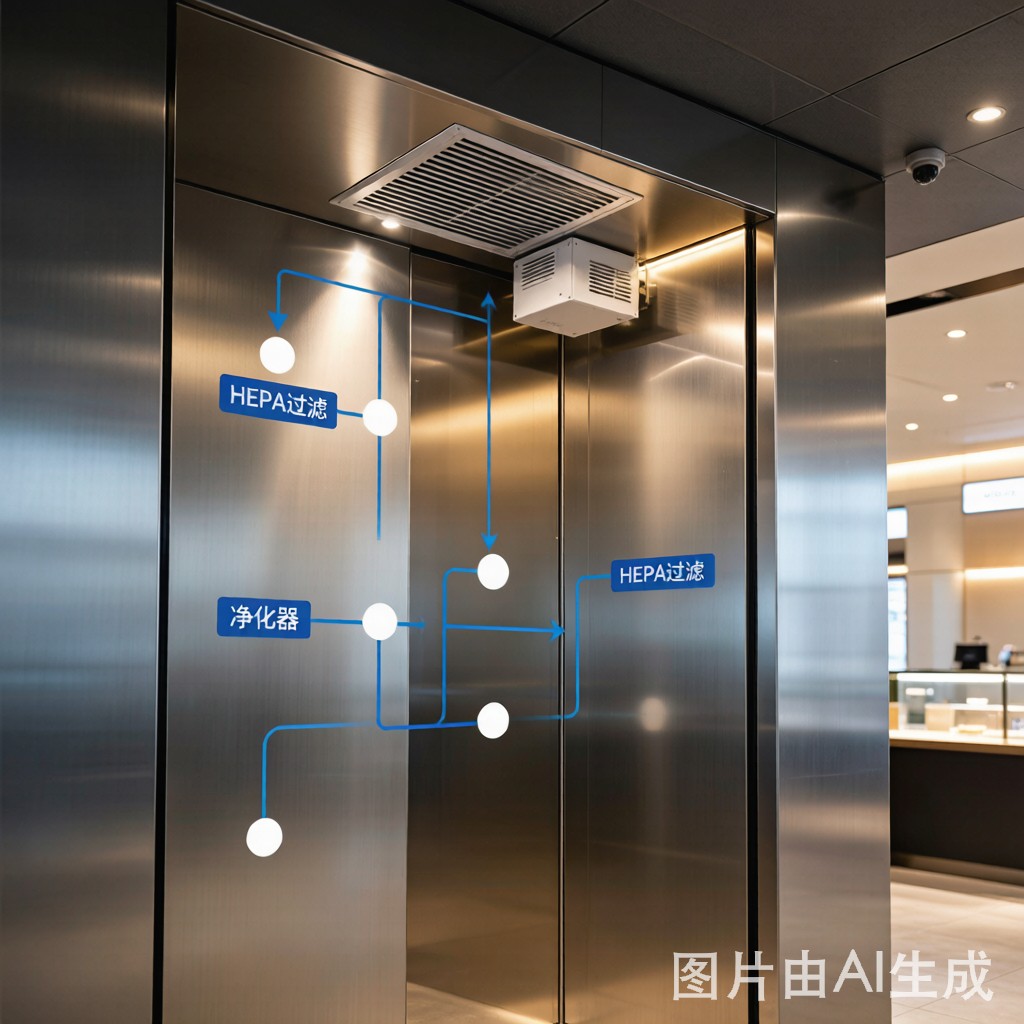
– Airflow path: bottom→up, sweeping smoke upward away from breathing zone
– Advantage: Natural thermal buoyancy assists smoke removal (smoke is warmer, rises naturally)
– Recommended for: Single-occupancy booths, airport installations
2. Wall-Mounted Exhaust (Cross-Flow)
– Supply air on one wall, exhaust on opposite wall
– Horizontal airflow at 0.2-0.4 m/s across occupant breathing zone
– Advantage: More uniform smoke removal in larger multi-occupancy lounges
– Risk: May direct smoke across non-smoking occupant path
– Recommended for: Multi-person smoking rooms (>4 occupants)
### Diffuser Selection
Low-wall supply diffusers should deliver air at 0.3-0.5 m/s face velocity — sufficient to establish directional airflow without creating uncomfortable drafts on seated occupants. Perforated plate diffusers with 20-30% free area provide uniform distribution with minimal pressure drop.
## Southeast Asian Climate Considerations
### Humidity Impact on Filtration
At ambient humidity >75% RH (common in Singapore, Thailand, Vietnam, Philippines):
– HEPA filter media moisture absorption increases resistance by 15-25%
– Activated carbon adsorption capacity decreases by 20-35% (water vapor competes for adsorption sites)
– Pre-filter lifespan reduces by 30-40% due to hygroscopic particle agglomeration
Mitigation strategies:
– Specify hydrophobic HEPA media (PTFE or glass fiber with moisture-resistant binder)
– Increase carbon mass by 50% in tropical installations (5-8 kg per booth vs 3-5 kg temperate)
– Reduce pre-filter replacement interval to 2-3 months
– Consider desiccant pre-treatment for supply air in extreme humidity locations (>85% RH)
### Condensation Management
Temperature differential between air-conditioned booth interior (22-24°C) and tropical exterior (30-35°C) creates condensation risk on enclosure walls and duct surfaces. Closed-cell foam insulation (minimum 25mm thickness, R-value ≥1.2) on duct runs and anti-condensation coatings on interior metal surfaces prevent moisture accumulation that would promote mold growth and corrode ventilation components.
## Maintenance Schedule and Cost Model
| Component | Inspection Interval | Replacement Interval | A
ual Cost (USD) |
|———–|——————-|———————|——————|
| Pre-filter (MERV 8) | Monthly | 2-3 months | 30-60 |
| HEPA filter (H13) | Quarterly | 6-9 months | 80-150 |
| Activated carbon | Quarterly | 6-9 months | 50-100 |
| Exhaust fan motor | Semi-a
ually | 5-8 years | 15 (inspection) |
| Duct insulation | A
ually | 10+ years | 10 (inspection) |
| Negative pressure sensor | Monthly calibration | 3-5 years | 20-40 |
| **Total a
ual maintenance | – | – | 200-360** |
## Conclusion
Effective smoking booth ventilation requires integrated design across filtration, exhaust capacity, airflow distribution, and climate adaptation. By specifying H13 HEPA filtration with activated carbon augmentation, maintaining -0.02 to -0.05 in. wg negative pressure, and adapting component sizing for Southeast Asian humidity conditions, smoking booth installations can achieve smoke containment efficiency above 95% while meeting ASHRAE 62.1 ventilation standards. The modest a
ual maintenance investment ($200-360) ensures consistent performance and regulatory compliance across the booth’s 10-15 year service life.
For sourcing smoking booth components including pre-engineered ventilation modules and HEPA filtration units designed for tropical installations, explore TechMartSE’s catalog of commercial smoking booth solutions.