## Why Solder Paste Shelf Life Matters in SMT Production
Solder paste is the lifeline of surface-mount technology (SMT) assembly. This critical material—a precise mixture of solder alloy particles suspended in flux vehicle—directly determines print deposition accuracy, component placement adhesion, and final reflow solder joint integrity. Yet many electronics manufacturers underestimate how profoundly storage conditions and shelf life affect paste performance on the production floor.
When solder paste degrades beyond its usable life, the consequences cascade through your entire process: stencil aperture clogging, inconsistent deposit volumes, component tombstoning during reflow, and ultimately defective solder joints that fail inspection under IPC-A-610 criteria. Understanding and managing solder paste shelf life is not merely a materials handling concern—it is a foundational quality control discipline.
## Understanding Solder Paste Composition and Degradation Mechanisms
### Flux Vehicle Chemistry and Its Vulnerabilities
The flux vehicle in solder paste serves multiple functions: it provides rheological properties for stencil printing, protects solder particles from oxidation, and activates during reflow to remove surface oxides. This vehicle typically contains:
– Rosin/resin binders (R, RMA, or RA types per J-STD-004) that determine activation level
– Organic acid activators (succinic, adipic, or citric acid) for oxide removal
– Thixotropic rheology modifiers that enable shear-thi
ing behavior during stencil printing
– Solvent carriers that dissolve and suspend all components
Each of these constituents has distinct aging vulnerabilities. Solvent evaporation increases paste viscosity over time, even in sealed containers. Organic activators undergo slow hydrolysis when exposed to humidity, reducing their effectiveness during reflow. Thixotropic agents can lose their shear-thi
ing response, producing inconsistent aperture fill during stencil printing.
### Solder Particle Oxidation Dynamics
Solder powder in Type 3 (25-45 μm) and Type 4 (20-38 μm) pastes presents enormous surface area relative to mass. A single gram of Type 4 SAC305 powder contains approximately 8-12 million individual particles, each with an oxide layer that grows logarithmically with exposure time and temperature:
| Storage Condition | Oxide Growth Rate | Impact on Wetting |
|—|—|—|
| Refrigerated (2-10°C) | 30°C) | 8-15 nm/month | Severe—significant wetting degradation within weeks |
| Humidity exposure (>60% RH) | Accelerated 3-5x | Combined thermal-humidity effect is worst case |
This oxide layer growth directly reduces solder wetting spread during reflow. IPC-J-STD-005 specifies minimum wetting area requirements, and aged paste can fall below these thresholds even while technically within its labeled shelf life.
## Refrigerated Storage: The Gold Standard
### Temperature Requirements per Industry Standards
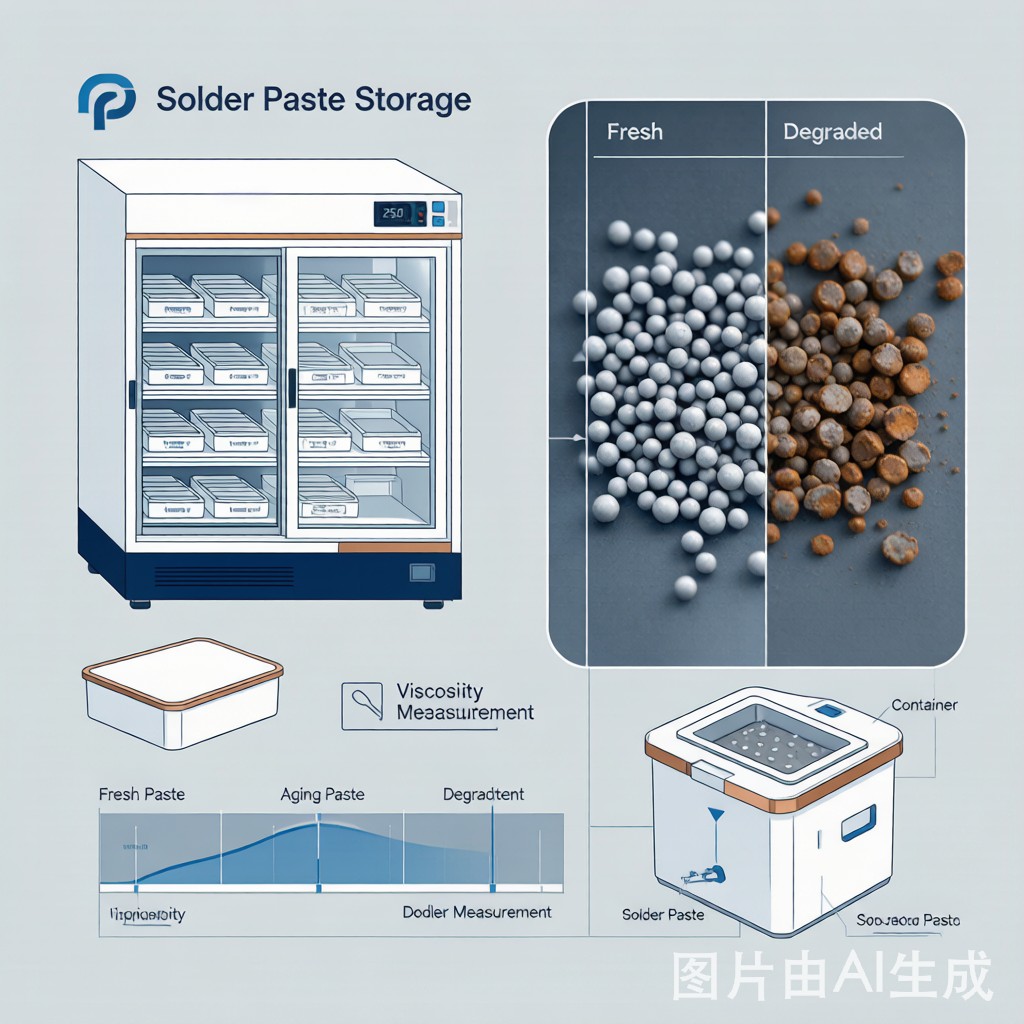
J-STD-005 and major paste manufacturers (Indium, KOKI, Alpha, Henkel) universally specify refrigerated storage at 2-10°C (35-50°F) for unopened solder paste containers. This temperature range slows all degradation mechanisms simultaneously:
– Solvent evaporation rate drops by 80-90% compared to ambient storage
– Organic activator hydrolysis reduces to negligible levels
– Solder particle oxide growth enters the sub-nanometer-per-month regime
– Thixotropic agent polymer stability extends dramatically
The refrigeration requirement is not optional—it is a process control prerequisite. Paste stored at ambient temperature may appear printable initially but will exhibit progressive viscosity drift, reduced tack force for component retention, and degraded wetting within weeks rather than months.
### Handling Protocol: Thawing Before Use
A critical but frequently misunderstood step: solder paste must be thawed to ambient temperature naturally before opening. Never accelerate thawing by:
– Placing containers on warm equipment surfaces
– Using heated cabinets or ovens
– Microwaving (this selectively heats solvents, destroying homogeneity)
– Opening containers while paste is still cold (condensation introduces moisture)
Proper thawing takes 4-8 hours at room temperature for standard 500g jars, or 2-4 hours for 100g syringes. During thawing, the sealed container prevents moisture condensation on the paste surface. Premature opening creates localized moisture absorption that produces solder ball defects during reflow.
## Shelf Life Tracking and Expiration Management
### Manufacturer Shelf Life Claims
Most solder paste manufacturers specify 6-12 months shelf life from date of manufacture when stored under proper refrigerated conditions. However, this timeline carries important qualifications:
– The date of manufacture is not the date you received the material—transit time at potentially non-refrigerated conditions consumes shelf life
– Shelf life assumes continuous refrigerated storage; any warm-period excisions accelerate aging proportionally
– Some manufacturers specify shelf life from first opening (typically 1-3 months), which is shorter than sealed-container life
### Practical Shelf Life Verification
Rather than relying solely on manufacturer date codes, implement active shelf life verification through:
1. Viscosity measurement using a rotational viscometer (Malcom PC-10S or equivalent) at specified shear rates—compare against manufacturer datasheet ranges
2. Tack force testing per IPC-J-STD-005 tackiness measurement method—declining tack force indicates vehicle degradation
3. Solder ball test (IPC-J-STD-005 Method 3.5)—excessive balling indicates moisture absorption or particle agglomeration
4. Wetting spread test on copper coupon per J-STD-003—reduced spread area confirms oxide accumulation
These tests provide quantitative data to determine whether paste near its labeled expiration is still production-worthy. A paste that passes all verification tests at 10 months may outperform expired-at-6-months paste that was improperly stored.
## Room Temperature Storage: When It Happens and What It Costs
### Unintended Ambient Exposure Scenarios
Even in well-managed facilities, solder paste experiences ambient temperature exposure in several common scenarios:
– Transit from supplier warehouse to your facility—shipping containers, truck beds, and customs holding areas are rarely refrigerated
– Stencil setup time—paste sits on the stencil printer platform for 4-8 hours during production runs
– Shift changeovers—paste may remain on equipment during breaks or overnight in facilities that do not retrieve paste between shifts
– Inventory staging—paste removed from refrigeration for upcoming jobs but not immediately used
Each ambient exposure period contributes to cumulative degradation. The relationship is not linear—initial degradation is slow, but accelerates as activators consume and oxide layers grow past critical thicknesses.
### Quantifying the Print Quality Impact
Research published in SMTA International proceedings demonstrates measurable print quality degradation from ambient storage:
| Metric | Fresh Paste (Refrigerated) | 2 Weeks Ambient | 4 Weeks Ambient |
|—|—|—|—|
| Print viscosity (Pa·s at 10 s⁻¹) | 180-220 | 240-280 (+30%) | 320-380 (+60%) |
| Aperture fill consistency (%CV) | 3-5% | 8-12% | 15-22% |
| Tack force (N/cm²) | 0.8-1.2 | 0.5-0.7 (-40%) | 0.2-0.4 (-70%) |
| Wetting spread area (mm²) | 45-52 | 38-44 (-15%) | 25-32 (-45%) |
These figures explain why production lines using ambient-stored paste experience increasing stencil clogging, inconsistent deposit volumes, and rising defect rates—problems that worsen progressively rather than appearing suddenly.
## Best Practices for SMT Paste Shelf Life Management
### Storage Infrastructure Requirements
Implement proper solder paste storage with these infrastructure elements:
– Dedicated refrigeration unit maintained at 5°C ±3°C, with temperature monitoring and alarm system
– Inventory tracking system that records date of manufacture, date received, and calculated expiration for each lot
– Thawing staging area at ambient temperature with clearly labeled thaw-time tracking
– First-in-first-out (FIFO) rotation to prevent old stock from accumulating in refrigeration
### Production Floor Handling Protocol
Establish and enforce these handling rules on the SMT production floor:
– Retrieve only the paste needed for the current production run—never stage multiple containers simultaneously
– Record paste lot number, thaw start time, and time-on-stencil for every shift
– Retrieve paste from stencil printer within 2 hours of run completion and return to refrigeration (this extends working life significantly)
– Discard paste that has been on-stencil for more than 8 cumulative hours, regardless of its labeled shelf life
– Never re-refrigerate paste that has been at ambient temperature for more than 24 hours—thermal cycling degrades the vehicle
### Documentation and Traceability
Complete shelf life management requires documentation at every stage:
– Material receiving log: date received, lot number, manufacturer date code, carrier temperature at receipt
– Storage log: refrigeration temperature records (continuous monitoring preferred)
– Thaw log: thaw start/end times, ambient temperature during thaw
– Production use log: stencil printer start/end times, cumulative ambient exposure time
– Disposition log: paste verified, expired, or discarded with reason codes
This documentation trail supports IPC process control requirements and provides data for correlating paste age with production defect trends.
## Conclusion: Shelf Life Management as a Quality Discipline
Solder paste shelf life management is not a passive activity of checking date codes and discarding expired material. It is an active quality discipline involving controlled storage, verified handling, quantitative testing, and complete traceability. The investment in proper refrigeration, monitoring, and documentation pays dividends in consistent print quality, reduced stencil maintenance, lower defect rates, and reliable solder joints that pass IPC-A-610 inspection without rework.
In Southeast Asia’s high-humidity manufacturing environments, the stakes are even higher—ambient conditions accelerate every degradation mechanism described here. Facilities that treat solder paste as a commodity to be stored casually will experience quality problems that are difficult to diagnose because they manifest gradually across multiple process steps. Treat solder paste shelf life management as the first line of defense in your SMT quality system, and the downstream benefits will compound through every stage of your assembly process.