Introduction: When LCP and PPS Are Not Enough
As lead-free SMT reflow profiles have pushed peak temperatures to 260°C and beyond, co
ector housing materials face increasingly demanding thermal stability requirements. Liquid Crystal Polymer (LCP) and Polyphenylene Sulfide (PPS) have become workhorse materials for high-temperature co
ector applications, but both have limitations: LCP exhibits severe anisotropic shrinkage and weld-line weakness in complex geometries, while PPS has a relatively low glass transition temperature (Tg 90°C) that limits mechanical performance during thermal cycling. For applications requiring both reflow compatibility and long-term high-temperature mechanical reliability — such as automotive power co
ectors, downhole electronics, and aerospace avionics — PEEK (polyetheretherketone) offers a step-change in performance.
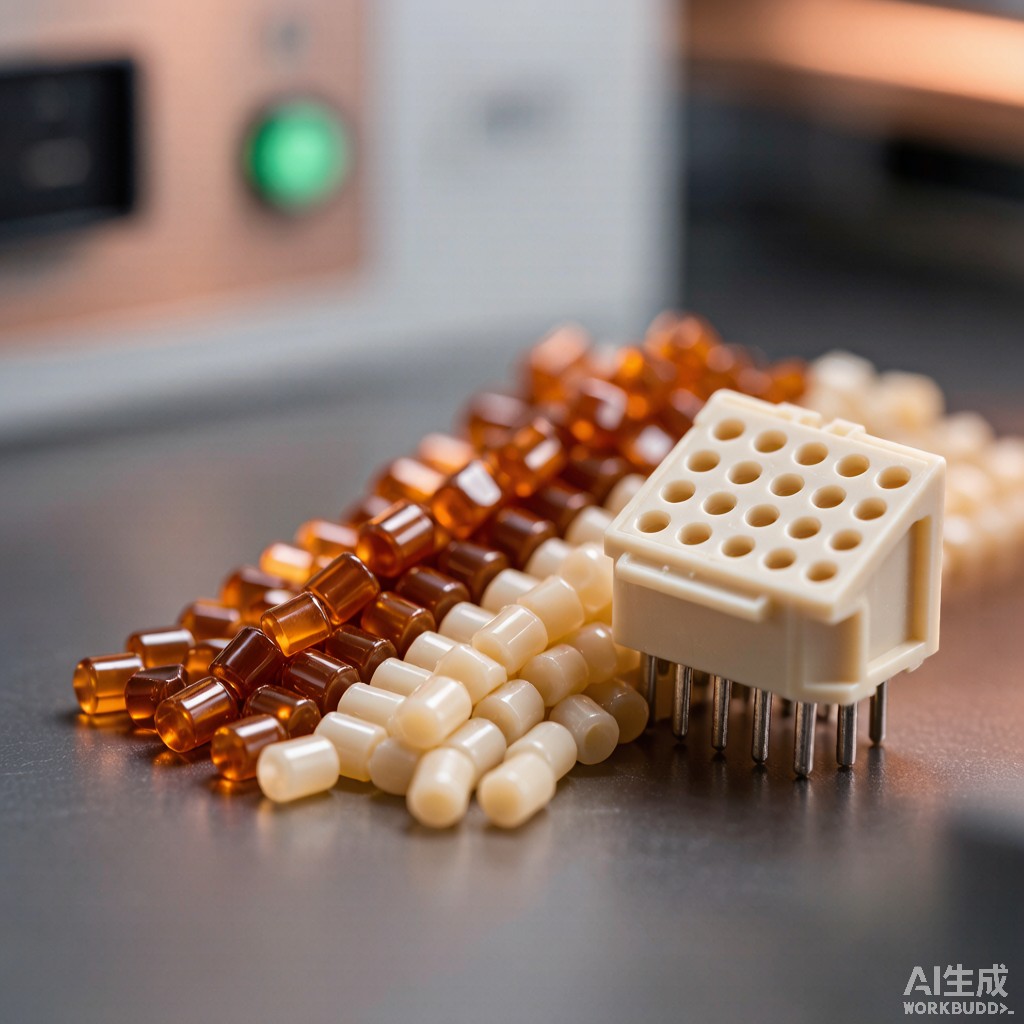
This article examines PEEK modified plastic pellets as a material solution for SMT reflow-compatible electronic co
ector housings, covering thermal performance, mechanical properties, processing characteristics, and a comparative cost-performance analysis against LCP, PPS, and PA46 alternatives.
PEEK Material Fundamentals
Semi-Crystalline High-Performance Thermoplastic
PEEK is a semi-crystalline aromatic thermoplastic with the repeat unit -O-C6H4-O-C6H4-CO-. Its molecular architecture provides an exceptional combination of thermal stability, mechanical strength, and chemical resistance. The key thermal transitions that define PEEK’s suitability for SMT reflow applications:
| Thermal Property | PEEK (Unfilled) | PEEK-GF30 | PEEK-CF30 | LCP-GF30 | PPS-GF40 | PA46-GF30 |
|---|---|---|---|---|---|---|
| Glass Transition (Tg) | 143°C | 143°C | 143°C | 110-120°C | 90°C | 78°C |
| Melting Point (Tm) | 343°C | 343°C | 343°C | 280-335°C | 280°C | 290°C |
| HDT @ 1.8 MPa | 160°C | 315°C | 320°C | 235°C | 260°C | 260°C |
| Continuous Use Temp (RTI) | 250°C | 250°C | 250°C | 200°C | 200-220°C | 150°C |
| CTE (below Tg) | 47 ppm/°C | 22 ppm/°C | 15 ppm/°C | 12 ppm/°C | 20 ppm/°C | 25 ppm/°C |
The critical advantage of PEEK is its HDT of 315-320°C in reinforced grades — well above the 260°C peak reflow temperature of lead-free SAC305 soldering profiles. This means PEEK co
ector housings maintain dimensional stability and mechanical integrity throughout the entire reflow cycle, with no risk of warping, blistering, or contact pin displacement that can occur with LCP or PPS housings during reflow.
Reflow Profile Compatibility
PEEK’s melting point of 343°C provides a 83°C margin above the SAC305 reflow peak (260°C). This margin ensures that the crystalline domains in PEEK do not soften or undergo partial melting during reflow, maintaining full mechanical property retention. By comparison, PPS (Tm 280°C) has only a 20°C margin, and PA46 (Tm 290°C) has a 30°C margin — both materials experience partial crystalline domain softening at reflow peak, which can cause dimensional drift in tightly toleranced co
ector geometries.
The low CTE of PEEK-GF30 (22 ppm/°C) is another critical advantage for SMT reflow compatibility. During reflow, the PCB substrate (CTE 14-17 ppm/°C for FR-4) and the co
ector housing experience different thermal expansion. A CTE mismatch of more than 15-20 ppm/°C can generate sufficient thermomechanical stress to crack solder joints or displace contact pins. PEEK-GF30’s CTE of 22 ppm/°C is well within this tolerance, while LCP-GF30 (12 ppm/°C) actually under-expands relative to FR-4, creating the opposite stress condition.
Mechanical Performance at Elevated Temperature
Property Retention Above Tg
While PEEK’s Tg is 143°C — similar to PPS (90°C) and below LCP (110-120°C) — its crystalline structure provides exceptional mechanical property retention above Tg. The degree of crystallinity in properly processed PEEK is typically 30-35%, and these crystalline domains maintain structural integrity until the melting point (343°C). This means that mechanical properties at 150-250°C — the range experienced during reflow and in high-temperature service — are governed by crystalline domain performance, not amorphous glass transition.
| Mechanical Property | PEEK at 23°C | PEEK at 200°C | % Retention | PPS-GF40 at 200°C | LCP-GF30 at 200°C |
|---|---|---|---|---|---|
| Tensile Strength (MPa) | 100 | 55 | 55% | 60 | 70 |
| Flexural Modulus (GPa) | 4.0 | 2.5 | 63% | 6.0 | 8.0 |
| Flexural Strength (MPa) | 150 | 80 | 53% | 90 | 100 |
| Izod Impact (J/m) | 90 | 45 | 50% | 40 | 35 |
PEEK retains 50-63% of its room-temperature mechanical properties at 200°C — a higher retention rate than many engineering plastics at significantly lower temperatures. For co
ector housings that must maintain contact pin retention force and mechanical integrity during reflow (260°C) and in high-temperature service (150-200°C), this property retention is the key performance differentiator.
Chemical Resistance for SMT Processing
Flux and Cleaning Agent Compatibility
SMT assembly exposes co
ector housings to aggressive chemical environments: no-clean flux residues (containing organic acids, activators, and solvents), aqueous cleaning agents (saponifiers, alkaline detergents), and occasional solvent-based cleaning (isopropyl alcohol, hydrofluorocarbon solvents). PEEK exhibits exceptional chemical resistance across this entire spectrum:
| Chemical Agent | PEEK (30 days @ 85°C) | PPS-GF40 | LCP-GF30 | PA46-GF30 |
|---|---|---|---|---|
| No-clean flux (rosin-based) | No effect | No effect | Minor discoloration | Surface swelling |
| Aqueous cleaning saponifier (pH 11) | No effect | No effect | No effect | Minor swelling |
| Isopropyl alcohol | No effect | No effect | No effect | Crack initiation risk |
| Sulfuric acid (10%) | No effect | No effect | Discoloration | Severe degradation |
| Sodium hydroxide (10%) | No effect | Minor etching | Discoloration | Severe degradation |
PEEK’s broad chemical resistance makes it suitable for applications involving harsh cleaning protocols or exposure to automotive fluids, downhole chemicals, and aerospace hydraulic fluids — environments where PPS and PA46 may exhibit degradation over extended service life.
Injection Molding Parameters
Processing Window and Challenges
PEEK’s high processing temperature (370-400°C barrel temperature) and high melt viscosity require specialized injection molding equipment. Key processing parameters and their recommended values:
| Parameter | PEEK (Unfilled) | PEEK-GF30 | Notes |
|---|---|---|---|
| Barrel Temperature | 370-390°C | 380-400°C | Must exceed Tm (343°C) by 30-60°C for adequate flow |
| Mold Temperature | 175-200°C | 180-200°C | Critical for crystallization; below 170°C gives amorphous parts |
| Injection Pressure | 80-140 MPa | 100-160 MPa | Higher than most engineering plastics |
| Drying Temperature | 150°C for 3-4 h | 150°C for 3-4 h | Moisture must be below 0.02% before processing |
| Cycle Time | 35-55s | 40-60s | Longer than LCP/PPS due to higher crystallization temp |
| Mold Material | Hardened steel (HRC 50+) | Hardened steel + chrome plating | Glass fiber causes significant mold wear |
The mold temperature of 175-200°C is the most critical parameter. Below 170°C, PEEK does not develop adequate crystallinity during cooling, producing amorphous parts with poor mechanical properties and poor chemical resistance. The high mold temperature requirement necessitates oil-heated molds (standard water-heated molds ca
ot reach this temperature), adding equipment cost and complexity.
Cost-Performance Analysis
When PEEK Justifies Its Premium
| Material | Relative Material Cost | Reflow Compatible (260°C) | HDT @ 1.8 MPa | Continuous Use Temp | Typical Application |
|---|---|---|---|---|---|
| PEEK-GF30 | 15-20x | Excellent (63°C margin) | 315°C | 250°C | Aerospace, downhole, automotive power |
| LCP-GF30 | 4-6x | Good (25-75°C margin) | 235°C | 200°C | Consumer electronics, telecom co
ectors |
| PPS-GF40 | 2-3x | Adequate (20°C margin) | 260°C | 200-220°C | Industrial, automotive under-hood |
| PA46-GF30 | 2-3x | Marginal (30°C margin) | 260°C | 150°C | Automotive co
ectors, cost-sensitive |
PEEK’s material cost of 15-20x that of PPS makes it impractical for cost-sensitive consumer electronics. However, for applications where a single field failure costs more than the material cost premium across an entire production run — aerospace avionics, oil and gas downhole electronics, medical implantable devices, and high-reliability automotive power electronics — PEEK’s performance margins provide insurance against thermomechanical failure modes that ca
ot be predicted through accelerated testing alone.
For Southeast Asian SMT manufacturers, PEEK co
ector housings are typically specified by international OEMs for export products targeting aerospace, medical, or automotive powertrain applications. The molding expertise required for PEEK processing is available at specialized facilities in Singapore, Malaysia, and Thailand, though lead times for PEEK pellet procurement can be 8-16 weeks compared to 2-4 weeks for LCP or PPS.
Conclusion
PEEK modified plastic pellets represent the apex of high-temperature thermoplastic performance for SMT reflow-compatible electronic co
ector housings. With an HDT of 315°C in reinforced grades, a 83°C melting point margin above SAC305 reflow peak, 50-63% mechanical property retention at 200°C, and exceptional chemical resistance, PEEK provides reliability margins that no competing material can match. The trade-offs are clear: PEEK costs 15-20x more than PPS, requires specialized high-temperature molding equipment, and demands precise mold temperature control to achieve adequate crystallinity. For applications where the cost of failure exceeds the cost premium — aerospace, downhole, medical, and high-reliability automotive — PEEK is the material of choice that enables co
ector designs operating at the boundary of thermoplastic performance limits.