Introduction
Gold plating on SMT contacts is only as reliable as the nickel underplate beneath it. The nickel layer serves two critical functions: acting as a diffusion barrier that prevents copper from migrating through the gold to the surface (where it oxidizes and increases contact resistance), and providing mechanical support that prevents the thin, soft gold layer from cracking under mating force. Getting the nickel thickness right is a precision engineering decision that balances performance, reliability, and plating cost.
The Metallurgical Role of Nickel Underplate
Diffusion Barrier Function
Gold is an exceptionally poor diffusion barrier. At SMT operating temperatures of 85-125°C, copper atoms from the substrate diffuse through 0.5 μm of gold in approximately 500-1,000 hours, forming a copper oxide (Cu₂O) surface film that increases contact resistance from below 10 mΩ to 100 mΩ or higher. Nickel’s face-centered cubic crystal structure with a lattice parameter of 0.352 nm creates an effective barrier — a properly engineered nickel layer of 2.5 μm thickness extends the copper breakthrough time to well beyond 10,000 hours at 125°C.
Mechanical Support Function
Gold is soft (60-80 HV for pure soft gold, 130-200 HV for hard gold with cobalt or nickel co-deposits). Under the normal force of a co
ector contact (typically 0.5-2.0 N), a thin gold layer without adequate nickel support can crack, exposing the substrate and creating corrosion sites. Nickel underplate with hardness of 450-600 HV (for sulfamate nickel) provides a rigid foundation that distributes contact force and prevents gold layer fracture.
Porosity: The Thickness-Quality Relationship
How Porosity Develops
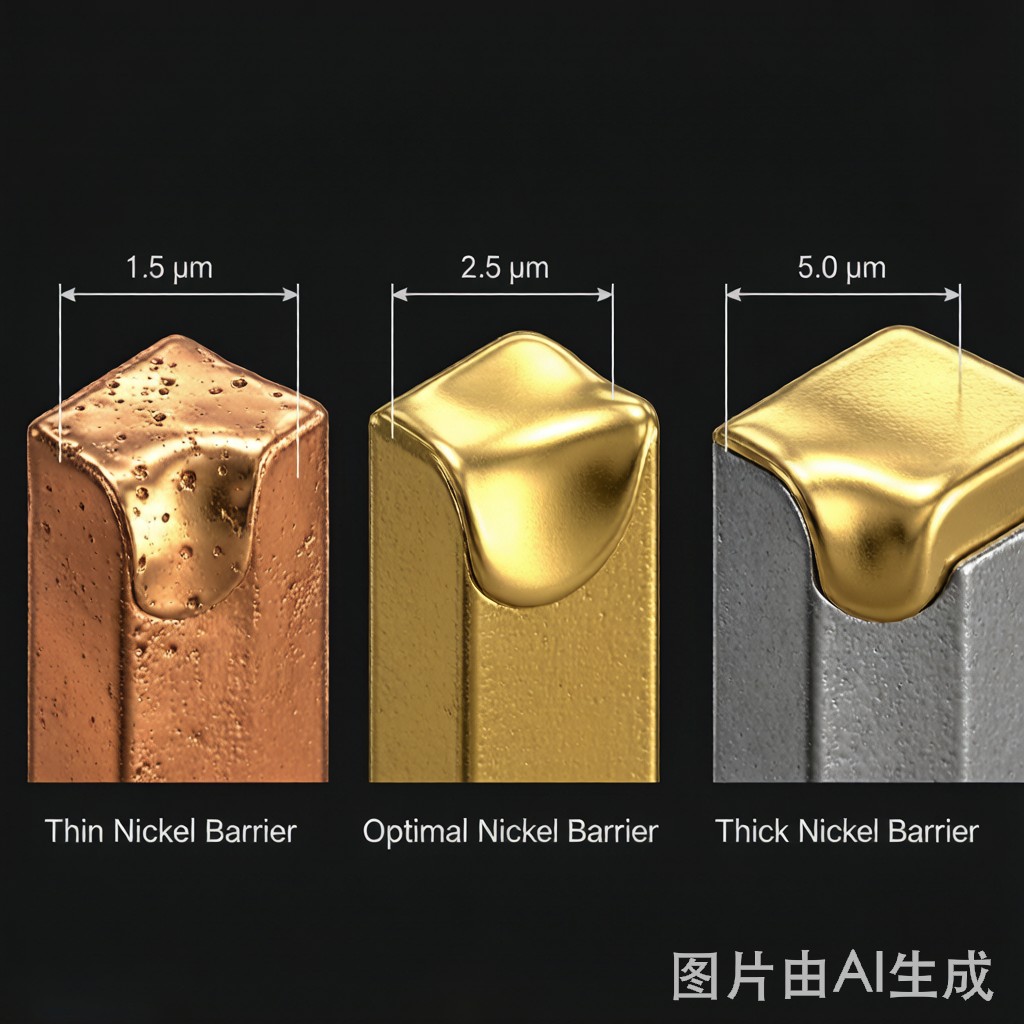
Porosity in gold-plated contacts refers to microscopic pinholes that extend from the gold surface through the nickel underplate to the copper substrate. These pinholes form due to substrate surface roughness, plating bath contamination, or insufficient nickel thickness. The relationship between nickel thickness and porosity is non-linear and follows an exponential decay curve.
| Nickel Thickness | Porosity (pores/cm²) | Suitability |
|---|---|---|
| 0.5 μm | 50-200 | Unsuitable — no effective barrier |
| 1.25 μm | 10-40 | Marginal — consumer electronics only |
| 2.5 μm | 1-5 | Good — standard industrial grade |
| 5.0 μm | 0.1-1 | Excellent — military/aerospace |
ASTM B488 Classification and Selection
ASTM B488 defines gold plating thickness classes for engineering applications. However, the standard assumes a sufficient nickel underplate — typically 1.25-2.5 μm minimum — and does not specify nickel thickness directly. Industry best practice, codified in MIL-DTL-45204D and ASTM B689 for engineering nickel coatings, recommends the following pairings:
Class 1 (0.69 μm Au min): Consumer Electronics
For low-cycle co
ectors (<50 mating cycles) in controlled environments. Nickel underplate: 1.25-2.0 μm minimum. At this thickness, batch-to-batch porosity consistency is the challenge — tight bath chemistry control is essential.
Class 2 (1.25 μm Au min): Industrial/Telecom
For co
ectors with 50-500 mating cycles. Nickel underplate: 2.5-3.75 μm minimum. This is the sweet spot for most SMT co
ector applications. The 2.5 μm barrier thickness eliminates >95% of porosity while adding approximately $0.003-0.005 per contact in plating cost compared to 1.25 μm.
Class 3 (2.0 μm Au min): High-Reliability/Automotive
For co
ectors requiring >500 mating cycles or exposure to corrosive atmospheres (mixed flowing gas per ASTM B845). Nickel underplate: 5.0 μm minimum. The additional nickel provides near-zero porosity and ensures consistent contact resistance over the product lifecycle.
Electroplating Process Considerations
Sulfamate vs. Watts Nickel for Underplate
Nickel sulfamate baths produce deposits with lower internal stress (3-50 MPa tensile) compared to Watts nickel (120-250 MPa tensile). For gold-plated SMT contacts that will experience thermal cycling during reflow soldering, low-stress sulfamate nickel is strongly preferred — high-stress Watts nickel can crack during the 245-260°C reflow peak, fracturing the gold overlay and creating corrosion sites.
Thickness Uniformity Challenges
Achieving uniform nickel thickness across a reel-to-reel plated co
ector strip is non-trivial. Current density variation across the strip width and edge effects can produce thickness ratios of 1.5:1 to 2:1 between high-current-density and low-current-density zones. Specifying a minimum thickness (rather than average) and using auxiliary anodes or shields to improve current distribution is essential for consistent porosity performance.
Cost-Quality Optimization
Nickel plating cost scales approximately linearly with thickness. At $0.12-0.18 per μm per thousand contacts (reel-to-reel process), the difference between 1.25 μm and 5.0 μm is $0.45-0.68 per thousand contacts — negligible for high-reliability products but significant for high-volume consumer co
ectors. The key optimization is specifying the minimum thickness that achieves the required porosity level for the application class, not over-engineering the nickel layer for cost-sensitive products.
Conclusion
Nickel underplate is not a commodity step in gold contact plating — it is the engineering foundation that determines contact reliability. For most SMT co
ector applications, a 2.5 μm minimum sulfamate nickel underplate with ≤5 pores/cm² porosity represents the optimal balance of diffusion barrier effectiveness, mechanical support, and cost. For high-reliability applications, increasing to 5.0 μm provides a near-bulletproof barrier with minimal incremental cost relative to the total co
ector value.