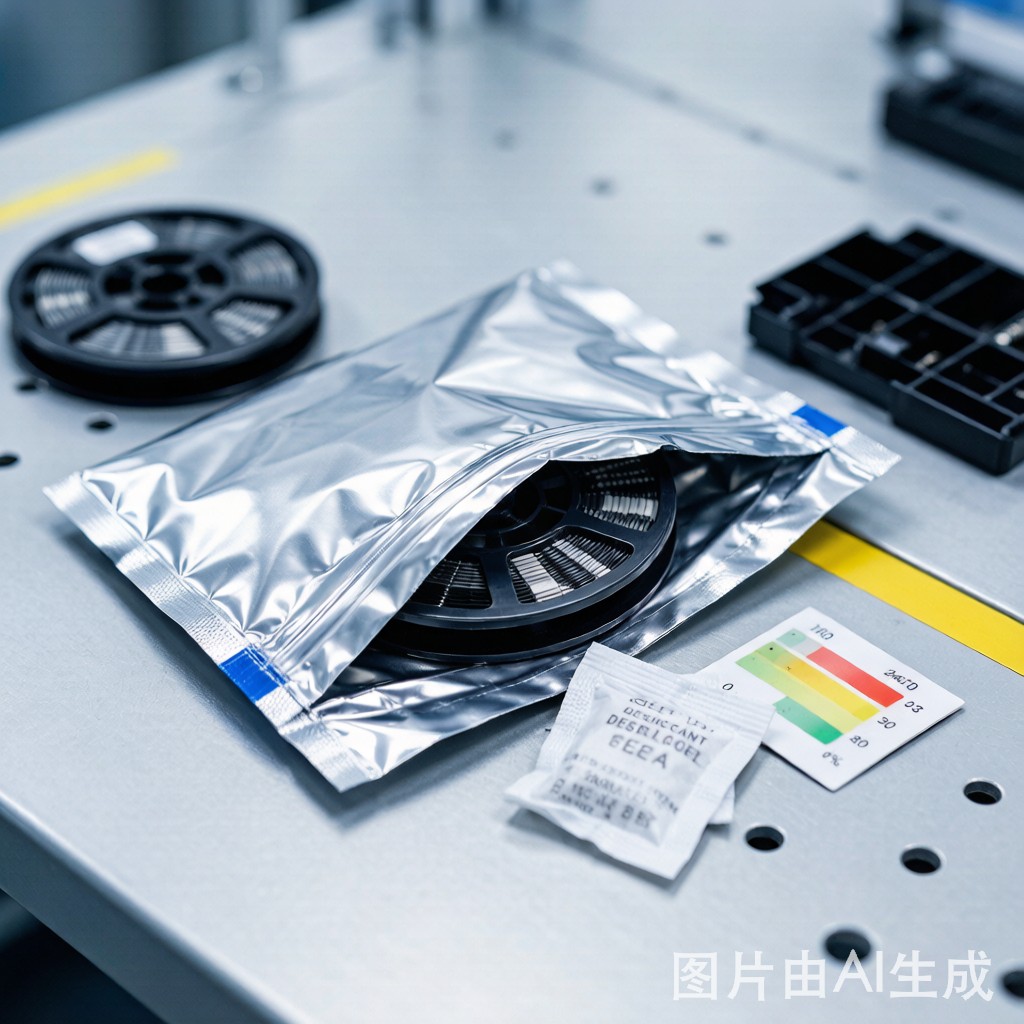
The moisture sensitivity of plastic-packaged SMT components is among the most persistent challenges in electronics manufacturing. When a component classified as MSL 3, 4, 5, or 5a absorbs moisture from ambient air, the absorbed water vaporizes explosively during reflow soldering (at 220–260°C), causing internal delamination — the infamous “popcorn” failure. The primary defense against this failure mode is the moisture barrier bag (MBB), a multi-layer laminate pouch that, together with desiccant and a humidity indicator card, creates a dry micro-environment that protects moisture-sensitive components from the moment they leave the component manufacturer’s dry-pack until they are mounted on the PCB.
MBB Construction: The Multi-Layer Laminate
A moisture barrier bag is not a simple plastic bag. It is a carefully engineered multi-layer laminate designed to provide a specific water vapor transmission rate (WVTR) over a defined shelf life. The standard MBB construction consists of:
- Outer layer — polyester (PET), ~12 μm: Provides abrasion resistance, printability for labeling, and structural integrity. PET has poor moisture barrier properties by itself but protects the barrier layer underneath.
- Barrier layer — aluminum foil, ~7–9 μm: The critical layer. Aluminum foil has a WVTR of essentially zero (< 0.0001 g/m²/24h at 38°C/90% RH) — effectively impermeable to water vapor. This is why MBBs are silver-colored: you are seeing the aluminum foil through the outer layers.
- Middle tie layers — polyethylene (PE) or adhesive, ~12–15 μm each: Bond the aluminum foil to the i
er and outer layers. These tie layers must maintain adhesion through thermal cycling (−40°C to +60°C storage, up to +70°C for some tropical warehouse environments) without delamination.
- I
er layer — static-dissipative polyethylene, ~50–75 μm
: Provides ESD protection (surface resistivity 10⁶–10¹¹ Ω/square per ANSI/ESD S541). This is the layer that contacts the components and must be free of contaminants (amines, amides, silicones) that could transfer to component leads and affect solderability.
The total laminate thickness is typically 100–150 μm. The aluminum foil layer is the most critical — if the foil is cracked, pinholed, or creased during bag manufacturing or handling, the WVTR can increase by orders of magnitude and protection is lost.
MBB WVTR specifications per J-STD-033B:
- Standard MBB: WVTR ≤ 0.02 g/m²/24h at 40°C/90% RH (measured per ASTM F1249).
- High-performance MBB (thicker foil, 12–15 μm): WVTR ≤ 0.005 g/m²/24h. Used for MSL 4–6 components or for 24+ month dry storage.
- Metal-in MBB (vacuum-deposited aluminum on polyester, no foil layer): WVTR 0.01–0.05 g/m²/24h. Lighter weight and transparent, but lower barrier performance than foil-laminate. Not recommended for MSL 4+ components.
Desiccant Calculation: How Much is Enough?
The desiccant inside the MBB absorbs residual moisture in the bag’s internal atmosphere and any moisture that permeates through the bag walls over time. The amount of desiccant required is calculated per J-STD-033B, Section 4.3.2.
J-STD-033 desiccant formula:
Desiccant Units = 0.3048 × (MBB surface area in m²) × (MBB MVTR in g/m²/24h) × (Shelf life in days) ÷ (Desiccant capacity in g)
Where 0.3048 is the conversion factor from the original formula in English units.
Practical desiccant calculation table (standard MBB, WVTR 0.02 g/m²/24h, 12-month shelf life):
| MBB Size (W × L, mm) | Surface Area (m²) | Desiccant Units Required | Typical Pack Configuration |
|---|---|---|---|
| 100 × 150 | 0.030 | 3 | 1 × 3-unit pouch |
| 150 × 250 | 0.075 | 7 | 1 × 5-unit + 1 × 3-unit |
| 200 × 300 | 0.120 | 11 | 1 × 10-unit + 1 × 3-unit |
| 300 × 400 | 0.240 | 22 | 2 × 10-unit + 1 × 3-unit |
| 400 × 500 (large reel bag) | 0.400 | 36 | 2 × 16-unit + 1 × 5-unit |
Desiccant unit definition: One unit of desicrant is the quantity that will absorb 3.0 g of water vapor at 20% RH and 25°C, or 6.0 g of water vapor at 40% RH and 25°C. Standard commercial desiccant pouches are available in 1, 2, 3, 5, 10, and 16 unit sizes. The most common are 3-unit (absorbs 9 g at 20% RH), 5-unit (15 g), and 10-unit (30 g) pouches.
The J-STD-033 formula assumes the desiccant will absorb all ingress moisture and maintain the bag’s internal RH below 10% for the specified shelf life. If the formula result is 10.3 units, use at least 11 units. Rounding down is not permitted.
Humidity Indicator Card (HIC) Reading
The HIC (humidity indicator card) is a paper card with spots impregnated with cobalt chloride (blue when dry) or cobalt-free alternatives (blue/amber when dry) that change color at specific relative humidity thresholds. Standard HIC spot thresholds: 5%, 10%, 15%, 20%, 25%, 30%, 40%, 50%, 60% RH.
HIC reading rules per J-STD-033:
- Before opening: The HIC visible through the transparent portion of the MBB (if provided) or examined immediately upon opening must show the 10% spot as blue (dry). If the 10% spot is pink (moisture detected), the bag’s seal has failed, and the components must be baked before use per J-STD-033 baking tables.
- After opening: The HIC continues to absorb moisture in the open air and will change from blue to pink over minutes to hours. An HIC read after 30 minutes of bag opening is meaningless — it reflects ambient RH, not the bag’s internal history.
- HIC placement: The HIC must be positioned so it is visible through the bag without opening (some MBB have a transparent window) OR placed immediately inside the bag for read-on-opening.
Cobalt-free HICs: Environmental regulations (EU REACH, China GB standards) restrict cobalt chloride in consumer products due to its classification as a suspected carcinogen. Cobalt-free HICs using iron-based or copper-based indicators are available and are becoming the industry standard. The color change from dry to wet is typically blue-to-amber or blue-to-colorless rather than the traditional blue-to-pink.
Vacuum Sealing vs Nitrogen Purge
Two methods are used to remove ambient air from the MBB before sealing:
Vacuum sealing: A vacuum pump evacuates the MBB to approximately −0.8 to −0.9 bar gauge, drawing the bag tightly around the component reel or tray. The vacuum-sealed bag has a distinctive “shrink-wrapped” appearance. Vacuum sealing removes approximately 95–98% of the air inside the bag, along with the moisture it contains. Advantages: visible seal integrity (a bag that has lost vacuum has a leak), simple equipment. Disadvantages: can crush fragile trays, can deform thin reel flanges.
Nitrogen backfill sealing: The bag is evacuated (to approximately −0.5 bar), then backfilled with dry nitrogen (< 50 ppm H₂O, dew point < −50°C) to a slightly positive pressure. The nitrogen displaces the ambient air, and the bag is heat-sealed while still slightly inflated. Advantages: gentler on components, bag is not crushed onto the reel, residual moisture is lower (N₂ is drier than the < 10% residual air in a vacuum bag). Disadvantages: bag is not visually "tight" and it is harder to identify a leak; requires N₂ supply and flow control equipment.
For MSL 3 components in commercial production, vacuum sealing is adequate and is the most common method. For MSL 4–6 components or high-reliability applications (automotive, aerospace, medical), nitrogen backfill is recommended because the residual moisture is lower and the bag environment is inert (no oxygen to oxidize component leads during storage).
Floor Life Management for Tropical Environments
The component’s floor life — the time the component can remain outside the MBB before reflow — is specified for standard conditions (≤ 30°C, ≤ 60% RH per J-STD-020). Southeast Asian factory floors routinely operate at 28–35°C and 70–90% RH, dramatically shortening actual floor life versus the datasheet rating.
Floor life derating factors for tropical environments (based on accelerated moisture absorption testing at Singapore/Malaysia/Thailand contract manufacturers):
| MSL Rating (at 30°C/60% RH) | Floor Life at 30°C/80% RH | Floor Life at 35°C/60% RH |
|---|---|---|
| MSL 3 (168 hours) | 72–96 hours (~50%) | 120–144 hours (~75%) |
| MSL 4 (72 hours) | 24–36 hours | 48–60 hours |
| MSL 5 (48 hours) | 12–24 hours | 24–36 hours |
| MSL 5a (24 hours) | 8–12 hours | 12–18 hours |
| MSL 6 (mandatory bake before use) | N/A — bake always | N/A — bake always |
For a Southeast Asian factory ru
ing a single shift with an 8-hour production day, MSL 3 components can typically be kept out of the MBB for a full shift without issue, even at elevated ambient humidity. For MSL 4 and 5 components, the floor life must be actively tracked with a floor-life clock — a timed countdown from the moment the MBB is opened. When the clock reaches the derated floor-life limit, the components must be either soldered immediately, returned to dry storage (< 10% RH cabinet), or baked.
Dry cabinet storage is the preferred method for storing partially-used component reels between shifts. A dry cabinet maintaining ≤ 5% RH at 25°C can extend the effective floor life indefinitely — a reel placed in dry storage after 4 hours of exposure accrues only 4 hours toward its floor-life limit, and the countdown pauses while the reel is in the cabinet (< 10% RH is considered moisture "bake-out" territory).
Baking: The Last Resort
When the floor life is exceeded or the HIC shows moisture ingress, baking is the corrective action. J-STD-033 specifies baking times and temperatures based on MSL, package thickness, and body size:
| MSL | Package Thickness | Bake at 125°C | Bake at 90°C | Bake at 40°C / ≤ 5% RH |
|---|---|---|---|---|
| MSL 3 | ≤ 1.4 mm | 7 hours | 24 hours | 8 days |
| MSL 3 | 1.4–2.0 mm | 9 hours | 33 hours | 13 days |
| MSL 4 | ≤ 1.4 mm | 11 hours | 37 hours | 15 days |
| MSL 4 | 1.4–2.0 mm | 13 hours | 48 hours | 19 days |
| MSL 5 | ≤ 1.4 mm | 15 hours | 48 hours | 24 days |
| MSL 5a | ≤ 1.4 mm | 19 hours | 62 hours | 31 days |
Important constraints:
- Baking at 125°C is the standard method for through-hole and thick packages, but it can oxidize component leads, degrade the solderability of tin-plated finishes, and cause intermetallic growth in already-formed solder joints on BGA balls. For thin packages (< 1.0 mm), 125°C baking is limited to 48 total hours across the component's lifetime per most component manufacturers' guidelines.
- Baking at 90°C is a lower-risk alternative for thin packages and components with pre-applied solder balls. It takes 3–4× longer but produces less oxidation.
- Baking at 40°C / ≤ 5% RH (low-temperature bake) is the gentlest method and can be performed indefinitely without degrading the component. It requires a specialized low-humidity oven or a continuously-purged nitrogen oven, which costs $5,000–15,000 but pays for itself through reduced component scrap.
- After baking, components must be re-packaged in a fresh MBB with fresh desiccant and HIC within 1 hour of removal from the oven (or 4 hours if stored in a dry cabinet).
MBB Seal Integrity Verification
A properly sealed MBB has no leaks. Three methods verify seal integrity:
- Visual inspection: The heat seal should be uniform, without wrinkles, gaps, or contamination (dust, component leads, tape). A vacuum-sealed bag should remain tight against the contents with no visible re-inflation over time.
- Compression (squeeze) test: Squeeze the sealed bag between two hands. A bag that maintains a slight positive pressure (for N₂-backfilled bags) or remains tight against the contents (for vacuum-sealed bags) is sealed. A bag that deflates or hisses has a leak.
- Water immersion test (for batch qualification): Submerge the sealed MBB in water and observe for 30 seconds. Bubbles from the seal area indicate a leak. This is destructive — the bag is not usable after immersion — and is used for seal-process qualification, not for production parts.
For high-reliability production, a leak rate specification is often included in the component procurement document: MBB leak rate ≤ 1 × 10⁻⁶ atm·cc/s of helium per MIL-STD-883 Method 1014. Testing to this standard requires helium mass spectrometer equipment ($50,000–100,000) and is performed by the MBB manufacturer during qualification, not by the SMT assembly house.
Supplier Qualification Checklist for MBB and Desiccant
When qualifying an MBB and desiccant supplier for the Southeast Asian market, the following checklist ensures compliance:
- MBB WVTR certification (tested per ASTM F1249, ≤ 0.02 g/m²/24h for standard, ≤ 0.005 g/m²/24h for high-performance)
- ESD surface resistivity certification (i
er layer 10⁶–10¹¹ Ω/sq per ANSI/ESD S541)
- Heat seal strength: peel strength ≥ 4.0 N/15 mm width per ASTM F88 after conditioning at 40°C/90% RH for 72 hours
- Desiccant capacity certification: meets or exceeds 3.0 g H₂O per unit at 20% RH, 25°C per MIL-D-3464
- HIC accuracy: spot color change at ±5% RH of indicated value per SAE AS26860
- Outgassing: no volatile condensables that transfer to component leads (GC-MS analysis of bag interior headspace)
- RoHS/REACH compliance: free of restricted substances (cobalt in HIC is the main concern)
The cost of MBB, desiccant, and HIC for a typical SMT component reel is approximately $0.05–0.20 per bag — a trivial cost compared to the component value ($1–500 per reel) and the cost of a popcorn failure ($5–50 in rework/scrap plus potential field reliability impact). For the Southeast Asian electronics supply chain, where tropical humidity is a constant challenge, proper MBB selection and management is not optional — it is a foundational quality practice.