Surface cleanliness is arguably the single most important material property of bare copper strip destined for SMT lead frame and co
ector manufacturing. A copper strip that arrives at the stamping line with residual ionic contamination — chloride from pickling baths, sulfate from electroplating pre-treatment, or sodium from handling — will produce lead frames that fail solderability testing, exhibit poor wire bonding adhesion, and in worst cases, generate electrochemical migration failures in the field. Ionic contamination testing is the quality gate that separates clean, reliable copper strip from material that will cause downstream assembly defects. This article covers the three principal test methods used in copper strip production for the electronics industry: ROSE, SEC, and ion chromatography.
Why Ionic Contamination Matters for Copper Strip
Ionic contaminants on a copper strip surface — whether deposited during manufacturing, cleaning, or handling — create problems at every stage of the SMT assembly chain:
- Solderability degradation: Chloride and sulfate ions accelerate surface oxidation during storage, creating a tarnish film that flux ca
ot fully remove. The result is poor wetting, insufficient hole fill, and non-wet opens in the final assembly.
- Wire bonding failure: For copper lead frames that will be wire-bonded (gold or copper wire), ionic residues reduce the adhesion strength of the bond at the lead frame pad. A few parts-per-million of chloride is enough to reduce pull strength by 30–50%.
- Electrochemical migration (ECM): In the presence of moisture and DC bias, ionic residues form an electrolyte that causes dendritic growth between adjacent leads. Chloride is the most aggressive ECM catalyst, but sulfate and organic acid residues also contribute.
- Plating adhesion loss: Nickel, palladium, or gold plating over an ionically-contaminated copper surface will blister, peel, or develop pinhole porosity during subsequent thermal cycling.
For the Southeast Asian electronics supply chain — where copper strip is shipped internationally, stored in tropical ambient conditions (25–35°C, 70–90% RH), and processed through multiple subcontractor facilities — ionic contamination control is not optional.
ROSE Test: The Industry Workhorse
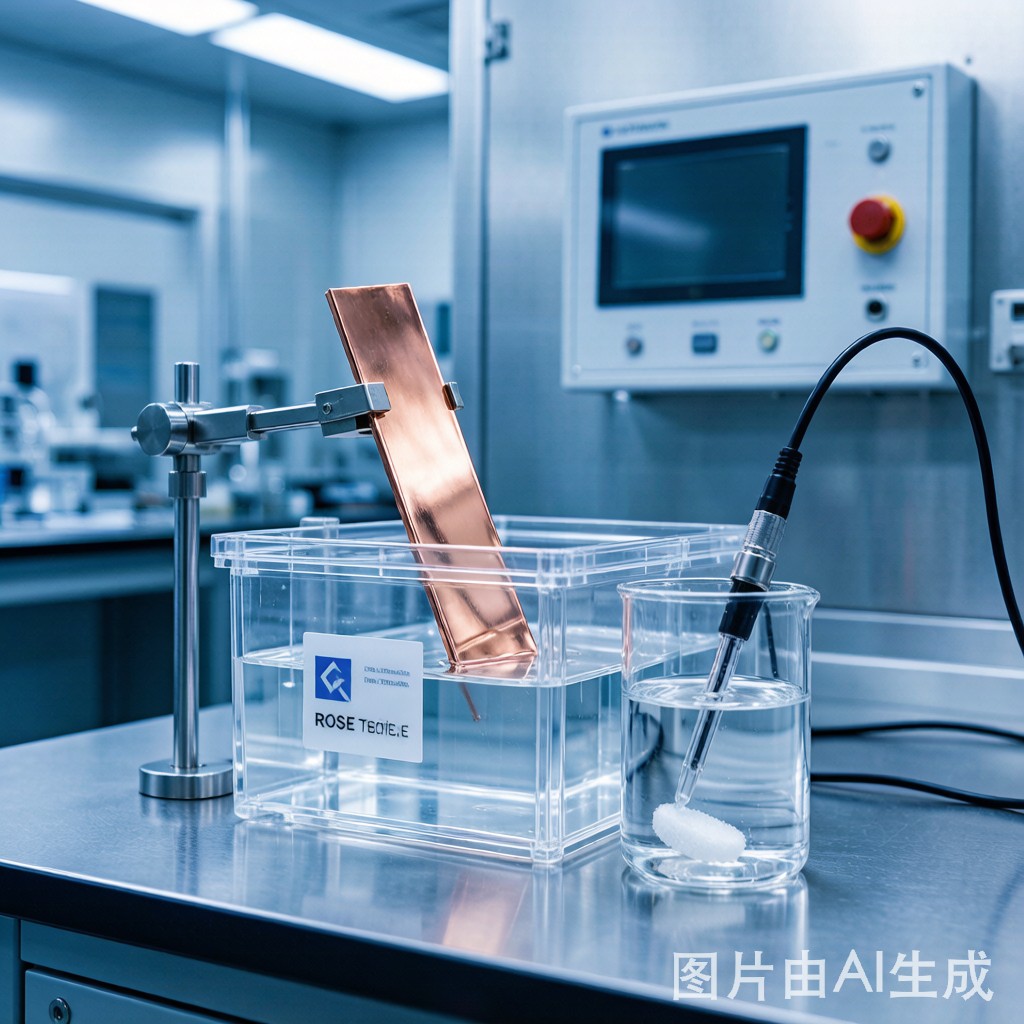
The ROSE test (Resistivity of Solvent Extract) is defined in IPC-TM-650 Method 2.3.25 and is the most widely used ionic contamination test in the PCB and component manufacturing industries. The method:
- A copper strip sample of known surface area (typically 15–100 cm², though standard ROSE equipment is designed for 625 cm² PCB panels and must be adapted for strip geometry) is placed in a test vessel containing a precise volume of 75% isopropyl alcohol (IPA) / 25% deionized water solution.
- The solution is heated to a controlled temperature (typically 40–65°C depending on the equipment — the Omegameter standard is 50°C) to accelerate dissolution of ionic species from the copper surface.
- A conductivity cell immersed in the solution continuously measures its resistivity. As ions dissolve into the solution, the resistivity drops. The instrument monitors the rate of change and terminates the test when the resistivity stabilizes (delta < 0.1 MΩ-cm over 60 seconds of dwell).
- The instrument calculates the total ionic contamination as micrograms of sodium chloride equivalent per square centimeter of surface area (μg NaCl eq/cm²).
Acceptance criteria for bare copper strip:
| Application | ROSE Limit (μg NaCl eq/cm²) | Standard Reference |
|---|---|---|
| Commercial SMT lead frames (standard) | ≤ 1.56 | IPC-6012, Class 2 |
| High-reliability SMT lead frames (automotive, medical) | ≤ 0.78 | IPC-6012, Class 3 |
| Wire-bondable lead frames | ≤ 0.50 | Internal spec, major OSATs |
| Gold plating pre-clean (before Ni/Au strike) | ≤ 0.30 | Plating industry best practice |
The ROSE test is fast (5–15 minutes per sample), uses inexpensive equipment ($5,000–15,000 for a standard Omegameter), and provides a single, quantifiable cleanliness number. Its limitation is that it reports only total ionic contamination — it ca
ot identify which ions are present. A high ROSE reading could be harmless carbonate from atmospheric CO₂ absorption, or it could be aggressive chloride from inadequate rinsing. ROSE alone is a screening tool; it tells you that something is dirty, but not what or why.
SEC (Solvent Extract Conductivity) Method
The SEC method (IPC-TM-650 Method 2.3.25C and J-STD-001) is an evolution of ROSE that uses dynamic extraction and real-time conductivity measurement to differentiate between ionic species by their dissolution rates. Instead of a single endpoint measurement, SEC produces a conductivity-vs-time curve whose shape reveals information about the type of contamination:
- Fast-dissolving species (chlorides, sulfates, nitrates): These show a sharp conductivity rise in the first 1–3 minutes. The peak rate of conductivity increase is proportional to the concentration of highly-soluble ionic species.
- Slow-dissolving species (organic acid salts, weakly-ionized residues, some flux activators): These show a gradual, sustained conductivity increase over 5–15 minutes. The slope of the late-phase curve indicates low-solubility ionic contamination.
- The shape of the curve — a sharp initial rise followed by a flattened tail vs. a gentle, sustained rise — distinguishes between surface-adherent contamination (sharp) and bulk-diffusing contamination from porous surfaces (gentle).
For bare copper strip, the SEC method is particularly useful for distinguishing between contamination from the copper surface (fast-dissolving — chlorides from pickling) and contamination absorbed into the strip’s surface oxide layer (slow-dissolving — from prolonged atmospheric exposure).
Ion Chromatography: The Gold Standard for Speciation
When the ROSE or SEC test reports a high reading and process engineers need to identify the specific ionic species responsible, ion chromatography (IC) is the definitive method. Defined in IPC-TM-650 Method 2.3.28, the IC method:
- Extracts the copper strip sample using the same IPA/water extraction protocol as ROSE.
- The extract solution is injected into an ion chromatograph where an eluent carries it through an ion-exchange column. Cations (Na⁺, K⁺, NH₄⁺) are separated using a cation-exchange column; anions (Cl⁻, Br⁻, SO₄²⁻, NO₃⁻, weak organic acids) are separated using an anion-exchange column.
- A conductivity detector measures each ionic species as it elutes, producing a chromatogram with peaks at characteristic retention times. The area under each peak is proportional to the ion concentration.
- The instrument reports concentration in μg of each ion per cm² of extracted surface area.
Target limits for specific ionic species on bare copper strip (per J-STD-001FS and industry consensus):
| Ionic Species | Limit (μg/cm²) | Source/Risk |
|---|---|---|
| Chloride (Cl⁻) | ≤ 0.50 | Pickling acid, tap water rinse; most aggressive ECM catalyst |
| Bromide (Br⁻) | ≤ 0.50 | Flame retardants, some flux formulations |
| Sulfate (SO₄²⁻) | ≤ 0.75 | Electroplating bath carryover, acid pickling |
| Nitrate (NO₃⁻) | ≤ 1.00 | Atmospheric deposition, chemical brighteners |
| Sodium (Na⁺) | ≤ 1.00 | Handling, tap water, perspiration |
| Potassium (K⁺) | ≤ 1.00 | Handling, flux activators |
| Weak organic acids (WOAs) | ≤ 1.50 | Flux residue from pre-ti
ing, cleaning solvent residue |
The capital cost for IC is significant ($40,000–80,000 for a mid-range system, plus $100–200 per sample in consumables and labor), so it is used for root-cause analysis, supplier qualification, and high-reliability production rather than routine incoming inspection. Most copper strip suppliers and contract manufacturers outsource IC testing to independent analytical laboratories at $150–300 per sample.
Correlating Contamination Test Results with Solderability
The relationship between ionic contamination test results and solderability performance is well established. A study of bare copper strip for QFP and QFN lead frames (published in the SMTA Journal, 2024) found:
- ROSE < 0.50 μg NaCl eq/cm²: 100% solderability pass rate (solder bath dip test per J-STD-002) after 8 hours of steam aging. Zero non-wet opens in production.
- ROSE 0.50–1.56 μg NaCl eq/cm²: 92–97% pass rate after 8 hours steam aging. Intermittent non-wet defects, especially on fine-pitch leads (< 0.4 mm pitch).
- ROSE > 1.56 μg NaCl eq/cm²: 60–80% pass rate after steam aging. Frequent non-wet defects, dewetting, and solder balling. Material rejected per IPC J-STD-001.
- Chloride > 0.50 μg/cm² by IC: Wire bond pull strength drops below the 5-gram minimum for 25 μm gold wire, even when plating adhesion otherwise appears adequate.
Practical Testing Protocol for Incoming Copper Strip Inspection
For a Southeast Asian SMT component manufacturer receiving bare copper strip from multiple suppliers, a cost-effective incoming inspection protocol might be:
- Stage 1 — ROSE screening (every shipment, every coil): One ROSE test per supplier lot. Pass/fail at 1.56 μg NaCl eq/cm² for commercial grade, 0.78 μg NaCl eq/cm² for automotive grade. ROSE instrument cost amortized at $0.50–2.00 per test.
- Stage 2 — SEC profiling (monthly per supplier): One SEC test per supplier per month to trend the dissolution curve shape. A change in curve shape (e.g., sharper initial peak) triggers Stage 3 investigation even if the ROSE value is within specification.
- Stage 3 — Ion chromatography (quarterly per supplier, or on ROSE fail): IC speciation to identify the offending ion. Used for supplier corrective action and process improvement, not for lot acceptance or rejection.
- Stage 4 — Solderability verification (a
ually or on supplier change)
: Full J-STD-002 solderability test (solder bath dip with steam aging) on material that passed ROSE. Confirms that the ROSE limit is adequate for the specific copper alloy, surface finish, and flux chemistry used in production.
The total cost of this protocol per supplier per year is approximately $2,000–5,000, which is an order of magnitude less than the cost of a single lot rejection or a field failure caused by contaminated copper strip. For any manufacturer shipping product into the automotive, medical, or aerospace supply chains, the economics of ionic contamination testing are unarguable.