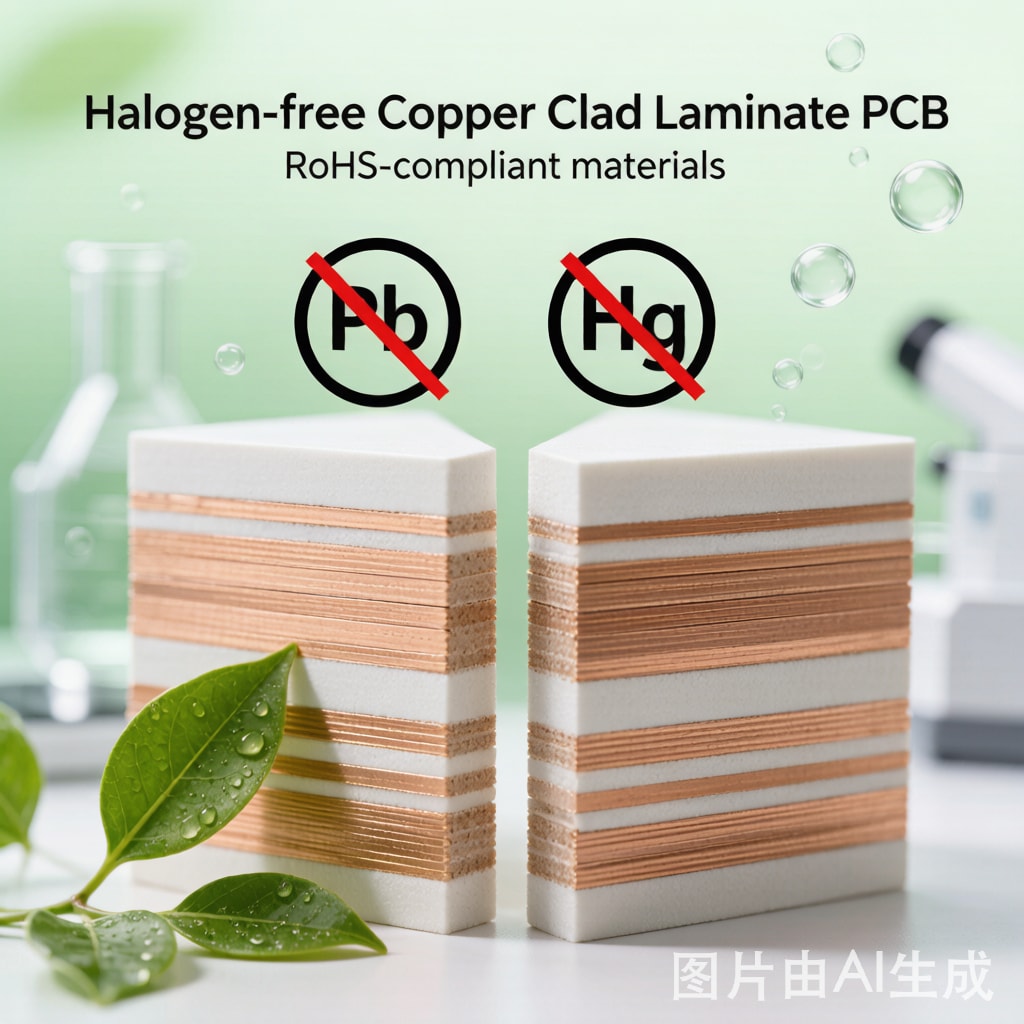
The global electronics industry’s transition to halogen-free materials represents one of the most significant shifts in PCB manufacturing since the lead-free soldering mandate. For SMT assembly operations serving the Southeast Asian and international markets, understanding halogen-free copper clad laminate (CCL) options is essential for RoHS compliance and market access.
The IEC 61249-2-21 standard defines halogen-free as containing less than 900 ppm chlorine, 900 ppm bromine, and 1500 ppm total halogens. This article provides a practical selection guide for engineers and procurement professionals evaluating halogen-free CCL materials.
Why Halogen-Free Matters
Traditional FR-4 laminates use brominated epoxy resins (typically tetrabromobisphenol-A, TBBPA) as flame retardants, constituting 15–20% of the resin weight. While highly effective at suppressing combustion, brominated flame retardants generate corrosive hydrogen bromide gas and toxic polybrominated dibenzodioxins/furans (PBDD/F) during incineration or uncontrolled fires.
Halogen-free laminates replace brominated flame retardants with phosphorus-based, nitrogen-based, or inorganic filler systems that achieve equivalent flame retardancy (UL 94 V-0 rating) without halogen chemistry.
Halogen-Free Resin Systems
1. Phosphorus-Based Epoxy
The most widely adopted halogen-free system incorporates reactive phosphorus compounds (typically 2–3% phosphorus by weight) into the epoxy backbone. During combustion, the phosphorus promotes char formation—a carbonaceous layer that insulates the underlying polymer and starves the flame of fuel.
Advantages: Process compatibility with standard FR-4 manufacturing (same pressing temperature, similar drilling parameters), good mechanical properties, and wide supplier availability.
Limitations: Slightly lower decomposition temperature (Td typically 320–340°C vs. 340–360°C for brominated FR-4), requiring careful lead-free reflow profiling to avoid delamination at peak temperatures above 260°C.
2. Benzoxazine-Modified Epoxy
Benzoxazine resins offer inherently flame-retardant properties through their nitrogen-containing heterocyclic structure. When blended with epoxy, they provide high Tg (170–190°C) and excellent thermal stability (Td > 360°C).
Advantages: Superior thermal performance, low moisture absorption (0.1–0.15% after 24-hour water immersion), and near-zero cure shrinkage for dimensional stability.
Limitations: Higher material cost (30–50% premium over phosphorus-based epoxy) and more brittle mechanical properties requiring careful handling during depaneling.
3. Hydrocarbon with Inorganic Fillers
Used primarily in high-frequency applications, hydrocarbon-based laminates (PTFE, PPE, or hydrocarbon-ceramic composites) achieve flame retardancy through high loading of inorganic fillers such as aluminum hydroxide (ATH) or magnesium hydroxide (MDH).
Advantages: Excellent dielectric properties (Dk 3.0–3.8, Df 0.002–0.005 at 10 GHz), low moisture absorption, and inherent UL 94 V-0 rating.
Limitations: Higher material cost, reduced copper peel strength (0.8–1.0 N/mm vs. 1.2–1.5 N/mm for epoxy systems), and specialized drilling/plating processes required.
Key Selection Parameters
| Parameter | Phosphorus Epoxy | Benzoxazine Epoxy | Hydrocarbon+Filler |
|---|---|---|---|
| Tg (DSC) | 140–160°C | 170–190°C | 180–220°C |
| Td (5% weight loss) | 320–340°C | 360–380°C | 380–400°C |
| CTE Z-axis (pre-Tg) | 45–55 ppm/°C | 35–45 ppm/°C | 30–40 ppm/°C |
| Dk @ 1 GHz | 4.3–4.6 | 4.0–4.3 | 3.0–3.8 |
| Copper peel strength | 1.2–1.5 N/mm | 1.1–1.3 N/mm | 0.8–1.0 N/mm |
| Relative cost | 1.0× (baseline) | 1.3–1.5× | 1.5–3.0× |
SMT Assembly Considerations
Halogen-free laminates require adjustments to standard SMT assembly processes:
Reflow profiling: Phosphorus-based systems demand tighter peak temperature control (maximum 255–260°C) due to lower Td. Benzoxazine and hydrocarbon systems tolerate standard lead-free profiles (peak 245–260°C) with wider margins.
Moisture sensitivity: Despite lower bulk moisture absorption, some halogen-free laminates exhibit higher moisture absorption rates during the first 24 hours of exposure. Extended baking (125°C for 4–6 hours) may be necessary before reflow for boards stored in humid tropical environments.
Via reliability: The lower CTE of benzoxazine and hydrocarbon systems (30–45 ppm/°C Z-axis) provides superior plated through-hole reliability compared to standard FR-4 (50–70 ppm/°C), particularly for thick boards (>2.4 mm) and high layer counts (>12 layers).
Compliance and Certification
When specifying halogen-free CCL, request supplier certification to IPC-4101E slash sheets that explicitly call out halogen-free variants (e.g., /126 for halogen-free FR-4). Third-party testing per IEC 62321 (determination of halogens by combustion ion chromatography) provides verification of chlorine and bromine content below the 900 ppm threshold for each element.
Conclusion
The halogen-free CCL market has matured significantly, with phosphorus-based epoxy systems offering a cost-effective drop-in replacement for traditional FR-4. For higher-performance applications, benzoxazine-modified and hydrocarbon-based laminates deliver superior thermal and electrical properties. When selecting materials, consider the complete supply chain—from laminate supplier certification through SMT assembly compatibility to end-product environmental compliance documentation.