Introduction
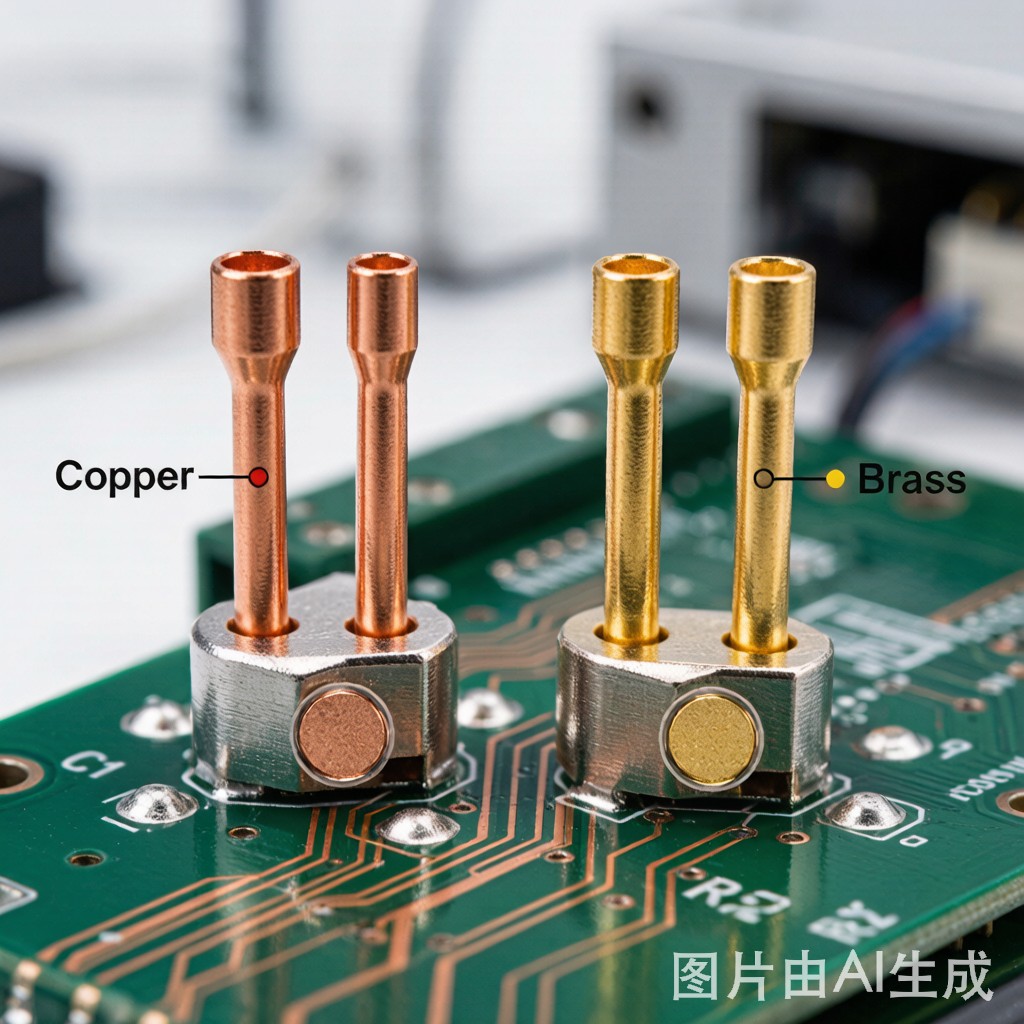
Selecting between copper and brass for SMT terminal pins is a fundamental material decision that affects co
ector performance, manufacturing cost, and long-term reliability. While pure copper offers superior electrical conductivity, brass (copper-zinc alloy) provides better machinability, higher strength, and often lower material cost. For electronics manufacturers in Southeast Asia’s humid tropical climate, this decision carries additional weight due to corrosion considerations.
Electrical Conductivity: The Core Differentiator
Copper: The Benchmark at 100% IACS
Pure copper (C11000, electrolytic tough pitch) defines the International A
ealed Copper Standard (IACS) at 100% conductivity — approximately 58 MS/m at 20°C. For SMT terminal pins carrying signal or low-power currents, this translates to minimal resistive heating and negligible voltage drop across the co
ector interface. In high-current applications such as power supply co
ectors or EV charging interfaces, copper’s superior conductivity directly reduces I²R losses and thermal management requirements.
Brass: 26-28% IACS Depending on Alloy
Common brass alloys for SMT terminals — C2680 (65% Cu, 35% Zn) and C2600 (70% Cu, 30% Zn) — achieve only 26-28% IACS conductivity. For signal-level currents under 1A, this difference is negligible. However, for terminals carrying 5A or more, the 3.5-4× higher resistivity means brass pins will operate 15-20°C hotter than equivalent copper pins at the same current, which can accelerate oxidation and reduce co
ector lifespan.
Mechanical Properties: Strength vs. Ductility
| Property | Pure Copper (C11000) | Brass C2680 (65/35) | Brass C2600 (70/30) |
|---|---|---|---|
| Tensile Strength | 220-310 MPa | 350-500 MPa | 330-470 MPa |
| Yield Strength | 70-250 MPa | 150-380 MPa | 130-350 MPa |
| Elongation | 5-45% | 3-40% | 5-40% |
| Hardness (HV) | 50-110 | 90-160 | 80-150 |
| Contact Normal Force Retention | Fair (stress relaxation at >100°C) | Good | Good |
Brass terminals maintain higher contact normal force over time due to superior yield strength and reduced stress relaxation, making them preferred for co
ector applications where insertion/withdrawal cycles exceed 100 mating cycles. Copper’s superior ductility, however, makes it the material of choice for crimp-type terminals and pins requiring significant post-stamping forming.
Corrosion Resistance in Tropical Environments
The Southeast Asian Challenge
Southeast Asia’s combination of high humidity (70-90% RH year-round), elevated temperatures (28-35°C ambient), and airborne saline in coastal manufacturing zones creates an aggressive corrosion environment for bare copper and brass terminals. Pure copper forms a protective patina (Cu₂O/CuO) that stabilizes after 3-6 months, but the initial bright copper surface is highly reactive and can develop non-conductive oxide films that increase contact resistance by 50-100 mΩ within weeks of exposure.
Brass: Dezincification Risk
Brass alloys with zinc content above 15% are susceptible to dezincification — a selective corrosion mechanism where zinc leaches out of the alloy matrix, leaving behind a porous, mechanically weak copper sponge. In tropical environments with condensation cycling, C2680 (35% Zn) terminals can show dezincification depths of 10-25 μm after 12 months of exposure. C2600 (30% Zn) offers marginally better resistance. For long-term reliability in unplated conditions, copper is the safer choice unless brass terminals receive a protective nickel or tin plating.
Cost Analysis
Brass C2680 strip typically costs 75-85% of equivalent pure copper strip on a weight basis in the Southeast Asian market. However, total cost of ownership must account for plating requirements. If the application already requires nickel or tin plating for solderability, brass becomes the clear cost wi
er. If terminals can be used bare (e.g., in hermetically sealed co
ectors), copper’s lower resistivity and better corrosion behavior may justify the premium.
Decision Framework
| Application | Recommended Material | Rationale |
|---|---|---|
| High-current (>5A) power pins | Copper | Lower I²R heating, better thermal stability |
| High-cycle co
ectors |
Brass | Superior normal force retention |
| Signal pins (<1A) | Brass (plated) | Adequate conductivity, lower cost |
| Outdoor/high-humidity | Copper (or plated brass) | No dezincification risk |
Conclusion
Neither copper nor brass is universally superior for SMT terminal pins. Copper wins on electrical and thermal conductivity, making it essential for power applications. Brass wins on mechanical strength and cost, making it ideal for high-volume signal co
ectors — provided adequate plating protects against dezincification in tropical environments. The smartest approach is application-specific selection based on the electrical, mechanical, and environmental demands of each co
ector design.