Introduction
Copper strip flatness is a critical quality parameter in SMT lead frame manufacturing. Shape defects such as edge wave, center buckle, and coil set—introduced during cold rolling and coiling—can cause feed misregistration, stamping burrs, and dimensional nonconformance in progressive die operations. Tension leveling is the most effective industrial process for eliminating these defects and achieving the tight flatness tolerances required for high-speed SMT production lines.
Common Copper Strip Shape Defects
After cold rolling and recoiling, copper strip exhibits several characteristic shape defects that must be corrected before stamping:
Edge Wave
Edge wave occurs when the strip edges are longer than the center, causing wavy edges that buckle under zero tension. This typically results from uneven roll gap profiles or thermal gradients across the roll face during rolling. Edge wave is quantified using the I-unit (ε = (π·h/2L)²), where h is the wave amplitude and L is the wavelength. I-unit values above 5 indicate visible edge wave requiring correction.
Center Buckle
Center buckle (also called full center) is the opposite condition—the center of the strip is longer than the edges, causing the middle to pucker. This defect is particularly problematic for SMT lead frames because it causes uneven die contact during stamping, leading to inconsistent burr height across the strip width.
Coil Set
Coil set is the residual curvature from the coiling process, where the strip tends to curl toward the i
er diameter. For SMT lead frames, coil set must be eliminated because it causes misalignment in the stamping feeder and inconsistent lead coplanarity after forming.
| Defect Type | I-Unit Range | Impact on SMT Stamping |
|---|---|---|
| Edge Wave | 5–30 | Feeder misregistration, edge burr variation |
| Center Buckle | 5–25 | Uneven die clearance, center burr |
| Coil Set | N/A (curvature) | Lead coplanarity failure, feed pitch error |
| Cross Bow | 3–15 | Transverse curvature, guide pin jam |
Tension Leveling Process Principle
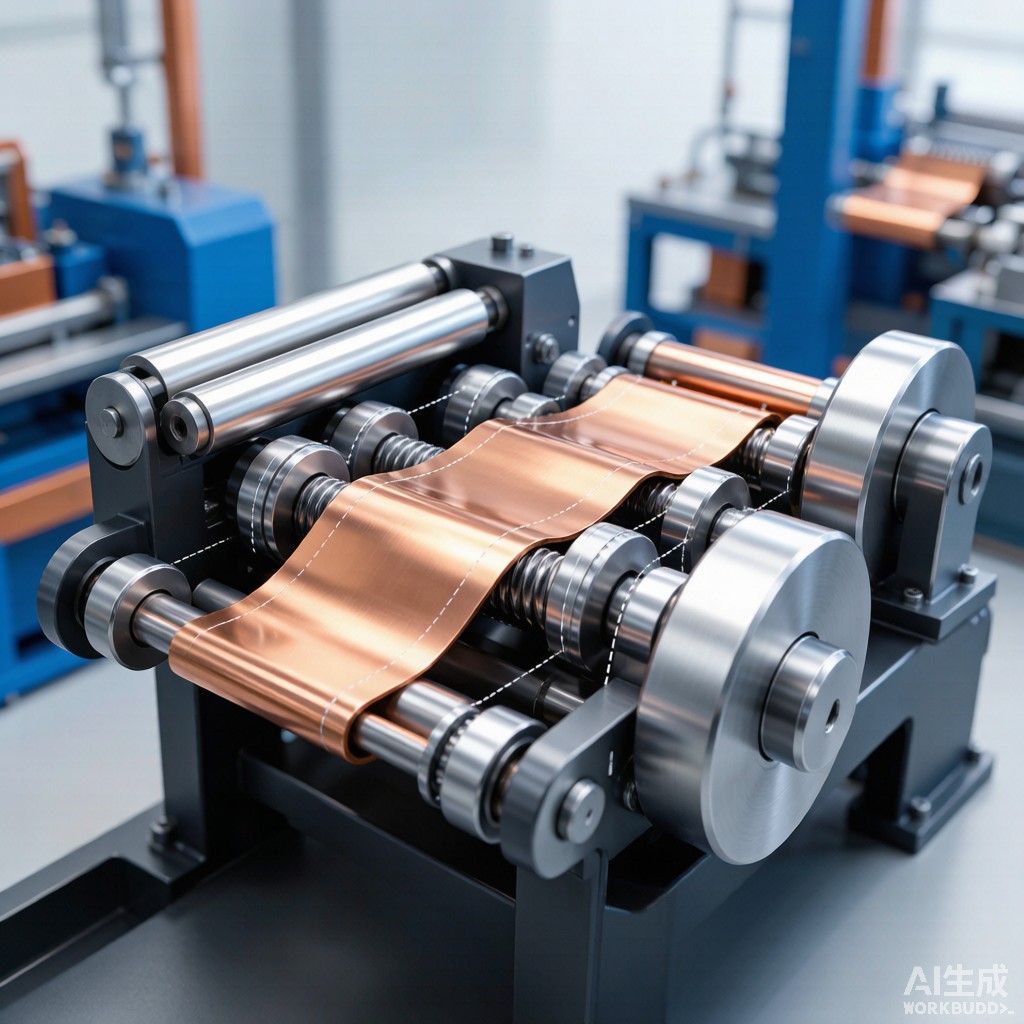
Tension leveling combines longitudinal tension with alternating bending to permanently remove shape defects. The strip passes through a series of bend rollers under applied tension, causing the fibers to exceed their yield point in alternation. This plastic deformation resets the internal stress distribution, producing a flat strip.
The key process parameters are:
- Elongation rate: 0.3%–2.0% depending on defect severity and material temper. For C11000 copper in H02 temper, 0.5%–1.0% elongation is typical.
- Tension level: 30%–70% of the material yield strength. For C11000 H02 (YS ≈ 280 MPa), the tension ranges from 84 to 196 MPa.
- Bend roller diameter: 20–40mm for 0.1–0.5mm strip thickness. Smaller rollers produce more plastic strain per pass but increase surface marking risk.
- Number of bend rollers: 11–23 rollers in a typical leveling machine, with more rollers providing finer correction.
Tension Leveling vs Roll Leveling vs Stretch Bend Leveling
Three main leveling technologies are used for copper strip, each with distinct capabilities:
| Parameter | Roll Leveling | Tension Leveling | Stretch Bend Leveling |
|---|---|---|---|
| Mechanism | Alternating bend only | Tension + alternating bend | Tension + small bend |
| Elongation | 0%–0.3% | 0.3%–2.0% | 0.5%–3.0% |
| Edge wave correction | Limited | Excellent | Excellent |
| Center buckle correction | Moderate | Excellent | Good |
| Coil set removal | Good | Excellent | Excellent |
| Surface marking | Low risk | Low–moderate | Very low risk |
| Suitable for SMT | No (insufficient) | Yes (standard) | Yes (premium) |
Flatness Measurement and Acceptance Criteria
After tension leveling, strip flatness is measured using non-contact laser displacement sensors or optical flatness gauges. The standard measurement method involves sca
ing the strip surface at multiple positions across the width while the strip is under minimal tension (5–10 N).
SMT Lead Frame Flatness Requirements
| Application | Max Flatness Deviation | Strip Thickness |
|---|---|---|
| QFP lead frames | 0.05mm/m | 0.10–0.15mm |
| QFN lead frames | 0.05mm/m | 0.15–0.20mm |
| Power module lead frames | 0.10mm/m | 0.30–0.80mm |
| Co
ector stamping |
0.08mm/m | 0.20–0.50mm |
Process Optimization for Different Copper Alloys
Different copper alloys require adjusted tension leveling parameters due to their varying yield strengths and work-hardening behaviors:
- C11000 (pure copper): Low yield strength (70–350 MPa depending on temper), easy to level. Elongation 0.3%–0.8% for H02 temper.
- C19400 (Cu-Fe-P): Higher yield strength (330–520 MPa), requires higher tension. Elongation 0.5%–1.2%.
- C51900 (phosphor bronze): High springback due to high elastic modulus. Requires 0.8%–1.5% elongation with increased tension.
- C7521 (nickel silver): Very high yield strength, requires maximum elongation (1.0%–2.0%) and careful roller diameter selection to avoid surface marking.
Conclusion
Tension leveling is an indispensable process for achieving the flatness tolerances required in SMT copper strip applications. By combining controlled longitudinal tension with alternating bending, the process permanently eliminates edge wave, center buckle, and coil set defects that would otherwise compromise stamping accuracy and lead frame quality. For manufacturers in Southeast Asia serving the global SMT supply chain, investing in proper tension leveling capability directly translates to higher stamping yields, reduced tool wear, and improved lead frame dimensional compliance with IPC standards.