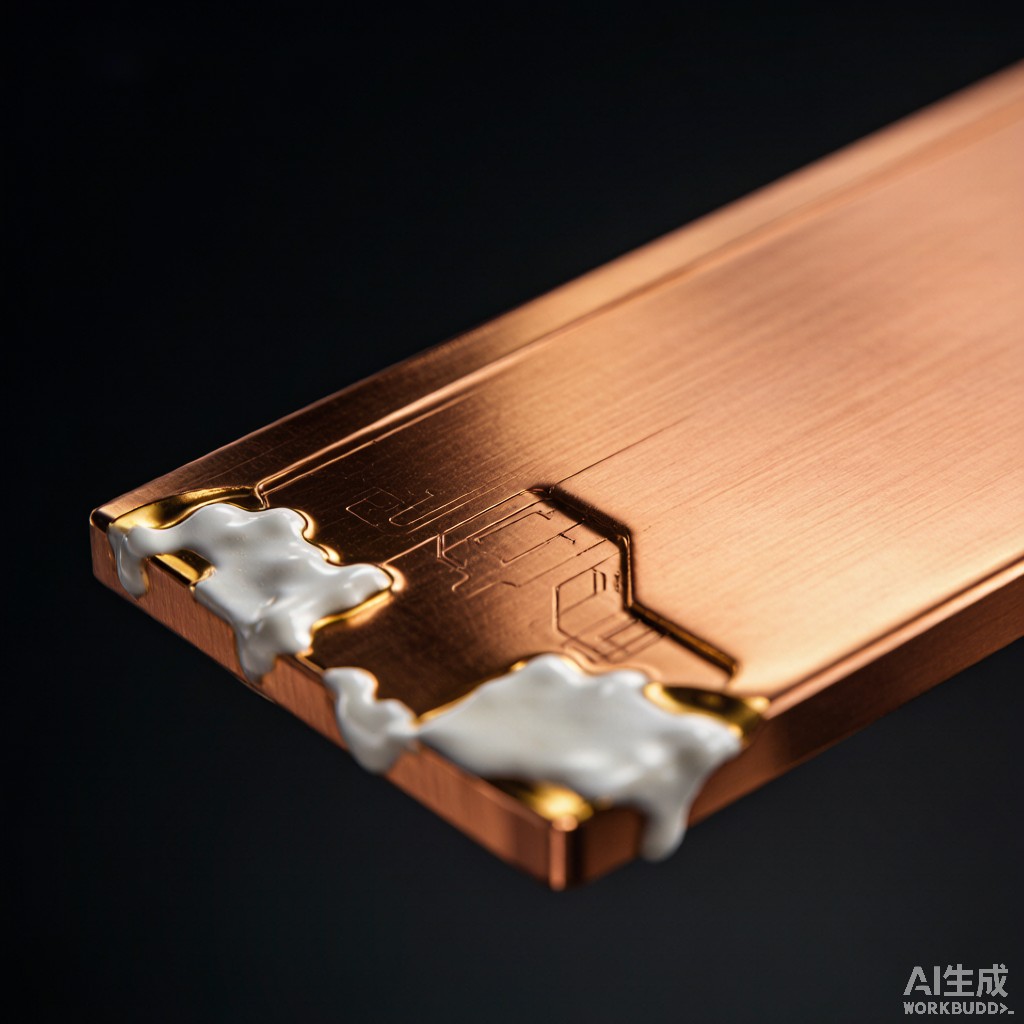
The surface finish applied to copper strip in SMT lead frame manufacturing determines solder joint integrity, wire bond yield, and long-term reliability in field deployment. For electronics destined for Southeast Asian tropical climates, where sustained 75-95% relative humidity and 30-40°C ambient temperatures accelerate corrosion mechanisms, the finish selection becomes a critical reliability decision rather than a cost optimization exercise. This article provides an engineering comparison of the four most prevalent surface finishes applied to C11000 (ETP copper) and C19400 (CuFe2.3) copper strip: Electroless Nickel Immersion Gold (ENIG), Electroless Nickel Electroless Palladium Immersion Gold (ENEPIG), Organic Solderability Preservative (OSP), and Immersion Tin (ImSn).
Surface Finish Fundamentals
ENIG: The Industry Workhorse
ENIG deposits a 3-6 µm electroless nickel-phosphorus layer (typically 9-12% P, amorphous structure) followed by 0.05-0.10 µm immersion gold. The nickel serves as a diffusion barrier preventing copper migration, while gold protects nickel from oxidation and provides a solderable surface. On C11000 copper strip, the ENIG deposition rate is 18-25 µm/hour at 85-90°C pH 4.8-5.2 bath. The immersion gold step is a galvanic displacement reaction that self-limits at 0.05-0.12 µm once the underlying nickel is fully covered. Key reliability concerns include ‘black pad’ defect—phosphorus enrichment at the nickel-gold interface causing brittle interfacial fracture—and gold embrittlement in solder joints when gold content exceeds 3 wt% of the joint.
ENEPIG: Premium Multi-Layer Finish
ENEPIG adds a 0.05-0.20 µm electroless palladium layer between nickel and gold. The palladium layer eliminates the black pad failure mode by replacing the displacement reaction with an autocatalytic deposition, producing a uniform, pore-free barrier. ENEPIG on C19400 copper strip enables both gold wire bonding (with 0.05 µm hard gold cap) and aluminum wire bonding (with 0.10-0.20 µm palladium surface). The additional palladium layer adds $0.8-1.5 per square meter of strip surface but eliminates $50-200 per million parts in wire bond failure costs at SMT assembly.
OSP: Cost-Effective Organic Coating
OSP applies a 0.2-0.6 µm azole-based organic film (imidazole, benzimidazole, or phenylimidazole derivatives) that bonds to exposed copper through nitrogen coordinate bonds, forming a Cu-azole complex. OSP is the lowest-cost finish ($0.05-0.15 per m²) and is planar—critical for fine-pitch SMT assembly. However, OSP degrades through thermal cycles: each reflow pass removes 30-50% of the coating thickness, limiting OSP to single or double reflow applications before solderability degrades below IPC J-STD-003B acceptance criteria.
Immersion Tin (ImSn)
ImSn deposits 0.8-1.2 µm of tin via displacement reaction with copper (Sn²⁺ + Cu → Sn + Cu²⁺). The finish is planar, solderable, and compatible with press-fit co
ectors. The critical concern is tin whisker formation—spontaneous growth of single-crystal tin filaments 1-50 µm diameter and up to several millimeters long—driven by compressive stress in the intermetallic Cu₆Sn₅ layer. Mitigation requires 2-3% bismuth alloying or post-deposit reflow at 235°C to relieve stress.
Solder Wettability Testing
Wetting Balance Method (IPC J-STD-003B)
The wetting balance method (Meniscograph) measures force-time curves as a coupon is immersed in molten solder at 245°C. Key metrics include:
- Zero cross time (T₀): Time to transition from buoyancy to positive wetting force. Acceptance: <1.0s for Class 3 (high-reliability), <2.0s for Class 2.
- Maximum wetting force (Fmax): Acceptance: >150 µN/mm for copper strip samples.
- Wetting rate (dF/dt): Slope of force curve at inflection. Higher values indicate faster wetting, critical for high-throughput SMT.
Comparative Results by Finish
| Finish | T₀ (s) | Fmax (µN/mm) | Shelf Life (months) | Reflow Cycles |
|---|---|---|---|---|
| ENIG | 0.4-0.8 | 220-280 | 12-18 | 3-4 |
| ENEPIG | 0.3-0.7 | 230-300 | 18-24 | 4-5 |
| OSP | 0.6-1.2 | 180-240 | 6-12 | 1-2 |
| ImSn | 0.5-0.9 | 200-260 | 9-15 | 2-3 |
Tropical Climate Corrosion Resistance
Mixed Flowing Gas (MFG) Testing per ASTM B827
Southeast Asian tropical environments expose electronics to Class IIIA severity: 50-75% RH, 30-40°C, with ppb-level H₂S (10-50 ppb), SO₂ (20-100 ppb), and Cl₂ (5-20 ppb) from industrial and vehicular emissions. MFG testing at 40°C/75% RH with 100 ppb H₂S + 100 ppb SO₂ + 20 ppb Cl₂ + 200 ppb NO₂ for 10 days simulates 5-7 years of field exposure. Post-exposure solder wettability retention:
- ENIG: 85-92% of baseline Fmax. Minor gold surface dulling, no underlying nickel corrosion.
- ENEPIG: 90-95% retention. Palladium barrier prevents sulfur attack on nickel.
- OSP: 40-65% retention. Azole film degraded by acid gases, exposed copper shows visible tarnish and Cu₂O/CuS formation.
- ImSn: 70-85% retention. SnO₂/SnS formation increases surface resistance; Cu₆Sn₅ intermetallic growth continues at 30°C.
Creep Corrosion on OSP
OSP-finished copper strip in tropical climates is susceptible to creep corrosion—lateral migration of copper sulfide/chloride corrosion products across the surface at 0.1-1.0 mm/year. This phenomenon, documented in field returns from Singapore and Malaysia data centers, can bridge 0.20 mm gaps between conductors within 12-24 months. ENIG and ENEPIG are immune due to the nickel barrier. ImSn shows moderate susceptibility at pores in the tin layer.
Wire Bond Reliability
Gold Wire Bonding (25 µm diameter)
For wire-bonded packages, finish selection directly affects bond pull strength and failure mode distribution:
- ENIG: Pull strength 8-12 gf. Failure mode: heel break (70%), neck break (20%), interfacial lift (10%). Immersion gold is too soft and porous for consistent thermosonic bonding at 200°C.
- ENEPIG: Pull strength 10-14 gf. Failure mode: heel break (85%), neck break (10%), interfacial lift (5%). Palladium layer enables intermetallic Au-Pd bond formation with superior interfacial strength.
- OSP: Not compatible with gold wire bonding. Exposed copper oxidizes within minutes at bonding temperature, preventing intermetallic formation.
- ImSn: Limited compatibility. Tin-gold intermetallic (AuSn₄) formation is brittle; bond strength degrades 20-30% after 500 hours at 150°C aging.
Cost and Selection Decision Matrix
| Application | Recommended Finish | Rationale |
|---|---|---|
| High-reliability automotive (AEC-Q200) | ENEPIG | Wire bond + tropical corrosion + multiple reflow |
| Consumer mobile (single reflow) | OSP | Lowest cost, planar for fine pitch, adequate shelf life |
| Industrial/telecom (tropical deployment) | ENIG | Balanced cost and corrosion resistance, no whisker risk |
| Press-fit co
ector |
ImSn | Planar, compatible with press-fit, lower cost than ENIG |
For copper strip lead frames destined for Southeast Asian deployment where 75-95% humidity, 30-40°C ambient, and industrial air pollutants present sustained corrosion risk, ENEPIG delivers the highest reliability margin—particularly for applications requiring gold wire bonding. The $0.8-1.5 per m² premium over ENIG is justified by the elimination of black pad risk, superior wire bond yield, and 18-24 month shelf life that accommodates extended supply chains common in regional electronics manufacturing.