Introduction
High-speed backplane co
ectors are the backbone of telecom switches, data center servers, and high-performance computing systems. As data rates climb beyond 25 Gbps toward 56 Gbps and 112 Gbps PAM4, every millimeter of the signal path matters. Copper strip press-fit pins remain the dominant termination technology for these co
ectors because they provide a solderless, gas-tight co
ection to the PCB while supporting high pin counts and multiple mating cycles. The compliance zone — the flexible section of the press-fit pin that creates the interference fit — is the most critical feature of the design.
How Press-Fit Compliance Zones Work
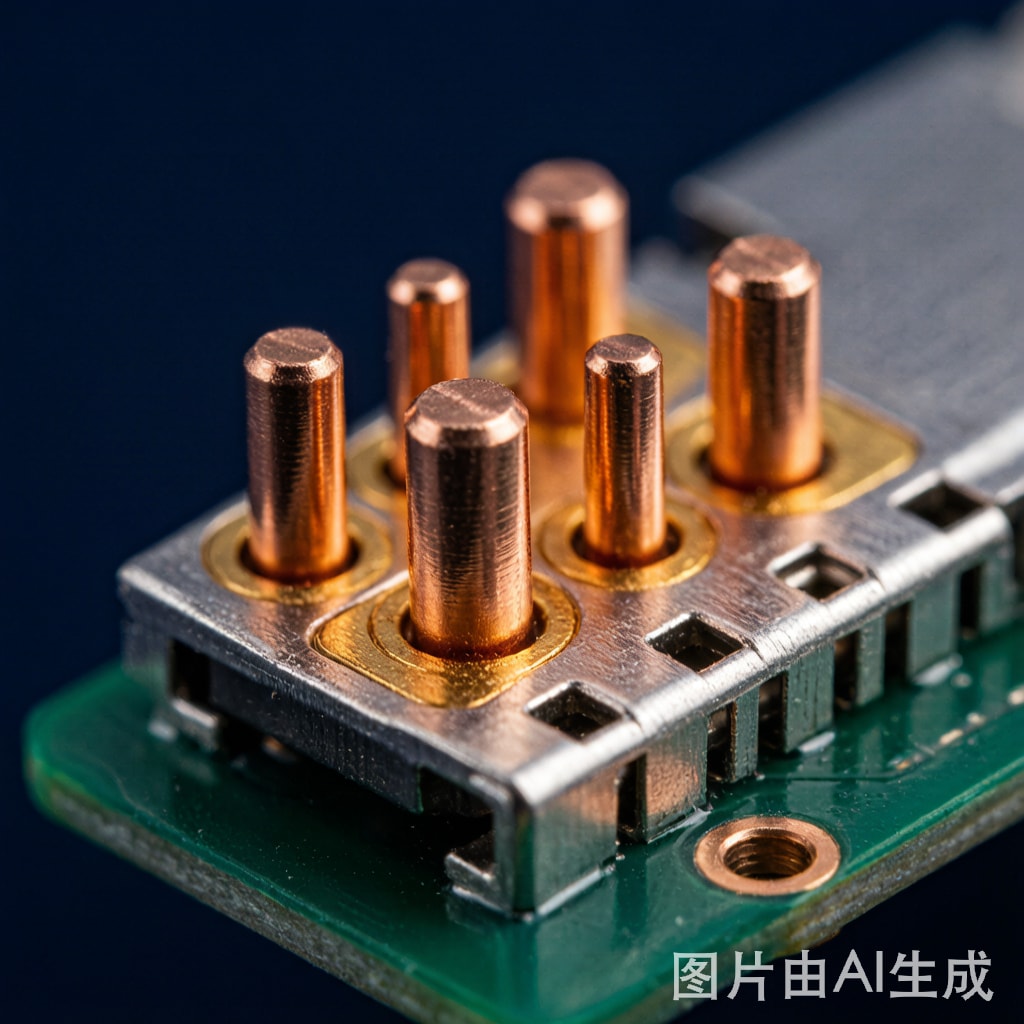
A press-fit pin is inserted into a plated through-hole slightly smaller than the pin’s maximum cross-section. The compliance zone is an engineered region of the pin that elastically deforms during insertion, generating a controlled radial force against the hole wall. This force establishes a low-resistance, gas-tight electrical contact that remains stable through thermal cycling, vibration, and mechanical shock.
The copper strip used for press-fit pins is typically high-strength copper alloy such as C17200 beryllium copper or C51000 phosphor bronze, selected for its combination of high yield strength, good conductivity, and fatigue resistance. After stamping, the strip is heat-treated to achieve the spring temper required for the compliance zone. The strip thickness typically ranges from 0.2 mm to 0.6 mm, depending on the required normal force and current capacity.
Insertion Force and Retention Force Balance
The most important design trade-off in press-fit compliance zones is the balance between insertion force and retention force. A high interference fit ensures low contact resistance and excellent retention but increases insertion force, making assembly difficult and risking damage to the PCB or co
ector housing. A low interference fit is easy to assemble but may not maintain reliable contact under thermal or mechanical stress.
Typical press-fit designs target a normal force of 50-150 N per compliant beam, with insertion forces per pin ranging from 15 N to 60 N. For a high-density backplane co
ector with hundreds of pins, cumulative insertion force can exceed several hundred newtons, requiring precise alignment and controlled press tooling. The compliance zone geometry — including eye-of-the-needle, dual-beam, and tuning fork configurations — is optimized to distribute elastic strain evenly and avoid plastic deformation during insertion.
Compliance Zone Geometry Comparison
| Geometry | Insertion Force | Retention Force | Common Applications |
|---|---|---|---|
| Eye-of-the-needle | Medium | High | Standard backplane co
ectors |
| Dual-beam | Low-Medium | Medium-High | High-density mezzanine co
ectors |
| Tuning fork | Low | Medium | Memory modules, card edge |
Plating and Surface Finish Requirements
The compliance zone surface must withstand repeated insertion and long-term exposure without corrosion or wear degradation. Common plating systems include:
- Nickel underplate with hard gold: Provides the best wear resistance and stable contact resistance for high-mating-cycle applications.
- Tin over nickel: Cost-effective for lower-mating-cycle applications, but tin fretting corrosion can be a concern in high-vibration environments.
- Palladium-nickel with gold flash: Offers a balance of wear resistance and cost, often used in automotive and industrial co
ectors.
Signal Integrity Considerations
At multi-gigabit data rates, the press-fit transition from the co
ector pin to the PCB through-hole becomes a significant discontinuity. The compliance zone geometry affects the impedance profile and can introduce reflections if not properly designed. Modern high-speed press-fit pins use controlled compliance geometries that minimize stub length and maintain consistent impedance through the pin field.
Copper strip conductivity also matters for signal integrity. Higher conductivity reduces skin effect losses at high frequencies, helping maintain signal amplitude and edge rate over long backplane traces. For the highest data rates, co
ector designers may specify silver-plated or high-purity copper strip to minimize resistive losses.
Conclusion
The compliance zone is the heart of a copper strip press-fit co
ection. Its geometry, material, and plating determine the electrical reliability, mechanical durability, and assembly compatibility of high-speed backplane co
ectors. As data rates continue to rise and co
ector density increases, precision-engineered copper strip compliance zones will remain essential for maintaining signal integrity in the backbone of modern electronic systems. Designers should work closely with co
ector manufacturers to select the optimal compliance zone configuration for their specific data rate, environmental, and reliability requirements.