Introduction
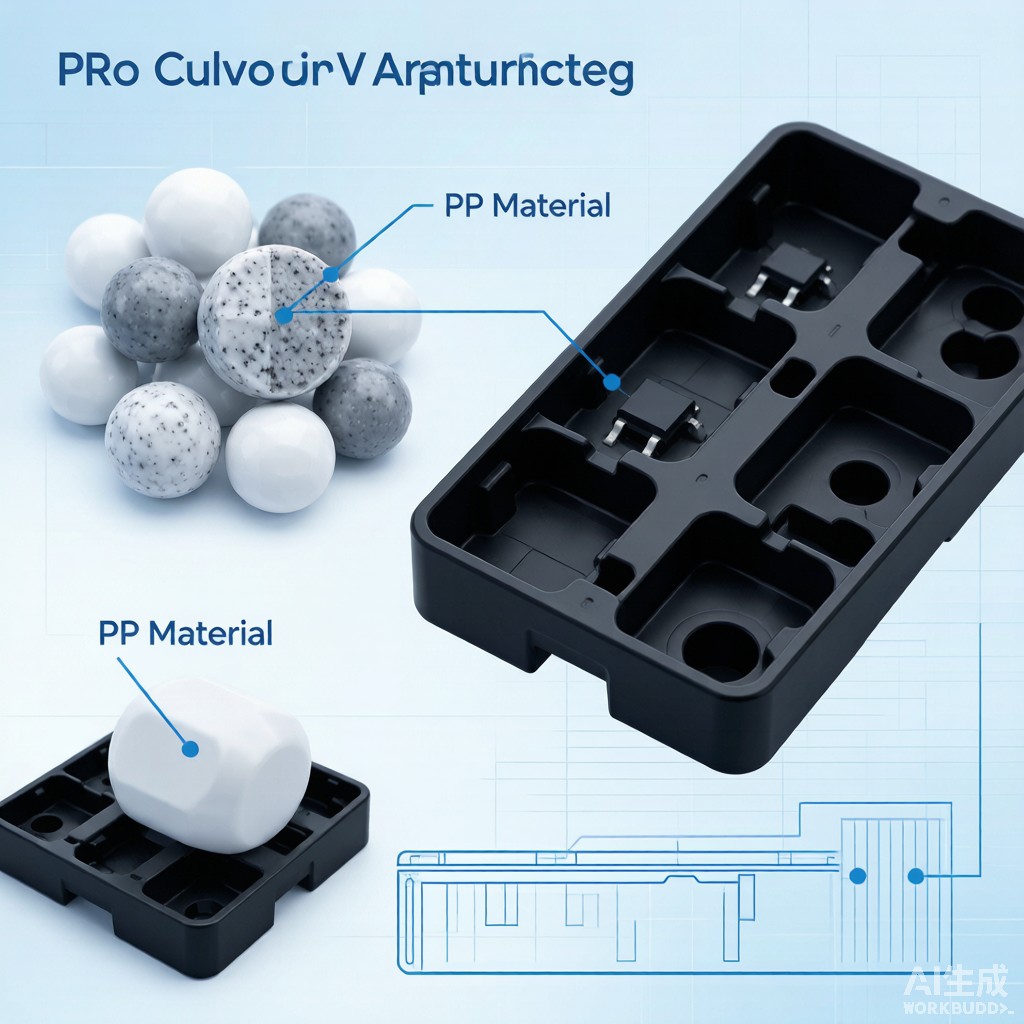
Injection-molded packaging trays are essential for SMT component handling, transport, and automated pick-and-place feeding. These trays must maintain precise cavity dimensions under thermal cycling, stacking loads, and humid storage conditions. Warpage—the most common defect in injection-molded trays—causes cavity misalignment, component jamming in pick-up nozzles, and stacking instability. Mineral-filled polypropylene (PP) pellets offer a cost-effective solution that dramatically reduces warpage while maintaining the mechanical strength and chemical resistance required for SMT packaging applications.
Why Mineral-Filled PP for SMT Trays?
Unfilled polypropylene has several limitations for precision tray molding:
- High mold shrinkage: 1.5–2.5%, causing dimensional variation
- Anisotropic shrinkage: Differential shrinkage in flow vs cross-flow directions causes warpage
- Low heat deflection temperature: 90–100°C (at 0.45 MPa), limiting use in thermal cycling
- High thermal expansion: CTE of 100–150 μm/m·°C, causing dimensional drift with temperature
Mineral fillers—primarily talc, calcium carbonate (CaCO₃), and barium sulfate (BaSO₄)—address these limitations by:
- Reducing overall shrinkage proportionally to filler loading
- Reducing anisotropic shrinkage by constraining polymer chain orientation
- Increasing HDT by 20–40°C depending on filler type and loading
- Reducing CTE by 30–60%
Mineral Filler Types and Properties
| Filler Type | Density (g/cm³) | Aspect Ratio | Typical Loading (%) | Shrinkage Reduction | Key Advantage |
|---|---|---|---|---|---|
| Talc | 2.75 | 5–20 (platy) | 20–40 | 40–70% | Best warpage control |
| CaCO₃ (ground) | 2.71 | 1–3 (equant) | 20–40 | 25–50% | Lowest cost, good surface |
| CaCO₃ (precipitated) | 2.65 | 1–2 | 15–30 | 20–40% | Excellent surface finish |
| Barium sulfate | 4.48 | 1–3 | 20–35 | 30–55% | X-ray opaque, high density |
| Wollastonite | 2.90 | 3–15 (acicular) | 15–30 | 30–50% | Mechanical reinforcement |
Talc: The Preferred Filler for Low-Warpage Trays
Talc (Mg₃Si₄O₁₀(OH)₂) is the most effective filler for warpage reduction due to its platy (lamellar) morphology. The high aspect ratio platelets align parallel to the mold surface during injection, constraining shrinkage in the flow direction while maintaining isotropic behavior in the transverse direction. This dramatically reduces the differential shrinkage that causes warpage.
Mechanical and Thermal Properties by Filler Loading
| Property | PP (unfilled) | PP + 20% Talc | PP + 30% Talc | PP + 40% Talc |
|---|---|---|---|---|
| Mold shrinkage (%) | 1.8 | 1.1 | 0.8 | 0.6 |
| Warpage (mm/m) | 8–15 | 3–5 | 1.5–3 | 0.5–1.5 |
| HDT @ 0.45MPa (°C) | 95 | 115 | 125 | 132 |
| CTE (μm/m·°C) | 120 | 80 | 65 | 50 |
| Flexural modulus (MPa) | 1,400 | 2,200 | 2,800 | 3,500 |
| Tensile strength (MPa) | 32 | 30 | 28 | 25 |
| Notched Izod (J/m) | 35 | 28 | 22 | 18 |
Note that while filler loading improves dimensional stability and stiffness, it reduces tensile strength and impact resistance. For SMT packaging trays, the optimal loading is typically 20–30% talc, which provides sufficient warpage control without excessive embrittlement.
Injection Molding Process Optimization
Drying Requirements
Unlike nylon or polycarbonate, polypropylene is hygroscopic only to a minimal degree (0.01–0.03% moisture absorption). However, mineral fillers can adsorb surface moisture during storage. A pre-drying step of 80–90°C for 1–2 hours is recommended to prevent surface defects (splay marks, silver streaking).
Molding Parameters for Mineral-Filled PP Trays
| Parameter | PP (unfilled) | PP + 30% Talc | Notes |
|---|---|---|---|
| Melt temperature (°C) | 200–230 | 210–240 | Higher temp needed for filled |
| Mold temperature (°C) | 20–40 | 30–50 | Higher mold temp improves surface |
| Injection pressure (MPa) | 60–90 | 80–120 | Higher viscosity requires more pressure |
| Injection speed | Medium-fast | Medium | Reduce speed to prevent jetting |
| Cooling time (s) | 15–25 | 12–20 | Faster cooling due to lower CTE |
| Cycle time (s) | 35–50 | 30–45 | 5–15% shorter cycle |
Cavity Dimensioning
When designing molds for mineral-filled PP trays, the mold shrinkage value must be adjusted from the unfilled PP standard. For PP + 30% talc, the mold shrinkage is 0.8% (vs 1.8% for unfilled PP). Cavity dimensions must be scaled by a factor of 1/(1-shrinkage) = 1/0.992 = 1.00806. This means a 100mm cavity should be cut to 100.81mm to achieve the target dimension after shrinkage.
Tray Design for SMT Component Packaging
Cavity Precision Requirements
| Component Package | Cavity Tolerance (mm) | Wall Thickness (mm) | Tray Material |
|---|---|---|---|
| 01005 (0402 metric) | ±0.05 | 0.8 | PP + 30% talc |
| 0603 | ±0.08 | 1.0 | PP + 20% talc |
| QFN (3×3mm) | ±0.10 | 1.2 | PP + 20% talc |
| BGA (15×15mm) | ±0.15 | 1.5 | PP + 20% CaCO₃ |
| QFP (28×28mm) | ±0.20 | 2.0 | PP + 15% CaCO₃ |
Stacking Features
SMT trays must stack securely without damaging components in lower trays. Mineral-filled PP provides the dimensional stability needed for consistent stacking features:
- Stacking ribs: 0.5mm protrusion on tray bottom, matched with recess on top surface. Warpage must be below 1mm/m for reliable stacking.
- Corner alignment pegs: 3mm diameter, ±0.1mm tolerance. Requires the low warpage of 30% talc-filled PP.
- Anti-static treatment: Carbon black or permanent anti-static additive (1–3%) for ESD-sensitive components.
Tropical Climate Performance
For Southeast Asian SMT manufacturing, the tropical climate affects tray performance:
- Moisture absorption: PP absorbs only 0.01–0.03% moisture (vs 0.5–2.5% for nylon), making it ideal for humid environments. Mineral-filled PP shows no measurable dimensional change from humidity.
- Thermal cycling: Warehouse temperatures in SE Asia can range from 25°C (night) to 45°C (daytime storage). The low CTE of mineral-filled PP (50–80 μm/m·°C) limits dimensional drift to less than 0.1mm per 100mm over a 20°C range.
- UV exposure: For trays stored in sunlit areas, adding 0.5% carbon black provides sufficient UV protection. Talc-filled PP without UV stabilizer shows surface chalking after 500 hours of UV exposure.
Cost Analysis
| Material | Cost ($/kg) | Density (g/cm³) | Cost per tray ($) | Warpage (mm/m) |
|---|---|---|---|---|
| PP unfilled | 1.40 | 0.91 | 0.28 | 8–15 |
| PP + 20% talc | 1.55 | 1.04 | 0.33 | 3–5 |
| PP + 30% talc | 1.65 | 1.13 | 0.38 | 1.5–3 |
| PS (crystal) | 1.70 | 1.05 | 0.36 | 5–8 |
| PC | 3.50 | 1.20 | 0.84 | 2–4 |
Mineral-filled PP provides the best cost-to-warpage-performance ratio for SMT packaging trays. At 30% talc loading, warpage is reduced by 80–90% compared to unfilled PP, at only a 35% cost premium—far more economical than polycarbonate alternatives.
Conclusion
Mineral-filled polypropylene pellets—particularly talc-filled grades at 20–30% loading—offer SMT packaging tray manufacturers an optimal combination of low warpage, dimensional stability, thermal resistance, and cost-effectiveness. The platy morphology of talc dramatically reduces anisotropic shrinkage, enabling the tight cavity tolerances required for automated pick-and-place handling of miniaturized SMT components. For Southeast Asian manufacturers, the minimal moisture absorption and low CTE of mineral-filled PP make it particularly suited for tropical climate operations, ensuring reliable tray performance throughout the component supply chain.