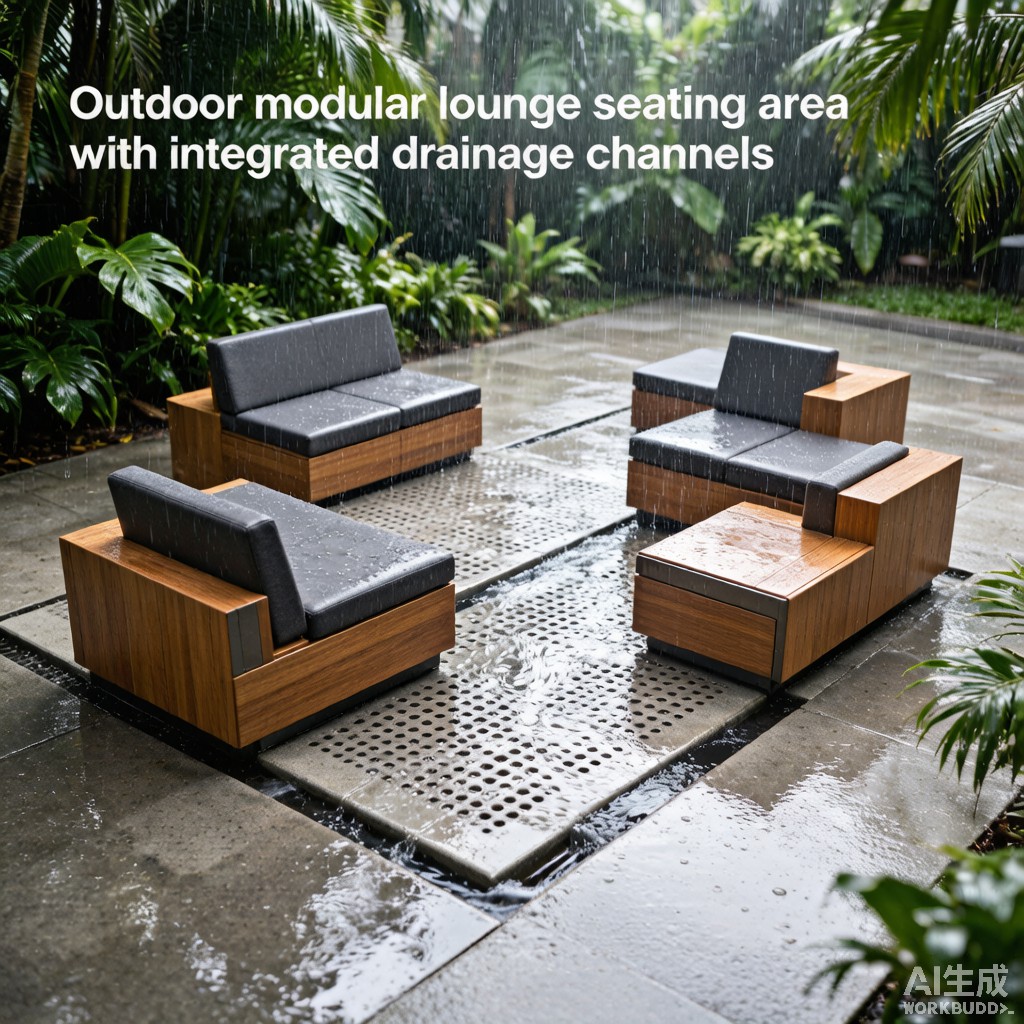
Southeast Asia’s tropical monsoon climate presents one of the most challenging environments for outdoor lounge installations. Rainfall intensities routinely exceed 150 mm/day during monsoon seasons, with extreme events reaching 300+ mm/day. Without engineered drainage and flood-resilient foundations, outdoor lounge furniture suffers from water damage, structural corrosion, mold growth, and ultimately premature failure. This guide provides a systematic approach to rainwater management design, ensuring that outdoor lounge installations maintain functionality and aesthetics throughout the region’s intense wet seasons.
Southeast Asian Rainfall Characteristics
Design Rainfall Intensity Data
| City | A
ual Rainfall (mm) |
Max 24h Rainfall (mm) | 10-Year Return Period (mm/h) |
|---|---|---|---|
| Singapore | 2,340 | 368 | 95 |
| Kuala Lumpur, Malaysia | 2,627 | 421 | 110 |
| Bangkok, Thailand | 1,482 | 312 | 85 |
| Jakarta, Indonesia | 1,861 | 385 | 100 |
| Manila, Philippines | 2,047 | 456 | 120 |
| Ho Chi Minh City, Vietnam | 1,936 | 298 | 80 |
Design drainage systems using the 10-year return period rainfall intensity as the minimum standard, with 25-year or 50-year return periods for premium installations in flood-prone areas. The Manila data is particularly noteworthy—typhoon-enhanced rainfall can deliver 120 mm/h sustained for 2+ hours, requiring drainage capacity far exceeding standard European or North American outdoor furniture design parameters.
Surface Drainage Design
Grade and Slope Requirements
Proper surface grading is the first and most cost-effective drainage measure. The lounge installation area should slope away from seating zones at a minimum gradient of 1.5–2.0% (1:67 to 1:50). For a 3-meter-wide seating zone, this translates to 45–60 mm of elevation drop from the seating center to the drainage perimeter.
Slope Materials and Construction
- Concrete pad: Sloped cast-in-place concrete with brushed finish for slip resistance. Minimum 100 mm thickness with welded wire reinforcement.
- Paver system: Interlocking concrete pavers on a 30–50 mm sand setting bed over compacted aggregate base. Paver joints (3–5 mm) provide secondary drainage through the sand layer.
- Permeable paving: Porous concrete or permeable interlocking pavers allow water to infiltrate directly through the surface, reducing surface runoff by 70–90%.
Permeable Paving Performance
| Paving Type | Infiltration Rate (mm/h) | Runoff Coefficient | Load Capacity |
|---|---|---|---|
| Standard concrete | 0 | 0.85–0.95 | Heavy vehicular |
| Pervious concrete | 150–300 | 0.10–0.25 | Light vehicular |
| Permeable pavers (grass) | 100–200 | 0.15–0.30 | Pedestrian only |
| Permeable pavers (gravel-filled) | 200–400 | 0.05–0.15 | Light vehicular |
| Resin-bound gravel | 500–1,000 | 0.02–0.10 | Pedestrian |
Resin-bound gravel surfacing offers the highest infiltration rate, capable of absorbing even Manila’s 120 mm/h typhoon rainfall entirely through the surface. However, it requires a properly designed sub-base reservoir to store and slowly release infiltrated water.
Subsurface Drainage Systems
French Drain Design
When surface drainage alone ca
ot handle the runoff volume, subsurface French drains capture and redirect water away from the lounge foundation. A French drain consists of:
- Perforated pipe: 100–150 mm diameter PVC or HDPE corrugated pipe with slots or perforations
- Filter fabric: Non-woven geotextile wrapping prevents fine soil particles from clogging the drainage aggregate
- Drainage aggregate: Clean crushed stone (20–40 mm) surrounding the pipe to provide void space for water storage and flow
- Trench dimensions: 300 × 300 mm minimum, placed at the perimeter of the lounge installation area
Drainage Capacity Calculation
The capacity of a French drain to handle design rainfall is calculated using Ma
ing’s equation:
Q = (1/n) × A × R^(2/3) × S^(1/2)
Where:
- Q = flow rate (m³/s)
- n = Ma
ing’s roughness coefficient (0.011 for PVC pipe)
- A = cross-sectional flow area (m²)
- R = hydraulic radius (m) = A / wetted perimeter
- S = slope (m/m), minimum 0.5%
For a 100 mm diameter PVC pipe at 0.5% slope:
- A = 0.00785 m² (full pipe)
- R = 0.025 m
- Q = (1/0.011) × 0.00785 × 0.025^(2/3) × 0.005^(1/2) = 0.0052 m³/s = 18.7 m³/h
This capacity handles runoff from approximately 186 m² of impervious surface at Manila’s 100 mm/h design intensity—more than sufficient for a typical 15–25 m² lounge installation with surrounding hardscape.
Flood-Resilient Foundation Design
Elevated Modular Platform Systems
In areas subject to periodic flooding (street-level flash floods common in Jakarta, Manila, and Ho Chi Minh City), the lounge foundation should be elevated above the 50-year flood level. Modular pedestal systems provide an elegant solution:
- Pedestal height: 50–200 mm adjustable, allowing precise leveling on uneven surfaces while creating a ventilation gap beneath the seating platform
- Material: Polypropylene pedestals with UV stabilizers (HALS + carbon black) rated for 500+ kg point load
- Decking surface: Composite wood-plastic decking boards (WPC) with 5 mm gaps between boards for water drainage
- Flood gap: The 50–200 mm pedestal height allows floodwater to flow freely beneath the platform without lifting or damaging the structure
Anchorage Against Flotation
During flooding, buoyancy forces can lift unanchored lounge furniture. The upward buoyancy force on a submerged object is:
F_buoyancy = ρ_water × g × V_displaced
For a modular seating unit of 1.5 × 0.6 × 0.45 m (V = 0.405 m³) with a mass of 35 kg:
- F_buoyancy = 1,000 × 9.81 × 0.405 = 3,973 N
- F_gravity = 35 × 9.81 = 343 N
- Net upward force = 3,630 N (equivalent to 370 kg)
Anchor each seating module using stainless steel L-brackets (SUS 304) bolted to the concrete pad with M12 chemical anchors rated for 5 kN pull-out force. This provides a 37% safety margin above the calculated buoyancy force.
Rainwater Harvesting Integration
For sustainability-focused installations, the drainage system can be integrated with rainwater harvesting to irrigate surrounding landscaping:
- Collection surface: Lounge canopy or adjacent roof area directs rainwater via gutters to a storage tank
- First-flush diverter: Diverts the first 0.5–1.0 mm of rainfall (containing dust, bird droppings, and debris) away from storage
- Storage tank: 500–2,000 L HDPE tank buried adjacent to the lounge foundation, screened with decorative landscaping
- Irrigation distribution: Solar-powered pump with timer delivers harvested water to surrounding planters during dry periods
- Overflow management: Tank overflow co
ects to the French drain system, ensuring no standing water accumulates near the lounge
A 10 m² canopy in Singapore’s climate can harvest approximately 23,400 L a
ually—sufficient to irrigate 20–30 m² of tropical landscaping with drip irrigation at 2 L/m²/day.
Material Selection for Tropical Wet Environments
| Component | Recommended Material | Expected Service Life | Maintenance |
|---|---|---|---|
| Frame structure | SUS 316 stainless steel (electropolished) | 20–25 years | A
ual wash, bi-a ual passivation check |
| Seating surface | HDPE recycled plastic lumber | 15–20 years | A
ual pressure wash |
| Fasteners | SUS 316 bolts with Nyloc nuts | 20+ years | None |
| Drainage pipe | HDPE corrugated (SN8 rating) | 50+ years | A
ual CCTV inspection |
| Geotextile filter | Non-woven polypropylene 200 g/m² | 15–20 years | Replace if clogged (check bi-a
ually) |
Conclusion
Designing outdoor lounge installations for Southeast Asian monsoon conditions requires a multi-layered approach: surface grading at 1.5–2.0% slope, permeable paving with 200+ mm/h infiltration capacity, subsurface French drains sized via Ma
ing’s equation, and elevated modular foundations with proper anchorage against flood buoyancy forces. By integrating rainwater harvesting and selecting corrosion-resistant materials rated for 15–25 year tropical service life, designers can create outdoor lounge spaces that remain functional, safe, and aesthetically appealing through the region’s most intense monsoon conditions. The investment in proper drainage engineering—typically 15–25% of total installation cost—pays dividends through eliminated flood damage repairs and extended furniture service life.