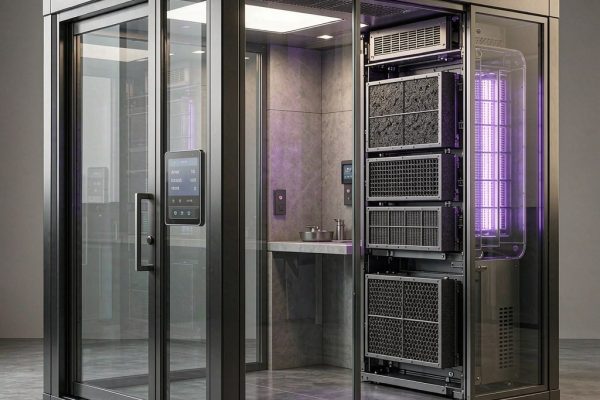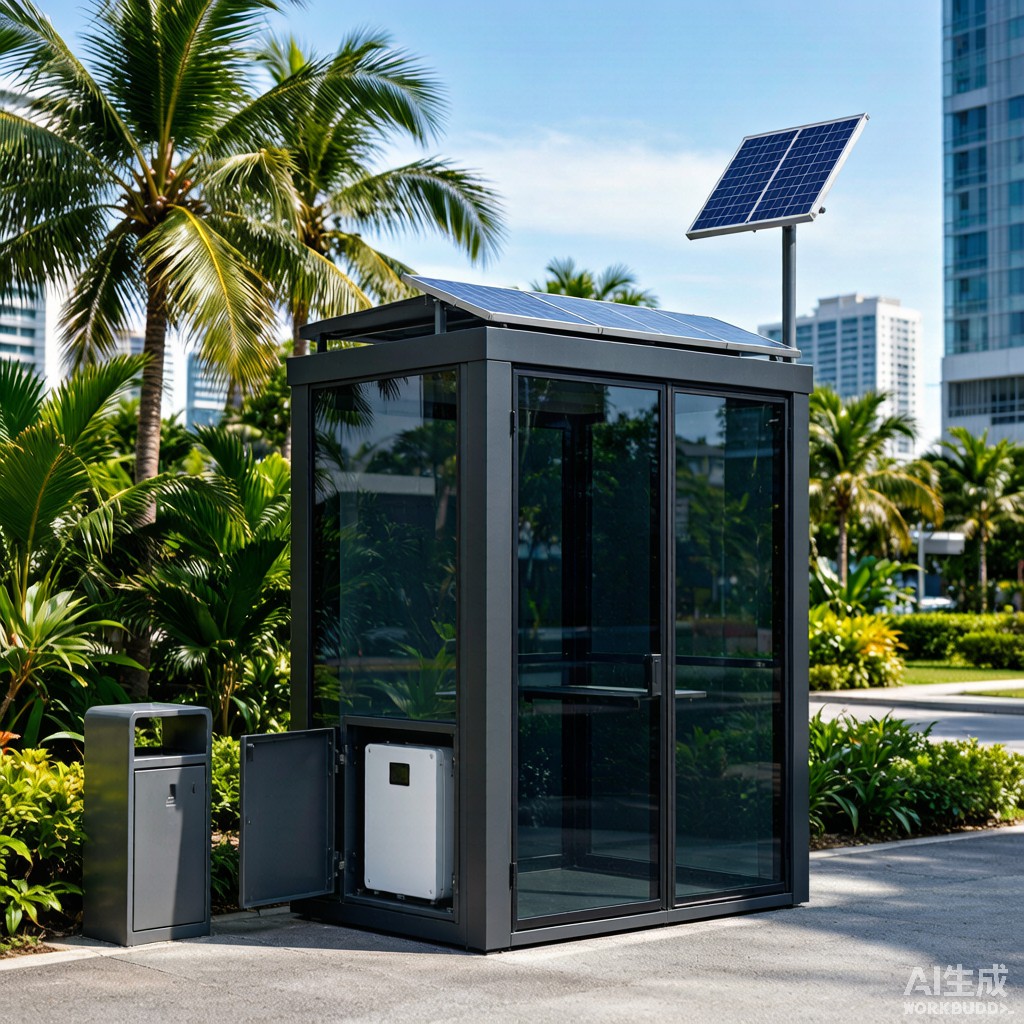
As commercial property developers across Southeast Asia increasingly adopt smoking booths to comply with indoor air quality regulations, many installation sites lack grid power infrastructure—particularly in remote campus environments, industrial parks, and resort properties. Solar-powered off-grid smoking booths provide a self-contained solution, combining photovoltaic generation, maximum power point tracking (MPPT) charge control, and lithium iron phosphate (LiFePO4) battery storage to power ventilation, lighting, and IoT monitoring systems indefinitely without external utility co
ections.
System Architecture Overview
A complete off-grid smoking booth power system consists of five subsystems:
- Photovoltaic (PV) array: Roof-mounted monocrystalline panels generating DC power during daylight hours
- MPPT charge controller: Maximum power point tracking controller optimizing PV output and managing battery charging
- Battery bank: LiFePO4 battery modules storing energy for nighttime and cloudy-day operation
- DC-AC inverter: Pure sine wave inverter converting stored DC to 220V AC for booth loads
- Energy management system (EMS): IoT-based controller monitoring generation, consumption, and battery state of charge
Load Analysis and Daily Energy Budget
Smoking Booth Power Consumption Profile
| Load | Power (W) | Daily Hours | Daily Energy (Wh) |
|---|---|---|---|
| EC exhaust fan (primary) | 120 | 24 | 2,880 |
| EC exhaust fan (backup) | 80 | 8 (peak hours) | 640 |
| LED lighting | 30 | 12 | 360 |
| PM2.5/TVOC sensor | 5 | 24 | 120 |
| IoT controller + 4G modem | 15 | 24 | 360 |
| UV-C air purifier | 40 | 6 (off-peak) | 240 |
| Signage + indicator | 10 | 24 | 240 |
Total daily energy consumption: 4,840 Wh/day
The primary exhaust fan is the dominant load, consuming 59% of daily energy. Implementing occupancy-based variable speed control can reduce fan energy by 40–55% during low-traffic periods, bringing the daily budget down to approximately 3,200–3,800 Wh/day for moderate-traffic installations.
Solar PV Array Sizing
Southeast Asian Solar Irradiance Data
| Location | Daily Peak Sun Hours (PSH) | A
ual Average (kWh/m²/day) |
|---|---|---|
| Singapore | 4.2 | 4.5 |
| Bangkok, Thailand | 4.8 | 5.1 |
| Ho Chi Minh City, Vietnam | 4.5 | 4.8 |
| Jakarta, Indonesia | 4.3 | 4.6 |
| Manila, Philippines | 4.6 | 4.9 |
PV Array Calculation
The required PV array size is calculated using:
P_pv = E_daily / (PSH × η_system × η_charge)
Where:
- E_daily = 4,840 Wh (conservative, without VSD optimization)
- PSH = 4.3 hours (worst-case for Singapore)
- η_system = 0.75 (array derating: temperature, dust, wiring, mismatch)
- η_charge = 0.95 (MPPT charge efficiency)
P_pv = 4,840 / (4.3 × 0.75 × 0.95) = 1,583 W
Using 400W monocrystalline panels (21% efficiency, 1,960 × 1,300 mm each), 4 panels provide 1,600W rated capacity with a compact 10.2 m² footprint—feasible for a standard 2.0 × 1.5 m smoking booth roof with an additional canopy extension.
Panel Selection for Tropical Conditions
- Temperature coefficient: Select panels with Pmax coefficient ≤ −0.35%/°C to minimize output loss at 50–65°C cell temperatures common in tropical environments
- PID resistance: Specify PID-resistant cells (IEC 62804 compliant) to prevent potential-induced degradation in high-humidity conditions
- Encapsulation: Double-glass (glass-glass) construction provides superior moisture barrier vs. glass-backsheet for 25+ year service life in 80%+ RH environments
LiFePO4 Battery Bank Sizing
Autonomy Requirement
For reliable off-grid operation, the battery bank must sustain the booth through consecutive cloudy days. Southeast Asian monsoon seasons can reduce solar yield by 60–80% for 2–3 consecutive days. Designing for 3 days of autonomy:
E_battery = E_daily × Days_autonomy / (DoD × η_inverter × η_DOD)
Where:
- E_daily = 4,840 Wh
- Days_autonomy = 3
- DoD = 0.80 (LiFePO4 safe depth of discharge)
- η_inverter = 0.92
- η_DOD = 0.95 (round-trip efficiency)
E_battery = 4,840 × 3 / (0.80 × 0.92 × 0.95) = 20,809 Wh ≈ 20.8 kWh
Battery Configuration
Using 51.2V, 100Ah LiFePO4 modules (5.12 kWh each), 4 modules in parallel provide 20.48 kWh nominal capacity. Key specifications:
- Chemistry: LiFePO4 (LFP) — superior thermal stability vs. NMC, no thermal runaway below 270°C
- Cycle life: 4,000–6,000 cycles at 80% DoD, equating to 10–15 years of daily cycling
- BMS: Integrated battery management system with cell balancing, overcurrent/overvoltage/overtemperature protection, and CAN bus communication to EMS
- Operating temperature: −20°C to 60°C (charge limited to 0–45°C for longevity)
MPPT Charge Controller Selection
The MPPT controller is critical for maximizing energy harvest, particularly during cloudy conditions when irradiance fluctuates rapidly. Key selection criteria:
| Parameter | Specification | Rationale |
|---|---|---|
| Rated current | 60A | 1,600W PV / 24V battery = 67A, 60A controller at 92% efficiency handles peak with margin |
| Tracking efficiency | >99% | PV curve sca
ing frequency ≥ 10s for rapid cloud-edge response |
| Conversion efficiency | >97% | Reduces heat dissipation requirements in enclosed booth electronics bay |
| Battery voltage | 48V nominal | Lower current for same power = smaller cabling, reduced I²R losses |
| Protections | PV reverse polarity, overcurrent, overtemperature, PV short circuit | Unattended operation in remote locations requires comprehensive self-protection |
Charge Algorithm
The MPPT controller implements a 4-stage charging profile optimized for LiFePO4 chemistry:
- Bulk (CC): Maximum available current until battery reaches 56.8V (3.55V/cell)
- Absorption (CV): Hold 56.8V for 30 minutes, current tapers naturally
- Float: Reduce to 53.6V (3.35V/cell) to prevent overcharge while maintaining full capacity
- Equalization bypass: LFP chemistry does not require periodic equalization—controller skips this stage automatically
Energy Management and Remote Monitoring
The IoT-based EMS provides real-time visibility into system performance and enables predictive maintenance:
- Real-time metrics: PV generation (W), battery voltage/current (V/A), load consumption (W), state of charge (%), estimated runtime (hours)
- Smart load shedding: When SOC drops below 30%, the EMS sequentially disables non-critical loads (UV-C purifier → backup fan → signage) while maintaining primary ventilation and safety monitoring
- Predictive alerts: Cloud-based analytics identify declining battery capacity trends, inverter efficiency degradation, and panel soiling losses, triggering maintenance dispatches before failures occur
- 4G LTE co
ectivity:
MQTT protocol transmits telemetry every 60 seconds to a centralized dashboard, with SMS alerts for critical faults (battery low, panel fault, inverter error)
System Cost Analysis
| Component | Specification | Cost (USD) |
|---|---|---|
| PV array (4 × 400W) | 1,600W mono double-glass | $1,200 |
| MPPT controller | 60A, 48V, 97% efficiency | $350 |
| LiFePO4 battery bank | 20.48 kWh (4 × 5.12 kWh) | $4,800 |
| Pure sine inverter | 3,000W, 48V DC → 220V AC | $450 |
| EMS + sensors + 4G modem | IoT controller, PM2.5, TVOC, temp/humidity | $400 |
| Wiring, breakers, enclosure | DC-rated components, IP65 enclosure | $500 |
| Installation labor | 2 days, 2 technicians | $600 |
Total system cost: approximately $8,300, with a projected payback period of 4–6 years compared to grid co
ection costs (transformer, trenching, metering) at remote sites. A
ual maintenance cost is minimal—panel cleaning every 3–6 months and battery health verification via remote diagnostics.
Conclusion
Solar-powered off-grid smoking booths represent a practical and increasingly economical solution for Southeast Asian commercial properties lacking grid infrastructure. The combination of 1.6 kW monocrystalline PV, 60A MPPT charge control, and 20.5 kWh LiFePO4 storage provides 3-day autonomy through monsoon conditions while powering continuous ventilation, lighting, and air quality monitoring. With total system costs under $9,000 and minimal maintenance requirements, the solar off-grid approach eliminates utility co
ection expenses and delivers true energy independence for remote smoking booth deployments.