Introduction: The Hidden Structural Workhorse in Electronics
While enclosure plastics receive the most attention for their cosmetic and flame-retardant requirements, the internal structural brackets of electronic devices — PCB mounting frames, power supply supports, co
ector alignment guides, and heat sink retention brackets — perform equally critical roles with entirely different material demands. These components are never seen by the end user, yet they must maintain precise dimensions across years of thermal cycling, resist creep under constant spring loading, and survive assembly-line handling and end-use vibration without cracking.
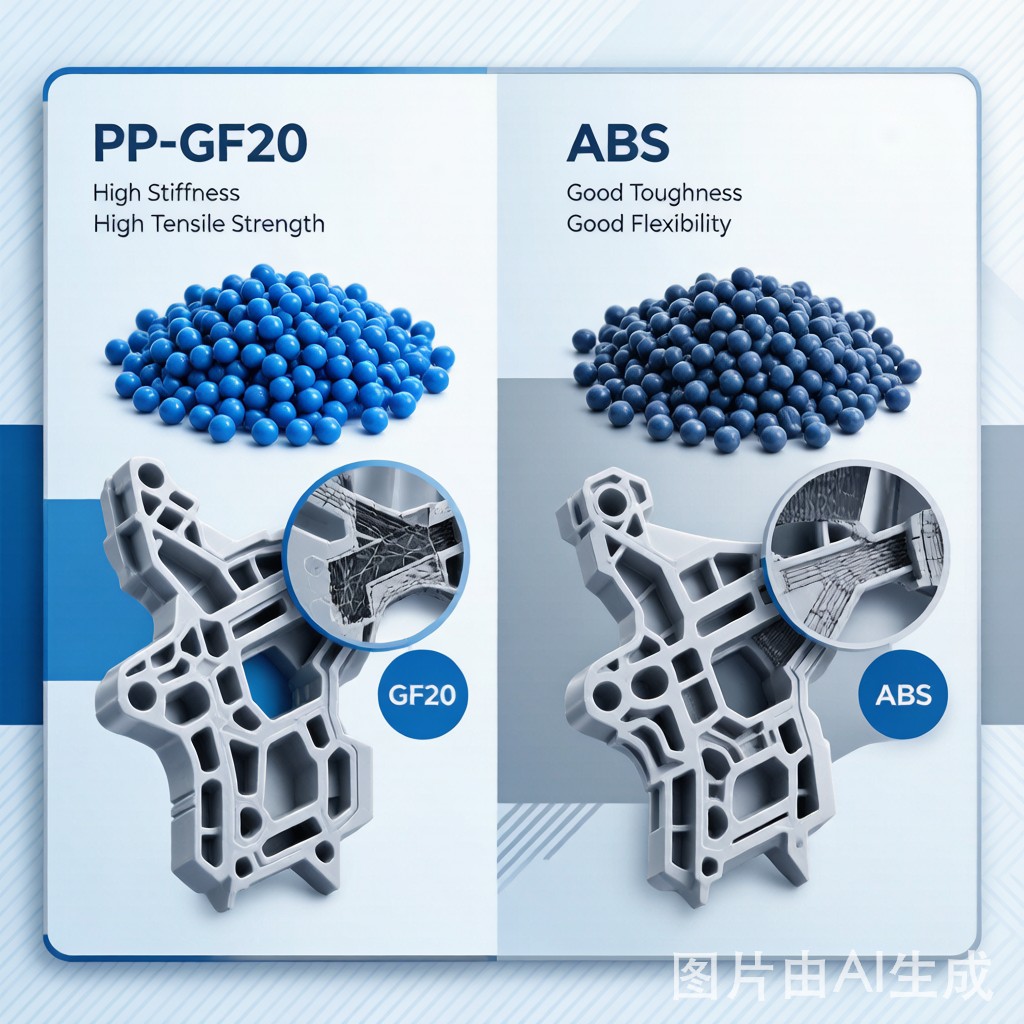
Two modified plastic pellet families dominate this application space in Southeast Asian electronics manufacturing: PP-GF20 (polypropylene with 20% glass fiber reinforcement) and general-purpose ABS (acrylonitrile-butadiene-styrene). The choice between them presents a cost-performance trade-off that directly impacts bill-of-materials cost, molding cycle time, and field reliability. This article compares PP-GF20 and ABS across the properties that matter for internal electronics brackets.
Material Properties: PP-GF20 vs ABS Head-to-Head
Mechanical Property Comparison
| Property | PP-GF20 | ABS (General Purpose) | Standard | Wi
er |
|---|---|---|---|---|
| Tensile Strength (MPa) | 65–80 | 40–50 | ASTM D638 | PP-GF20 |
| Flexural Modulus (MPa) | 3,500–4,500 | 2,000–2,600 | ASTM D790 | PP-GF20 |
| Izod Impact, notched 23°C (J/m) | 80–120 | 200–350 | ASTM D256 | ABS |
| Izod Impact, notched -20°C (J/m) | 50–70 | 80–120 | ASTM D256 | ABS |
| HDT @ 1.82 MPa (°C) | 140–155 | 85–95 | ASTM D648 | PP-GF20 |
| Density (g/cm³) | 1.02–1.06 | 1.04–1.07 | — | PP-GF20 (lighter) |
| Mold Shrinkage (%) | 0.3–0.6 (flow) / 0.8–1.2 (transverse) | 0.4–0.7 | ASTM D955 | ABS (isotropic) |
| Creep Resistance (23°C, 20 MPa) | 0.8–1.2% strain after 1000h | 0.4–0.7% strain after 1000h | ISO 899-1 | ABS |
| Fatigue Endurance Limit (10⁷ cycles, MPa) | 18–22 | 11–15 | ASTM D7774 | PP-GF20 |
| Chemical Resistance (acids, alkalis, oils) | Excellent | Poor to moderate | — | PP-GF20 |
| UV Resistance (unmodified) | Poor (requires UV stabilizer) | Poor (yellowing in 6–12 months outdoor) | — | Tie (both need stabilizers) |
Key insight: PP-GF20 dominates in tensile strength (+60%), stiffness (+70%), heat resistance (+60°C HDT), and fatigue endurance (+50%). ABS wins narrowly on ambient-temperature impact resistance and creep resistance. For internal brackets where impact during assembly handling is the primary mechanical risk, ABS offers a safety margin that PP-GF20’s lower notched impact strength may not provide — particularly at cold temperatures (below 10°C) where PP’s ductile-brittle transition kicks in.
Glass Fiber Reinforcement in PP: Strengths and Pitfalls
The 20% glass fiber loading in PP-GF20 creates, on average, a 2.5–3× increase in tensile strength and a 3–4× increase in flexural modulus compared to unfilled PP — bringing it into the mechanical performance range of engineering thermoplastics at a fraction of the cost. However, GF reinforcement introduces anisotropic shrinkage: the polymer matrix shrinks more in the transverse-to-flow direction (0.8–1.2%) than in the flow direction (0.3–0.6%) because glass fibers constrain shrinkage along their axis of orientation. This creates warpage risk in flat, thin-walled brackets if gate location and mold filling pattern are not carefully designed to balance fiber orientation.
Additionally, glass fibers increase the abrasive wear on injection molding screws, barrels, and mold surfaces — typically reducing screw life by 30–50% compared to processing unfilled ABS. For high-volume production (500,000+ shots/year), the additional tooling maintenance cost of GF-reinforced material should be factored into the total cost of ownership calculation.
Mold Flow and Processing Comparison
Injection Molding Parameters
| Processing Parameter | PP-GF20 | ABS | Implication |
|---|---|---|---|
| Melt Temperature (°C) | 220–260 | 220–250 | Similar energy consumption |
| Mold Temperature (°C) | 30–50 | 50–80 | PP-GF20: lower mold temp → faster cycle |
| MFI (g/10min, typical) | 8–15 (230°C/2.16kg) | 15–30 (220°C/10kg) | ABS flows better in thin walls |
| Drying Required | Optional (2h @ 80°C if exposed >4h) | Mandatory (2–4h @ 80°C) | PP-GF20: lower pre-processing cost |
| Cycle Time Reduction (relative) | Baseline | +15–25% (higher mold temp, longer cooling) | PP-GF20: faster cycle by 15–25% |
| Material Cost (USD/kg, SE Asia bulk) | 1.20–1.60 | 1.60–2.20 | PP-GF20: 25–35% cheaper |
PP-GF20’s lower and optional drying requirement is a significant operational advantage in humid Southeast Asian factories: ABS must be dried to ≤0.05% moisture (5–10 times more stringent than PP) to prevent splay marks and hydrolysis degradation at processing temperature. The 2–4 hour drying step for ABS adds energy cost and a potential bottleneck if dryer capacity limits throughput.
Weld Line Strength Considerations
Internal brackets often have holes, bosses, and ribs that create multiple melt flow fronts meeting at weld lines — the weakest points in any injection-molded part. Glass fiber-reinforced materials are particularly vulnerable at weld lines because fibers do not cross the weld-line interface; instead, they align parallel to it, creating a pure-matrix region with 50–70% of the bulk tensile strength. ABS, being unfilled (unless specifically a filled grade), shows milder weld-line strength reduction (typically 75–85% of bulk). For brackets with complex geometry and multiple weld lines, ABS may actually outperform PP-GF20 at these critical locations despite lower bulk strength.
Environmental Resistance for Southeast Asian Conditions
Moisture and Humidity Effects
In Southeast Asian factory and warehouse conditions (30–35°C, 80–95% RH), PP-GF20 demonstrates superior moisture resistance:
- PP-GF20 equilibrium moisture absorption: 0.01–0.03% (essentially none — PP matrix is hydrophobic)
- ABS equilibrium moisture absorption: 0.3–0.8% (polar nitrile groups in acrylonitrile attract water)
The practical consequence: PP-GF20 brackets maintain their mechanical properties (±2% variation) across all humidity conditions without drying. ABS brackets absorb moisture over weeks of warehouse storage, causing dimensional swelling (0.1–0.3% linear) that can affect snap-fit and press-fit assembly clearances. If tight tolerances (±0.05 mm) must be maintained, ABS parts may need to be assembled shortly after molding or stored in moisture-controlled conditions.
Thermal Aging and Creep Performance
For brackets near heat sources (power supplies, processor heatsinks, motor drives), the long-term thermal aging behavior differentiates these materials:
- PP-GF20 at 90°C continuous: Retains ≥80% tensile strength after 5,000 hours (per UL 746B RTI Mechanical = 105°C with impact, 120°C without impact). Glass fibers provide thermal stabilization; PP matrix oxidation is the limiting factor.
- ABS at 90°C continuous: Embrittlement onset at 500–1,000 hours due to polybutadiene rubber phase oxidation. UL RTI Mechanical = 60°C — ABS should not be used for structural brackets above 60°C continuous.
Creep under sustained load is the one thermal-mechanical area where ABS outperforms PP-GF20. Under 15 MPa flexural stress at 23°C, PP-GF20 creeps 0.5–0.8% over 1,000 hours versus 0.3–0.5% for ABS. For snap-fit retention brackets where a constant spring force is required (e.g., PCB edge holders), ABS’s better creep resistance means less relaxation and more consistent clamping force over the product lifetime.
Cost Analysis: Material, Processing, and Tooling
| Cost Element | PP-GF20 | ABS | PP-GF20 Advantage |
|---|---|---|---|
| Material cost (USD/part, 50g bracket) | 0.065–0.080 | 0.085–0.110 | 25–35% lower |
| Cycle time (seconds, 2mm wall) | 18–22 | 22–28 | 15–25% faster |
| Drying energy (kWh per 1,000 parts) | 0–2 | 8–15 | Significant savings |
| A
ual tooling maintenance (USD) |
800–1,500 (GF abrasive wear) | 400–800 | ABS lower tooling cost |
| Scrap rate (molding defects) | 2–4% (warpage risk) | 1–3% (weld-line cracks) | Comparable |
| Density-adjusted part cost index | 1.0 (reference) | 1.3–1.5 | 25–35% overall |
Application Selection Decision Matrix
| Application Scenario | Recommended Material | Rationale |
|---|---|---|
| PCB mounting bracket, consumer electronics (ambient temp) | ABS | Better weld-line strength, lower tooling wear, acceptable cost for B2C margins |
| Power supply support bracket (elevated temp, 60–90°C) | PP-GF20 | Higher HDT, better thermal aging, essential for >60°C environments |
| Snap-fit retention bracket (constant spring force) | ABS | Better creep resistance maintains clamping force over product lifetime |
| High-volume (>1M/year) cost-sensitive bracket | PP-GF20 | 25–35% material cost saving + faster cycle time → significant a
ual savings |
| Automotive under-hood bracket (chemical exposure) | PP-GF20 | Superior chemical resistance to oils, fuels, battery acid |
| Cold-environment bracket (outdoor, <0°C) | ABS | Better low-temperature impact — PP-GF20 notch-sensitive below 0°C |
Conclusion
PP-GF20 modified plastic pellets and ABS each occupy well-defined niches in electronics internal bracket applications. PP-GF20 wins on tensile stiffness (+70%), heat resistance (+60°C HDT), chemical resistance, material cost (25–35% lower), and cycle time (15–25% faster) — making it the default choice for cost-sensitive, high-temperature, and chemically exposed brackets. ABS wins on ambient and low-temperature impact resistance, weld-line strength, creep resistance, and lower tooling wear. The decision turns on three questions: (1) Is the operating temperature above 60°C? If yes, PP-GF20 is mandatory. (2) Is creep under sustained load critical? If yes, ABS is preferred. (3) Is cost the dominant driver? If yes, PP-GF20 provides 25–35% total cost advantage. For the majority of electronics internal brackets in consumer and industrial products — which operate below 60°C, don’t see sustained loads, and prioritize cost — PP-GF20 is the engineering and economic wi
er for Southeast Asian manufacturers.