Introduction: The Evolving Role of the Prefabricated Guard Booth
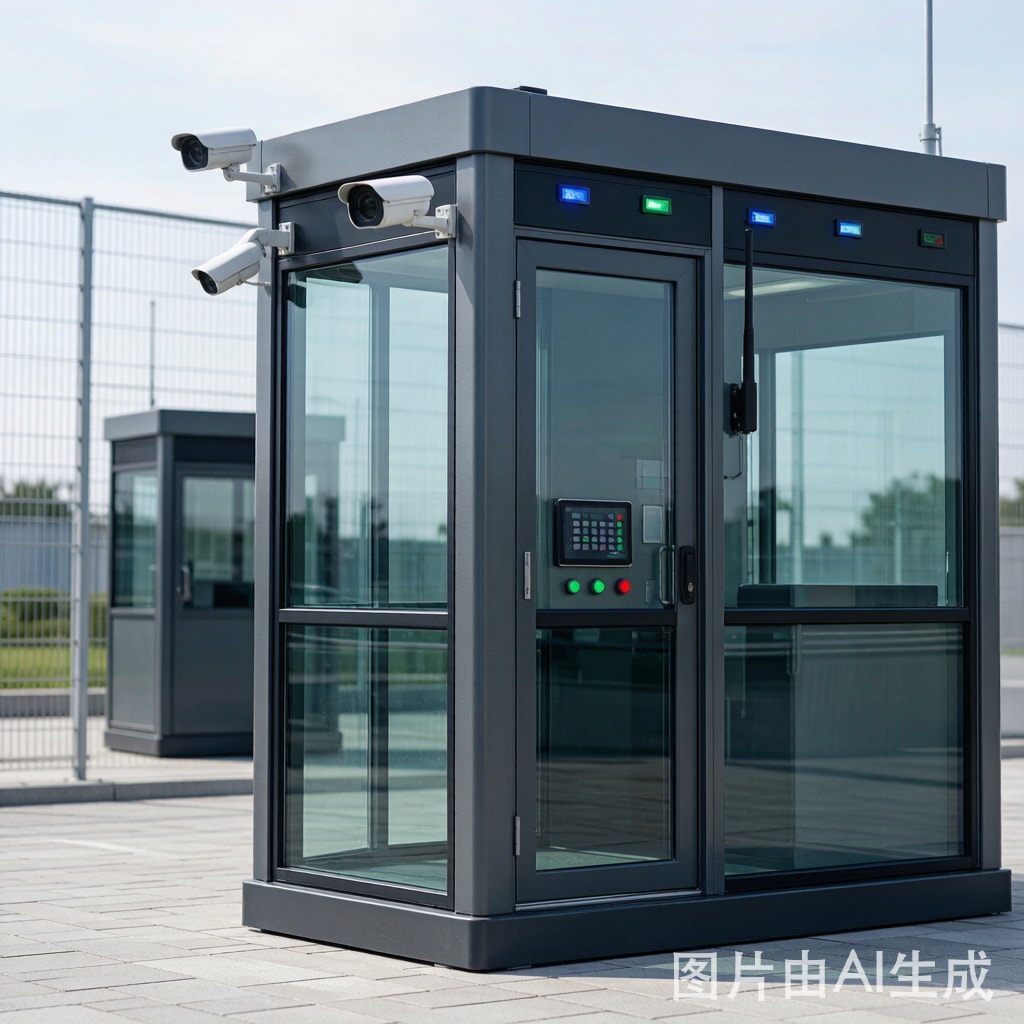
The traditional guard booth — a simple shelter for a security officer checking IDs and logging visitors — has evolved into a sophisticated security operations node. Modern prefabricated guard booths deployed at industrial parks, gated communities, logistics centers, and critical infrastructure sites now function as integrated security hubs, housing access control servers, CCTV NVRs (network video recorders), intercom panels, biometric enrollment stations, and emergency communication links.
This integration demands thoughtful design at the booth manufacturing and deployment stage — not as an aftermarket retrofit. Power distribution, structured cabling, equipment environmental hardening, and remote co
ectivity architecture must be built into the booth structure itself. This article provides an engineering framework for these integrated systems, with specific attention to Southeast Asian deployment conditions (heat, humidity, dust, and power quality).
Power Infrastructure Design
Power Budget and Distribution
A fully equipped security guard booth requires reliable, conditioned power for mission-critical electronics:
| Equipment | Typical Power (W) | Qty | Subtotal (W) | Voltage |
|---|---|---|---|---|
| CCTV NVR (8-cha
el, PoE) |
65–90 | 1 | 80 | 110–240 VAC |
| Access control controller (4-door) | 25–40 | 1 | 35 | 12 VDC / PoE |
| Biometric reader (fingerprint/face) | 12–20 | 2 | 35 | 12 VDC / PoE |
| 24″ CCTV monitor (LED) | 25–35 | 1 | 30 | 110–240 VAC |
| Intercom master station | 10–15 | 1 | 12 | PoE / 24 VDC |
| Network switch (8-port, managed, PoE+) | 150–250 (PoE budget) | 1 | 200 | 110–240 VAC |
| LED interior lighting | 20–30 | 1 | 25 | 110–240 VAC |
| Air conditioning (0.75 HP split) | 550–750 | 1 | 650 | 220 VAC |
| UPS (maintains electronics during mains fail) | — | 1 | — | — |
| Total (electronics only, excl. AC) | ~420 W | |||
| Total (with AC) | ~1,070 W |
UPS Sizing for Critical Electronics
A line-interactive or online double-conversion UPS (1,000–1,500 VA / 700–1,000 W) provides:
– Voltage regulation (AVR): Compensates for ±15–25% input voltage variation common in Southeast Asian industrial power
– Battery backup for electronics only (exclude AC): 420 W load × 30 minutes minimum runtime → required battery capacity ≈ 210 Wh. A 1,000 VA UPS with 2 × 12V 7Ah batteries (168 Wh usable at 50% depth of discharge) provides approximately 20–25 minutes — acceptable for orderly shutdown.
– Surge suppression: Built-in surge protection (≥600 J rating) for lightning-prone tropical environments
Extended runtime option: For sites with frequent extended outages, a 100 Ah deep-cycle AGM battery (1,200 Wh) with a 500 W pure sine wave inverter provides 2+ hours of electronics runtime.
Power Quality Considerations in Southeast Asia
Southeast Asian industrial power typically exhibits:
– Voltage sag: 5–15% below nominal for 1–30 seconds (motor starting, welding equipment)
– Voltage swell: 5–10% above nominal during off-peak hours
– Frequency variation: ±1 Hz from 50 Hz nominal
– Harmonic distortion: 5–15% THD in industrial zones (VFD motor drives, UPS systems from neighboring facilities)
An online double-conversion UPS completely isolates the security electronics from these power quality issues by continuously regenerating clean AC power — strongly recommended for guard booths in industrial park and port/logistics environments.
CCTV Surveillance System Design
Camera Selection and Placement
| Camera Position | Camera Type | Resolution | Lens (mm) | IR Range | Purpose |
|---|---|---|---|---|---|
| Booth exterior — entry door | Bullet / turret, IP66 | 4–5 MP (2560×1920) | 2.8–4 mm | 15–30 m | Visitor facial capture at 1.5 m height |
| Booth exterior — vehicle gate approach | Bullet, motorized varifocal | 4–5 MP | 2.8–12 mm | 30–50 m | License plate recognition (LPR) at 5–15 m |
| Booth exterior — panoramic / overview | Dome / fisheye | 5–8 MP | 1.7 mm (fisheye) | 10–20 m | 180–360° situational awareness |
| Booth interior (optional) | Mini dome / wedge | 2–4 MP | 2.8 mm | 5–10 m | Officer safety / incident recording |
Camera specifications for tropical outdoor deployment:
– Temperature range: —30 to +60°C (critical: many “outdoor” cameras are rated only to +50°C; direct sun on a metal guard booth in Bangkok can push surface temperatures to 55–60°C)
– IP rating: IP66 minimum, IP67 recommended for monsoon rain exposure
– IK rating: IK08 (5 J impact) minimum for anti-vandalism in public-access locations
– WDR (Wide Dynamic Range): 120 dB minimum — essential for entrance cameras facing bright outdoor/indoor transition (guard booth doorway has extreme backlight)
– IR cut filter: Mechanical (ICR) for true day/night switching; IR LEDs rated for the camera’s maximum range
NVR and Storage Architecture
Storage calculation for a 4-camera guard booth system:
– 4 cameras × 4 MP resolution × H.265 compression
– Average bitrate per camera: 4–8 Mbps (H.265, 25 fps, medium complexity scene)
– Total recording rate: 16–32 Mbps continuous
– Daily storage: 32 Mbps × 86,400 s/day ÷ 8 bits/byte ÷ 1,024³ = 322 GB/day (upper estimate)
– 7-day retention: 322 × 7 = 2,254 GB ≈ 2.2 TB
– Recommended HDD: 4 TB surveillance-grade (WD Purple or Seagate SkyHawk, 24×7 rated) — provides 12+ days retention at maximum quality
Network architecture:
– Dedicated PoE switch (8-port, Gigabit, managed, PoE+ 30W per port, ≥150W total PoE budget) for camera co
ectivity
– VLAN segmentation: Cameras + NVR on VLAN 10 (isolated from internet, no direct WAN access); intercom and access control on VLAN 20 (with controlled WAN access for remote monitoring)
– Fiber uplink (single-mode, LC co
ector) from booth to site security control room for >100 m distances; Gigabit copper (Cat6A) for ≤100 m
Access Control System Integration
Door Controller and Reader Configuration
The guard booth itself has one access door for the security officer, plus it may serve as the access control hub for the facility entrance gate:
Booth door access:
– RFID card reader (MIFARE DESFire EV2, 13.56 MHz) or biometric (fingerprint + PIN) on booth exterior
– Electric strike or magnetic lock (600 lb / 272 kg holding force, fail-secure configuration)
– Request-to-exit (REX) button or PIR sensor on interior for officer egress
– Door position sensor (magnetic reed switch) for forced-entry / door-held-open alarm
Facility vehicle gate control (from booth):
– 2-cha
el relay output from access controller for gate open/close control
– Vehicle loop detector input (inductive loop in road surface) for automatic gate closure after vehicle passage
– Intercom call button at vehicle gate pedestal → booth intercom master station
Biometric Enrollment Station
For facilities requiring biometric access (fingerprint, facial recognition, or iris scan), the guard booth serves as the enrollment and verification point:
– USB biometric enrollment sensor (fingerprint: 500 DPI optical, FBI PIV-071006 certified; face: dual-camera IR + visible for liveness detection)
– Enrollment workstation (small-form-factor PC or industrial panel PC, 10–15″ touchscreen)
– Local database with encrypted template storage, synchronized to central access control server via VPN
Communication and Intercom Infrastructure
Intercom System Architecture
A two-wire or IP-based intercom system co
ects the guard booth to:
– Vehicle entrance gate pedestal (visitor call-in)
– Pedestrian entrance gate
– Facility reception or main office
– Secondary guard posts on the site perimeter
IP intercom specification:
– SIP-compliant (RFC 3261) for integration with VoIP phone systems
– PoE powered (802.3af, simplifies cabling — single Cat6 for data + power)
– Outdoor substation: IP66, IK08, —30 to +60°C, full-duplex audio with echo cancellation, integrated 2 MP camera for visitor video preview on master station screen
– Master station (in booth): 7–10″ touchscreen, hands-free or handset, supports up to 16 substations, call recording to SD card or NVR
Network Co
ectivity for Remote Monitoring
The guard booth requires reliable IP co
ectivity to:
– Transmit CCTV streams to central security operations center (SOC)
– Synchronize access control events and biometric templates
– Support remote intercom calls
– Receive firmware updates and security patches
Co
ectivity options (in order of preference):
1. Fiber optic (single-mode, 1 Gbps): Best option for new installations where trenching is possible. Provides electrical isolation (no ground loop, lightning immunity) — critical in lightning-prone Southeast Asia.
2. Point-to-point wireless bridge (60 GHz + 5 GHz failover): 1 Gbps at up to 500 m line-of-sight. Useful where trenching is impossible (hardscape, existing infrastructure). Requires clear line of sight and mast mounting.
3. 4G/5G cellular router: Backup or primary for remote sites without fixed-line infrastructure. Requires external ante
a (IP66, pole-mounted) for reliable signal in metal-ski
ed booth (Faraday cage effect of metal enclosure attenuates cellular signal by 10–20 dB).
4. Cat6A copper (≤100 m): Simple but vulnerable to ground potential differences and lightning-induced surges. Ethernet surge protector (gas discharge tube + TVS diode, IEC 61643-21 Class D) required at both ends.
Environmental Hardening for Southeast Asian Deployment
Thermal Management for Electronics
Security electronics (NVR, access controller, network switch) continuously generate 150–250 W of heat inside the booth. In tropical conditions (outside 35°C, solar radiation 800–1,000 W/m²), the booth interior can reach 45–50°C without active cooling — exceeding the 0–40°C operating range of most security electronics.
Cooling strategy:
– Split-type air conditioner (0.75–1.0 HP, inverter) set to 25–26°C maintains electronics-safe interior temperature
– Dedicated ventilated equipment rack or wall-mount cabinet with thermostatically controlled exhaust fan (activates at 30°C) for electronics — separates equipment cooling from human comfort cooling
– Temperature monitoring sensor (1-Wire or SNMP-enabled) with remote alert if equipment compartment exceeds 35°C
– Power the AC from mains directly (not UPS); UPS serves electronics only
Dust and Insect Protection
– Equipment cabinet: IP5X (dust-protected) minimum with filtered air intake (G3 grade, 80–90% arrestance for particles >5 μm)
– Cable entry glands: IP68-rated compression glands at all wall penetrations, sealed with silicone sealant
– Insect mesh (stainless steel, 1 mm aperture) on all ventilation openings — prevents ants and cockroaches (common in tropical environments) from colonizing warm electronics enclosures
Lightning and Surge Protection
Southeast Asia experiences some of the highest lightning ground flash densities globally (20–40 flashes/km²/year in Malaysia, Thailand, Indonesia). Protection strategy:
– AC power: Type 1+2 surge protective device (SPD) at booth main distribution board (Class I+II per IEC 61643-11, 25 kA 10/350 μs + 40 kA 8/20 μs)
– Network/data lines: Ethernet surge protectors (IEC 61643-21 Category D1/C2, 2.5 kA 10/350 μs + 5 kA 8/20 μs) on all copper data cables entering the booth
– Grounding: Booth metal frame bonded to site grounding electrode (≤10 Ω resistance per IEC 62305-3). All SPDs must reference this same ground.
– Equipotential bonding: All metal components (door frame, equipment rack, cable trays) bonded to the common ground busbar
Conclusion
The modern prefabricated guard booth is a security operations node, not merely a shelter. Integrated system design — from power distribution and UPS sizing to CCTV camera selection, access control architecture, and communication infrastructure — must be engineered into the booth at the manufacturing stage. Key design imperatives for Southeast Asian deployment include: (1) online double-conversion UPS for clean power in industrial environments; (2) IP66/IP67 outdoor cameras rated to +60°C with 120 dB WDR; (3) fiber-optic or 60 GHz wireless backhaul for reliable co
ectivity; (4) active thermal management maintaining electronics below 35°C in tropical conditions; and (5) comprehensive lightning/surge protection with equipotential bonding. When these systems are properly integrated, the guard booth becomes a force multiplier — enabling one security officer to manage access control, monitor CCTV, and coordinate emergency response across an entire facility perimeter.