Introduction: The Quality Dilemma of Recycled Plastic Pellets in Electronics Manufacturing
As sustainability mandates and cost pressures drive electronics manufacturers toward recycled plastic pellets for enclosure injection molding, the engineering community faces a critical quality question: can recycled pellets deliver the same dimensional precision, mechanical performance, and cosmetic consistency as virgin material in demanding SMT electronics enclosure applications?
The answer depends heavily on the recycling source, processing history, and quality control rigor applied to the recycled stream. This article provides a comprehensive engineering analysis comparing recycled and virgin plastic pellets — focusing on melt flow index (MFI) degradation, mechanical property retention, and practical quality control protocols for ensuring production-grade molding outcomes.
Melt Flow Index: The Primary Processability Indicator
MFI Fundamentals and Specification
Melt flow index (MFI, also MFR — melt flow rate) measured per ISO 1133 or ASTM D1238 is the most widely used single-point indicator of polymer processability. It quantifies the mass of polymer extruded through a standard capillary (2.095 mm diameter, 8 mm length) under a specified load (typically 2.16 kg for polypropylene, 5 kg for ABS/PC) at a specified temperature (230°C for PP, 240°C for ABS).
For electronics enclosure applications, MFI directly predicts:
– Mold filling capability (flow length in thin-wall sections)
– Injection pressure requirements
– Weld line strength (where two flow fronts meet)
– Surface finish quality (flow marks, jetting, sink marks)
MFI Degradation in Recycled Pellets
Each thermal processing cycle (extrusion, injection molding, re-grinding, re-extrusion) causes measurable MFI change due to two competing mechanisms:
Molecular chain scission (↑ MFI): Thermal and shear stress during processing breaks long polymer chains into shorter fragments, reducing melt viscosity and increasing MFI. Dominant in polypropylene (PP), ABS, and polystyrene (PS).
Cross-linking / chain extension (↓ MFI): Reactive species generated during thermal processing can form intermolecular bonds, increasing molecular weight and decreasing MFI. Dominant in polyethylene (PE) with oxidative cross-linking, and in polymers containing reactive additives.
| Material | Virgin MFI (g/10min) | 1× Recycled MFI | 2× Recycled MFI | MFI Shift (%) | Primary Mechanism |
|---|---|---|---|---|---|
| PP (homopolymer) | 12–18 | 15–22 | 18–28 | +25–55% | Chain scission |
| PP (copolymer) | 8–15 | 10–18 | 12–22 | +20–47% | Chain scission |
| ABS | 15–25 | 18–30 | 22–38 | +20–52% | Chain scission |
| PC (polycarbonate) | 8–12 | 7–10 | 5–9 | —12–25% | Cross-linking + yellowing |
| HDPE | 4–8 | 3–7 | 2–6 | —10–25% | Oxidative cross-linking |
| PBT | 15–25 | 18–28 | 20–35 | +20–40% | Chain scission + hydrolysis |
Critical observation: For electronics enclosure molding (typically 1.5–3.0 mm wall, 100–200 mm flow length), the acceptable MFI window is narrow — typically ±30% of the virgin specification. Single-recycled PP and ABS often fall within this window, but double-recycled material frequently exceeds it, causing process instability.
MFI Quality Control Protocol
Incoming inspection protocol for recycled pellets:
1. MFI test per ISO 1133: Minimum 3 replicates per batch, report mean ± standard deviation
2. Acceptance criteria: MFI within ±30% of virgin target specification (tighter ±20% for thin-wall precision enclosures)
3. Batch-to-batch consistency: Standard deviation across 5 consecutive batches ≤5% (indicates stable recycling process)
4. Thermal history verification: DSC (differential sca
ing calorimetry) melt peak shift ≤2°C from virgin reference (indicates controlled thermal processing)
Mechanical Property Retention in Recycled vs Virgin Pellets
Tensile and Impact Property Comparison
| Property | Virgin PP | 1× Recycled PP | 2× Recycled PP | Test Standard |
|---|---|---|---|---|
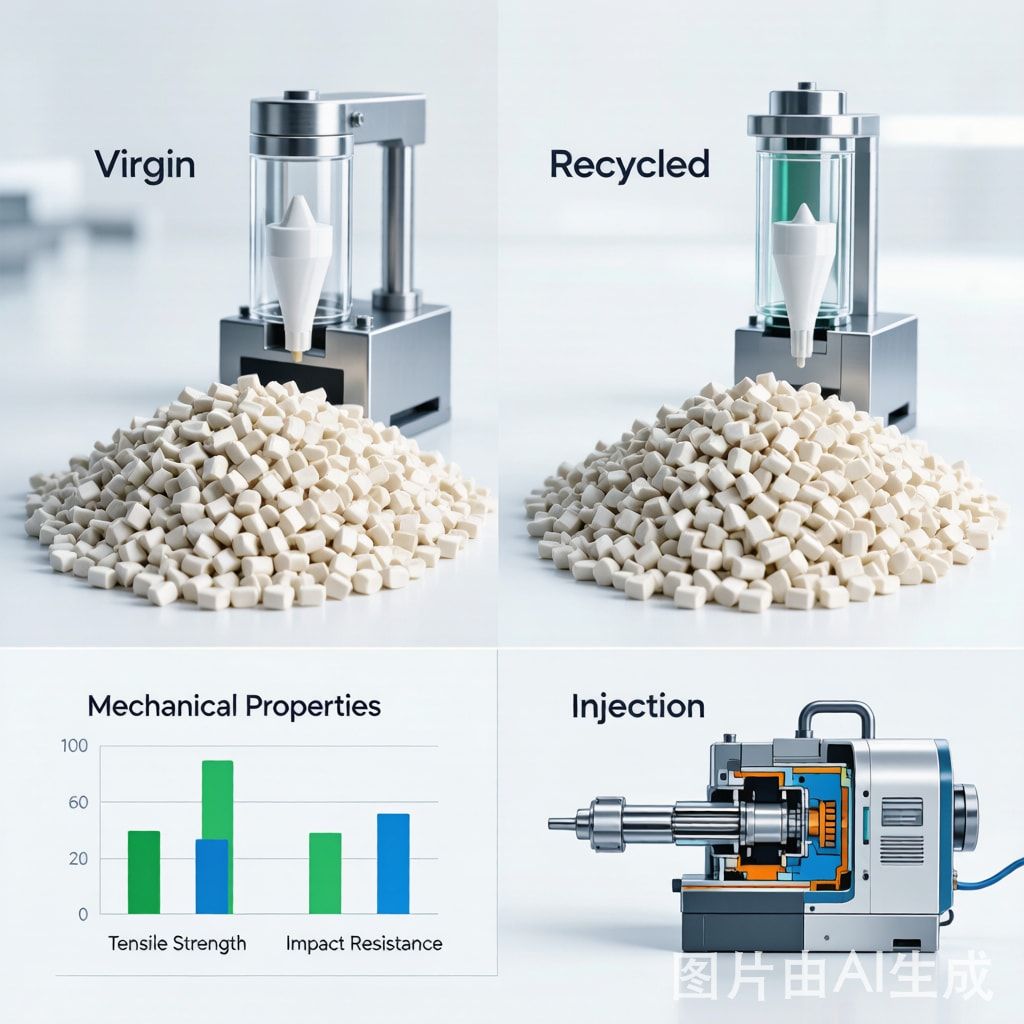
| Tensile Strength (MPa) | 32–38 | 28–34 (—12%) | 24–30 (—25%) | ASTM D638 |
| Flexural Modulus (MPa) | 1,500–1,800 | 1,400–1,700 (—7%) | 1,200–1,500 (—17%) | ASTM D790 |
| Izod Impact (J/m, notched) | 45–65 | 35–55 (—22%) | 25–40 (—45%) | ASTM D256 |
| HDT @ 0.45 MPa (°C) | 100–110 | 95–105 (—5%) | 88–98 (—12%) | ASTM D648 |
| elongation at Break (%) | 200–400 | 150–300 (—25%) | 80–180 (—55%) | ASTM D638 |
For electronics enclosures, the most critical degradation is impact strength (notched Izod). A handheld device enclosure that survives a 1.5 m drop test with virgin PP (impact ≈55 J/m) may fail at the same drop height with double-recycled PP (impact ≈30 J/m). This 45% degradation represents a significant reliability risk for consumer electronics.
Contamination-Driven Property Variability
Beyond thermal degradation, recycled pellets face contamination from:
– Mixed polymer cross-contamination: PP contaminated with PE, PS, or PVC fragments (even 0.5% PVC in PP causes severe degradation due to HCl release at processing temperatures)
– Additive residue mismatch: Stabilizers, pigments, and fillers from the original product may be incompatible with the enclosure molding specification
– Metallic contamination: Staples, screws, and aluminum flakes from recycling streams (visible as dark specks in molded parts, and potentially causing mold damage)
Contamination impact on properties:
– 0.5% PVC in PP stream: —30% impact, —40% elongation, severe surface discoloration
– 1% PE in PP stream: MFI shift +8%, minor dimensional effects
– 0.1% metal fragments: cosmetic defects, potential mold insert damage
Virgin Pellet Advantages for Precision Electronics Enclosures
Dimensional Consistency
Virgin pellets provide inherently superior dimensional consistency due to:
– Controlled molecular weight distribution (MWD) — directly correlates with shrinkage uniformity
– No thermal history variability — single processing pass from polymerization
– Consistent additive package — UV stabilizers, antistatic agents, and nucleating agents precisely formulated
– Zero contamination risk — clean compounding from reactor-grade resin
For a 150 mm × 100 mm × 30 mm SMT electronics enclosure with ±0.15 mm tolerance:
– Virgin PP: Cpk = 1.8–2.2 (well within ±0.15 mm)
– Single-recycled PP: Cpk = 1.2–1.6 (marginally acceptable)
– Double-recycled PP: Cpk = 0.8–1.1 (out of specification frequently)
Cosmetic Quality
Consumer electronics enclosures demand Class A cosmetic surfaces — no visible flow marks, weld lines, or discoloration. Virgin pellets consistently deliver this quality level because:
– Uniform MFI ensures smooth mold filling without jetting or flow hesitation
– No contamination specks or color inconsistency
– Stable pigment dispersion (recycled pellets often exhibit streaky color from mixed-source pigments)
Cost-Quality Trade-Off Matrix
| Factor | Virgin Pellets | 1× Post-Consumer Recycled | 1× Post-Industrial Recycled | 2× Recycled |
|---|---|---|---|---|
| Material Cost ($/kg) | $1.20–1.80 | $0.60–0.90 | $0.80–1.20 | $0.30–0.60 |
| MFI Consistency | ★★★★★ | ★★★☆☆ | ★★★★☆ | ★★☆☆☆ |
| Mechanical Retention | 100% | 75–88% | 85–92% | 55–75% |
| Dimensional Cpk | 1.8–2.2 | 1.2–1.6 | 1.4–1.8 | 0.8–1.1 |
| Cosmetic Class A | ★★★★★ | ★★☆☆☆ | ★★★★☆ | ★☆☆☆☆ |
| Drop Test Pass Rate | 98–99% | 85–92% | 92–96% | 60–75% |
| Environmental Rating | Standard | ★★★★★ | ★★★★☆ | ★★★★★ |
Post-industrial recycled pellets (scrap from controlled manufacturing processes) represent the optimal compromise — 85–92% mechanical retention, good dimensional Cpk (1.4–1.8), Class A cosmetic quality possible with proper sorting, and significant cost savings (20–35% below virgin).
Post-consumer recycled pellets (from consumer waste streams) suffer from contamination uncertainty and thermal history variability, making them suitable only for non-critical applications (internal brackets, non-visible structural components) where cosmetic quality and tight tolerances are not required.
Recommended Quality Control Protocol for Production
Incoming QC for Recycled Pellets
1. MFI testing: ISO 1133, 3 replicates, ±30% window
2. Contamination analysis: Visual inspection + XRF for metallic, FTIR for polymer identification
3. DSC verification: Melt peak within 2°C of virgin reference
4. Mechanical test coupon: ASTM D638 tensile bars from first trial mold run, compare to virgin baseline
5. Pilot run: 50–100 parts, measure dimensional Cpk before committing to production volume
Blending Strategy for Cost Optimization
A practical approach for electronics enclosures: blend virgin and post-industrial recycled pellets at 70:30 ratio. This delivers:
– 90–95% mechanical retention (close to virgin)
– Cpk 1.6–2.0 (production-grade dimensional quality)
– Class A cosmetic quality maintained
– 15–20% material cost savings
– Documented recycled content for sustainability reporting
Conclusion
The recycled vs virgin plastic pellets decision for electronics enclosure injection molding is not binary but a graduated spectrum. Virgin pellets guarantee production-grade quality across all criteria. Post-industrial recycled pellets offer a practical compromise with 85–92% mechanical retention and acceptable dimensional Cpk. Post-consumer recycled pellets carry contamination and consistency risks that limit them to non-critical internal components. The recommended approach — 70:30 virgin-to-post-industrial blending — balances cost savings, quality assurance, and sustainability objectives for Southeast Asian electronics manufacturers seeking to meet both performance and environmental targets.