Introduction: The Demand for Durable Outdoor Lounge Solutions in Tropical Southeast Asia
The growing trend of outdoor lounge spaces in Southeast Asian urban parks, resort developments, and commercial plazas demands furniture that can withstand year-round tropical exposure — intense UV radiation (UV index 8–12+), monsoon rainfall, high humidity (80–95% RH), and temperature cycling between 25–40°C. High-density polyethylene (HDPE) modular furniture systems have emerged as a leading solution, offering superior weatherability, low maintenance requirements, and cost-effective lifecycle performance compared to traditional materials like wood, metal, or low-grade plastics.
This article examines the engineering design principles behind HDPE outdoor lounge furniture, from UV stabilization chemistry to modular co
ection systems, with specific data on performance degradation in tropical conditions.
HDPE Material Properties and UV Stabilization Chemistry
Base HDPE Properties for Outdoor Furniture
HDPE (high-density polyethylene, density 0.94–0.97 g/cm³) provides an excellent base material for outdoor lounge furniture due to its inherent moisture resistance, chemical inertness, and impact toughness. However, unprotected HDPE undergoes rapid photo-oxidative degradation under tropical UV exposure:
| Property | Unstabilized HDPE | UV-Stabilized HDPE | Test Standard |
|---|---|---|---|
| Tensile Strength (initial) | 26–33 MPa | 26–33 MPa | ASTM D638 |
| Tensile Strength (after 2000h UV) | 8–12 MPa (—70%) | 24–30 MPa (—8%) | ASTM D638 + G154 |
| Impact Strength (Izod, initial) | 200–350 J/m | 200–350 J/m | ASTM D256 |
| Impact Strength (after 2000h UV) | 50–80 J/m (—75%) | 180–320 J/m (—10%) | ASTM D256 + G154 |
| Color Retention (ΔE, 1000h) | ΔE > 25 (severe) | ΔE < 5 (minimal) | ASTM D2244 |
| Surface Cracking (1000h UV) | Severe microcracks | No visible cracks | Visual + SEM |
UV Stabilizer Formulations for Tropical Performance
Effective UV stabilization of HDPE for tropical outdoor applications requires a synergistic three-component system:
1. Hindered Amine Light Stabilizers (HALS): The primary UV defense mechanism. HALS operate through the Denisov cycle — scavenging free radicals generated by UV photon absorption before they propagate polymer chain scission. Chimassorb 944 (polymeric HALS, molecular weight >2000) provides the longest service life due to low volatility and migration loss. Recommended concentration: 0.3–0.6% by weight.
2. UV Absorbers (UVA): Benzotriazole-type UV absorbers (Tinuvin 326, 327) convert UV photon energy into harmless heat through reversible molecular rearrangement. They protect the polymer’s interior where HALS ca
ot reach (HALS are surface-active). Concentration: 0.2–0.4%.
3. Antioxidants: Primary AO (Irganox 1010, phenolic) and secondary AO (Irgafos 168, phosphite) prevent thermal-oxidative degradation during processing and long-term service. Concentration: 0.1–0.2% each.
Optimal tropical formulation: 0.5% Chimassorb 944 + 0.3% Tinuvin 326 + 0.1% Irganox 1010 + 0.1% Irgafos 168 = total 1.0% additive package. This formulation achieves >5 years of outdoor service in Southeast Asian conditions before noticeable aesthetic or mechanical degradation.
Color Retention and Pigment Selection
Pigment Systems for Long-Term Color Stability
Color fading in tropical UV environments is driven by two mechanisms: pigment photo-degradation and polymer surface chalking. The pigment system selection critically determines long-term appearance:
| Pigment Type | Color Range | ΔE after 3000h UV | Tropical Suitability | Cost Impact |
|---|---|---|---|---|
| Inorganic (iron oxide, titanium dioxide) | Browns, reds, whites, blacks | < 3 | ★★★★★ | +5–10% |
| Phthalocyanine (CuPc blue/green) | Blues, greens | < 5 | ★★★★☆ | +10–15% |
| High-performance organic (DPP, quinacridone) | Reds, oranges, violets | 5–10 | ★★★☆☆ | +15–25% |
| Standard organic (azos, diarylide) | Full range | 15–30 | ★★☆☆☆ | +2–5% |
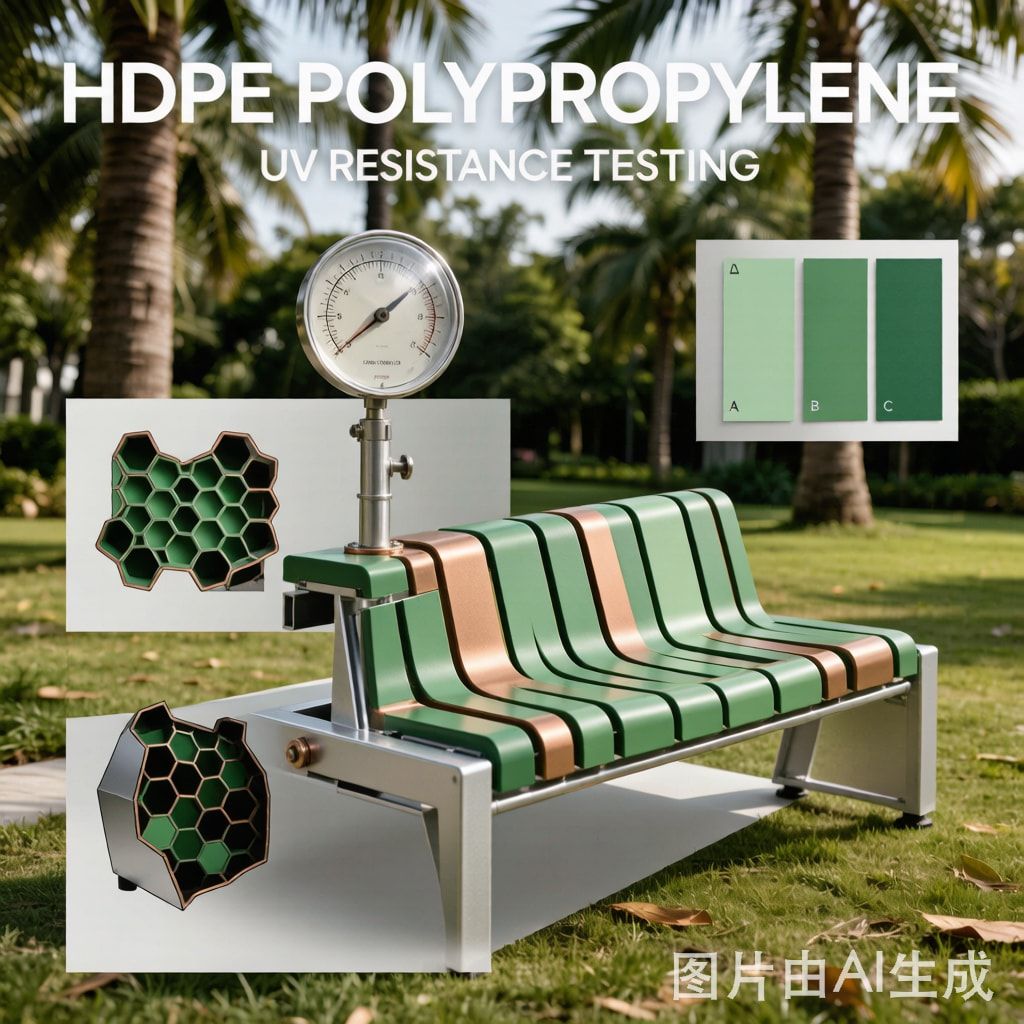
For Southeast Asian outdoor lounge furniture, inorganic pigments (iron oxide brown/red, TiO₂ white, carbon black) and phthalocyanine blue/green provide the best long-term color retention. DPP reds and quinacridone violets are acceptable for accent colors but require higher UV stabilizer loading (0.8% HALS minimum).
Surface Texture and Chalking Resistance
A matte or semi-textured surface finish (wood-grain emboss or pebble texture) reduces visible challing compared to glossy smooth surfaces. The micro-textured surface distributes any polymer oxidation residue across a larger visual area, making individual chalk spots less perceptible. Additionally, the textured surface improves tactile comfort in hot conditions by reducing the contact area that transfers heat to skin.
Modular Co
ection System Design
Frame-to-Slat Co
ection Methods
The modular outdoor lounge bench typically consists of an aluminum extrusion frame (Al 6063-T5) with HDPE slats attached via co
ection systems that must maintain structural integrity over 5+ years of thermal cycling, moisture exposure, and dynamic loading:
Option A: Stainless Steel Bolt-through Co
ection
– SS 304 or 316 M6 bolt with nylon insert lock nut
– HDPE slat drilled with oversize hole (9 mm for M6 bolt) allowing thermal expansion movement
– Neoprene washer on both sides prevents stress concentration
– Maintenance: periodic torque verification (a
ual recommended)
– Pros: Highest structural reliability, adjustable, serviceable
– Cons: Visible fasteners, periodic maintenance required
Option B: Snap-fit Cleat System
– Aluminum extrusion with integrated T-slot cleat
– HDPE slat with injection-molded snap-fit clip (HDPE or nylon PA66-GF30)
– Clip engages with spring-force retention, allows slat replacement
– Maintenance: clip replacement every 3–5 years (UV degradation)
– Pros: Clean aesthetics, easy slat swap, no visible fasteners
– Cons: Clip UV degradation, limited to lighter-duty applications
Option C: Adhesive Bond (3M VHB Tape)
– 3M VHB 4941 (1.0 mm, acrylic foam adhesive)
– High initial bond strength, compensates for thermal expansion differential
– Maintenance: none (but bond inspection required at 3-year intervals)
– Pros: Invisible attachment, vibration damping
– Cons: Non-serviceable, bond reliability depends on surface preparation
For tropical park deployments with high public use and maintenance constraints, bolt-through (Option A) remains the most reliable long-term solution, despite visible fasteners.
Thermal Expansion Accommodation
HDPE’s coefficient of thermal expansion (CTE = 150–200 × 10⁻⁶/°C) is significantly higher than aluminum (CTE = 23 × 10⁻⁶/°C). A 1-meter slat experiences dimensional change of 1.5–2.0 mm over a 10°C temperature swing (typical tropical day-night cycle). Co
ection systems must accommodate this differential:
– Slats should not be rigidly fixed at both ends — one end fixed, one end sliding
– Oversized bolt holes (2× bolt diameter) at sliding end
– Minimum 5 mm gap between adjacent slats for expansion clearance
– Frame design should include expansion gaps at module joints
Mechanical Loading and Safety Requirements
Design Load Standards
Outdoor lounge bench seating must meet structural loading requirements:
– BIFMA X5.1 (Outdoor seating): 750 lb (340 kg) static load, 3-occupant distributed
– EN 581-2 (Outdoor furniture): 150 kg per seat position, fatigue 20,000 cycles
– AS 4689.2 (Australian outdoor): Similar to EN 581-2 with additional wind load consideration
HDPE slat dimension calculation for a 1.5 m bench span with 340 kg distributed load:
– Required slat width: 60–80 mm (3–4 slats per seat width)
– Slat thickness: 25–30 mm for unsupported span up to 500 mm
– Moment of inertia requirement: I ≥ PL³/(48Eσ_allow) where σ_allow = 8 MPa (UV-stabilized, 5-year degraded value, safety factor 3)
Lifecycle Cost Comparison in Southeast Asian Deployment
| Material | Initial Cost | A
ual Maintenance |
Service Life (tropical) | 10-Year Total Cost |
|---|---|---|---|---|
| UV-Stabilized HDPE | $120–180/bench | $5–10 (cleaning only) | 8–12 years | $170–280 |
| Aluminum + powder coat | $200–320/bench | $15–25 (touch-up + bolt check) | 10–15 years | $350–570 |
| Teak hardwood | $300–500/bench | $30–50 (oil treatment a
ual) |
15–25 years | $600–1,000 |
| Steel + paint | $80–130/bench | $20–40 (repaint 2–3yr cycle) | 5–8 years (corrosion) | $280–530 |
| Unstabilized plastic | $50–80/bench | $50+ (replacement 1–2yr) | 1–2 years | $550–800 |
UV-stabilized HDPE outdoor lounge furniture delivers the best 10-year lifecycle cost in tropical Southeast Asian conditions, primarily due to near-zero maintenance requirements and adequate service life without structural degradation.
Conclusion
HDPE modular outdoor lounge furniture, when properly engineered with synergistic HALS+UVA+antioxidant UV stabilization, inorganic pigment systems, and thermal-expansion-accommodating co
ection designs, provides a durable, low-maintenance, and cost-effective seating solution for tropical Southeast Asian park and commercial deployments. The 8–12 year service life with minimal maintenance, combined with the lowest 10-year lifecycle cost among competitive materials, makes UV-stabilized HDPE the pragmatic engineering choice for outdoor lounge applications in high-UV, high-humidity environments.