## Introduction
Outdoor lounge furniture in Southeast Asian commercial and hospitality settings faces relentless environmental stress: ultraviolet radiation equivalent to 5-7 kWh/m²/day, ambient temperatures routinely reaching 32-38°C, relative humidity averaging 75-85% year-round, and seasonal monsoon rainfall delivering 1500-2500mm a
ually. The frame material selection directly determines structural longevity, occupant thermal comfort, aesthetic retention, and total lifecycle cost.
This technical comparison evaluates aluminum alloy 6063-T5 against stainless steel grades 304 and 316 for outdoor lounge seating frames, providing decision criteria based on corrosion resistance, mechanical performance, thermal properties, fabrication considerations, and 10-year lifecycle economics.
## Material Properties Overview
### Aluminum 6063-T5 (Architectural Grade)
6063-T5 is the standard architectural aluminum alloy, optimized for extrusion complexity, surface finish quality, and anodizing response. Its composition (0.4-0.8% Si, 0.2-0.4% Mg, T5 artificial aging) delivers moderate strength with excellent formability.
| Property | Aluminum 6063-T5 |
|———-|—————–|
| Yield Strength | 110 MPa |
| Ultimate Tensile Strength | 145 MPa |
| Elastic Modulus | 69 GPa |
| Density | 2.70 g/cm³ |
| Thermal Conductivity | 200 W/m·K |
| Thermal Expansion | 23.4 × 10⁻⁶/°C |
| IACS Electrical Conductivity | 50% |
### Stainless Steel 304 / 316
| Property | SS 304 | SS 316 |
|———-|——–|——–|
| Yield Strength | 205 MPa | 205 MPa |
| Ultimate Tensile Strength | 515 MPa | 515 MPa |
| Elastic Modulus | 193 GPa | 193 GPa |
| Density | 7.93 g/cm³ | 8.03 g/cm³ |
| Thermal Conductivity | 16.2 W/m·K | 16.3 W/m·K |
| Thermal Expansion | 17.3 × 10⁻⁶/°C | 16.0 × 10⁻⁶/°C |
| Chromium Content | 18-20% | 16-18% |
| Nickel Content | 8-10.5% | 10-14% |
| Molybdenum | 0% | 2-3% |
## Corrosion Resistance in Tropical Environments
### Aluminum Corrosion Mechanisms
Aluminum forms a natural Al₂O₃ passive film (2-5 nm thickness) that provides baseline atmospheric corrosion resistance. In clean rural atmospheres, aluminum corrodes at only 0.02-0.05 μm/year — negligible over a 15-year service life. However, Southeast Asian coastal and urban environments introduce specific degradation mechanisms:
Pitting Corrosion: Chloride ions (NaCl from sea spray, industrial emissions) penetrate the passive film at defect sites, initiating localized pit formation. Pit depth progression follows approximately d = k × t⁰·³³ where k depends on chloride concentration. In coastal Thailand/Vietnam (Cl⁻ deposition 50-200 mg/m²/day), pit depths of 50-150 μm develop over 5-10 years without protective coating.
Galvanic Corrosion: When aluminum contacts dissimilar metals (stainless steel fasteners, copper alloy brackets), the 0.5-1.2V potential difference drives accelerated aluminum dissolution at contact points. Insulating washers and nylon spacers are mandatory at all mixed-metal junctions.
Filiform Corrosion: Under organic coatings (paint, powder coat) at humidity >80% RH, filamentary corrosion threads propagate at 0.1-0.5 mm/day along the coating-metal interface, appearing as fine blister trails. This is the primary failure mode for coated aluminum in tropical climates.
### Stainless Steel Corrosion Mechanisms
SS 304: The 18% Cr + 8% Ni composition provides excellent general corrosion resistance, but chloride pitting remains the dominant failure mode in tropical coastal environments. The pitting resistance equivalent number (PREN) for 304 is approximately 18 (PREN = %Cr + 3.3×%Mo + 16×%N). At PREN 200 mg/m²/day — common in SE Asian coastal cities.
SS 316: The addition of 2-3% molybdenum raises PREN to 24-26, providing significantly enhanced chloride pitting resistance. 316 is the recommended grade for any outdoor lounge installation within 5km of coastline in Southeast Asia.
| Environment | Aluminum 6063-T5 (anodized) | SS 304 | SS 316 |
|————|—————————|——–|——–|
| Urban inland (low Cl⁻) | Excellent | Excellent | Excellent |
| Urban coastal (moderate Cl⁻) | Good (with coating) | Fair (pitting risk) | Excellent |
| Marine direct spray | Poor (severe pitting) | Poor | Good |
| Industrial + coastal | Fair (with coating) | Fair | Good |
## Mechanical Strength and Structural Design
### Load Requirements for Lounge Seating
Commercial outdoor lounge seating must withstand:
– Static load: 150-200 kg per seat (BS EN 16139 Level 4)
– Dynamic fatigue: 100,000 cycles at 75 kg (EN 16139)
– Wind load: 0.5-1.0 kN/m² (tropical storm gusts 100-150 km/h)
– Impact resistance: 30 J drop test (EN 581-2 outdoor furniture)
### Weight Comparison for Equivalent Strength
Due to aluminum’s lower density (2.70 vs 7.93 g/cm³) but also lower yield strength (110 vs 205 MPa), weight comparison requires stress-normalized analysis:
Specific strength = Yield Strength / Density
– Aluminum 6063-T5: 110/2700 = 40.7 kN·m/kg
– SS 304: 205/7930 = 25.8 kN·m/kg
Aluminum’s 57% higher specific strength means that for equivalent load-bearing capacity, an aluminum frame weighs approximately 63% less than a stainless steel frame. For a typical 2-seat lounge chair frame, this translates to 4-6 kg (aluminum) vs 10-14 kg (stainless) — a significant difference affecting shipping cost, installation ease, and occupant maneuverability.
### Deflection Considerations
Aluminum’s lower elastic modulus (69 vs 193 GPa) results in 2.8× greater deflection under equal load for equal cross-section. Design compensation requires either increased section dimensions or strategic stiffening ribs. Typical aluminum lounge frame tubing uses 40×40×2mm vs stainless 30×30×1.5mm for equivalent rigidity.
## Thermal Comfort Properties
### Surface Temperature Behavior
In direct tropical sunlight (solar irradiance 800-1000 W/m²), bare metal frame temperatures reach:
| Material | Surface Temp (direct sun) | Surface Temp (shade) | Time to cool after shade |
|———-|————————–|———————|————————|
| Aluminum 6063 (anodized dark) | 55-65°C | 28-32°C | 5-8 minutes |
| Aluminum 6063 (anodized light) | 40-48°C | 28-32°C | 3-5 minutes |
| SS 304 (polished) | 48-55°C | 28-32°C | 15-25 minutes |
| SS 304 (brushed) | 52-60°C | 28-32°C | 20-30 minutes |
Critical finding: Stainless steel’s low thermal conductivity (16 W/m·K vs 200 W/m·K) means it absorbs solar heat slowly but also dissipates it very slowly. After moving from direct sun to shade, stainless steel remains uncomfortably warm for 20-30 minutes — aluminum cools within 5-8 minutes. For lounge seating where occupants frequently shift between sun and shade positions, aluminum provides superior thermal comfort recovery.
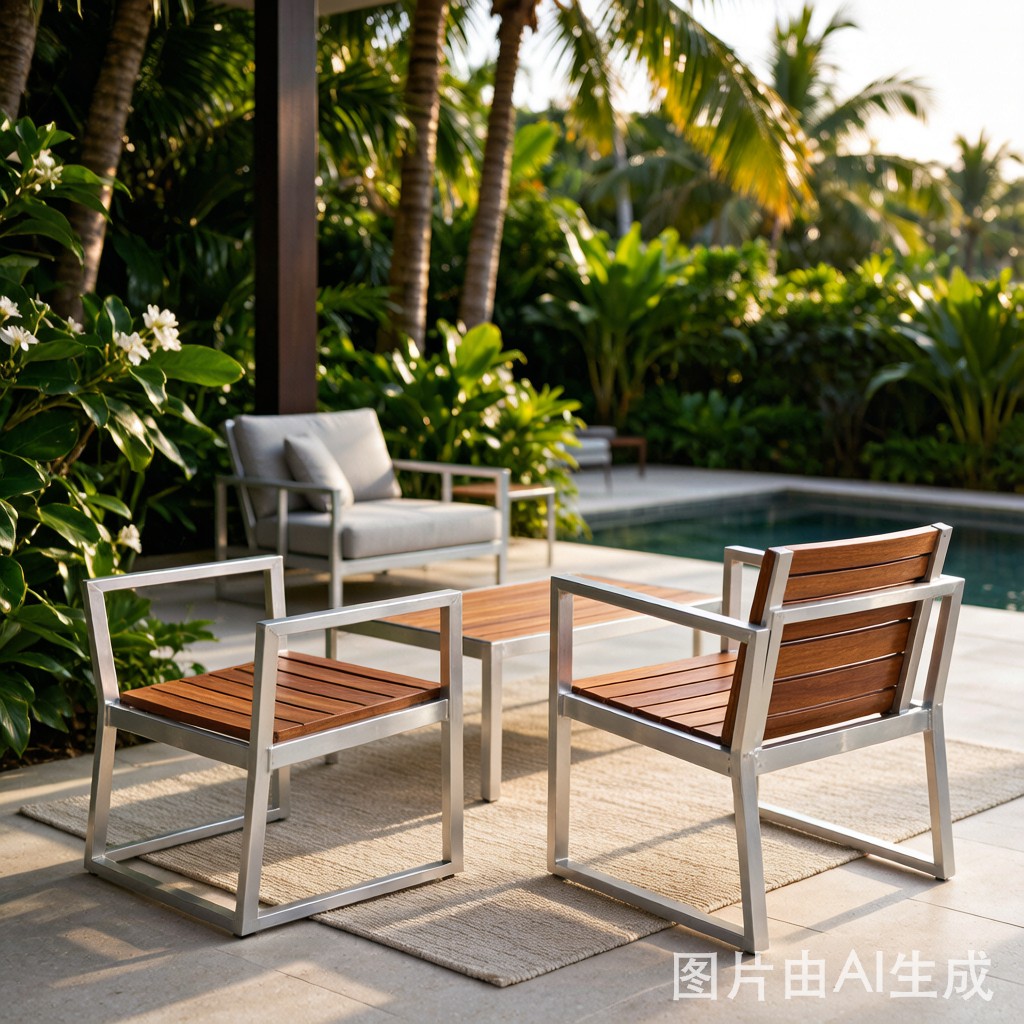
Design recommendation: For both materials, specify light-colored anodizing/powder coat (solar reflectance >60%) and ensure that skin-contact frame surfaces have wood, textile, or polyethylene slat overlays that thermally isolate occupants from metal surfaces.
## Fabrication and Assembly Methods
### Aluminum Fabrication
Extrusion: Aluminum 6063-T5 excels in complex extrusion profiles — hollow multi-cavity sections, integrated snap-fit grooves for slat attachment, and hidden fastener cha
els can be produced in single extrusion passes. Custom extrusion die cost: $2,000-5,000 (amortized over 500+ units).
Welding: MIG welding with 5356 filler rod provides 60-70% joint efficiency. TIG welding with 4043 filler achieves 70-80% joint efficiency. Post-weld heat treatment (artificial aging at 175°C, 8 hours) recovers 90% of base metal strength at critical joints.
Surface Finishing: Anodizing Type II (decorative, 5-15 μm) in light bronze, champagne, or natural silver provides excellent UV resistance and surface hardness (200-300 HV). Anodizing Type III (hard, 25-50 μm) for high-wear contact surfaces.
### Stainless Steel Fabrication
Tube Bending: CNC tube bending for 304/316 produces smooth curves with minimal ovality (<5%). Minimum bend radius: 2× tube OD for thin-wall, 2.5× for standard.
Welding: TIG welding with 308L (for 304) or 316L (for 316) filler provides full-strength joints. Post-weld passivation (ASTM A967) restores chromium oxide film at heat-tinted weld zones.
Surface Finishing: Brushed (#4 satin), mirror (#8), or bead-blasted finishes. Powder coating possible but less common than for aluminum; adhesion requires proper primer system (zinc chromate or epoxy primer).
## Lifecycle Cost Analysis (10-Year, SE Asian Installation)
| Cost Element | Aluminum 6063-T5 (anodized) | SS 304 (brushed) | SS 316 (brushed) |
|————-|—————————|——————-|——————-|
| Frame material cost (per unit) | $35-50 | $80-120 | $100-150 |
| Fabrication cost | $25-40 | $30-50 | $35-55 |
| Surface treatment | $10-20 (anodizing) | $5-10 (passivation) | $5-10 (passivation) |
| Shipping (per unit, 63% lighter) | $8-12 | $18-25 | $20-28 |
| Installation labor | $15-20 | $20-30 | $20-30 |
| Initial total | $93-142 | $153-225 | $160-273 |
| A
ual maintenance | $5-10 (cleaning) | $3-8 (cleaning) | $2-5 (cleaning) |
| Re-coating (year 7-8) | $25-40 | $0 (no coating) | $0 (no coating) |
| Fastener replacement (year 5) | $5-8 (galvanic) | $0 | $0 |
| 10-year total | $153-220 | $183-265 | $180-298 |
### Decision Matrix
| Priority | Recommended Material | Reasoning |
|———-|———————|———–|
| Lowest initial cost | Aluminum 6063-T5 | 40-55% lower upfront investment |
| Lowest lifecycle cost (inland) | Aluminum 6063-T5 | Anodized aluminum lasts 10-15 years inland |
| Lowest lifecycle cost (coastal) | SS 316 | No coating maintenance, no galvanic issues |
| Lightest weight (rooftop/portable) | Aluminum 6063-T5 | 63% weight reduction |
| Maximum thermal comfort | Aluminum 6063-T5 | Rapid cooling, higher conductivity |
| Maximum corrosion resistance (marine) | SS 316 | PREN 24-26, no coating dependency |
| Design flexibility (custom profiles) | Aluminum 6063-T5 | Extrusion enables integrated features |
| Zero maintenance goal | SS 316 | Self-passivating, no coating lifecycle |
## Conclusion
For most Southeast Asian outdoor lounge installations, anodized aluminum 6063-T5 delivers the optimal balance of cost efficiency, thermal comfort, structural adequacy, and design flexibility — particularly for inland and urban-coastal settings where proper anodizing and galvanic isolation provide reliable 10+ year service life. SS 316 is the clear choice for direct marine environments and premium hospitality installations where zero-maintenance performance and maximum corrosion resistance justify the higher initial investment.
Regardless of material selection, three design principles are essential for tropical longevity: (1) light-colored surface treatment for solar heat management, (2) thermal isolation overlays at skin-contact points, and (3) drainage design that prevents water accumulation at frame joints and fastener locations.
Explore TechMartSE’s outdoor lounge seating collection featuring both aluminum and stainless steel frame options engineered for Southeast Asian environmental conditions.