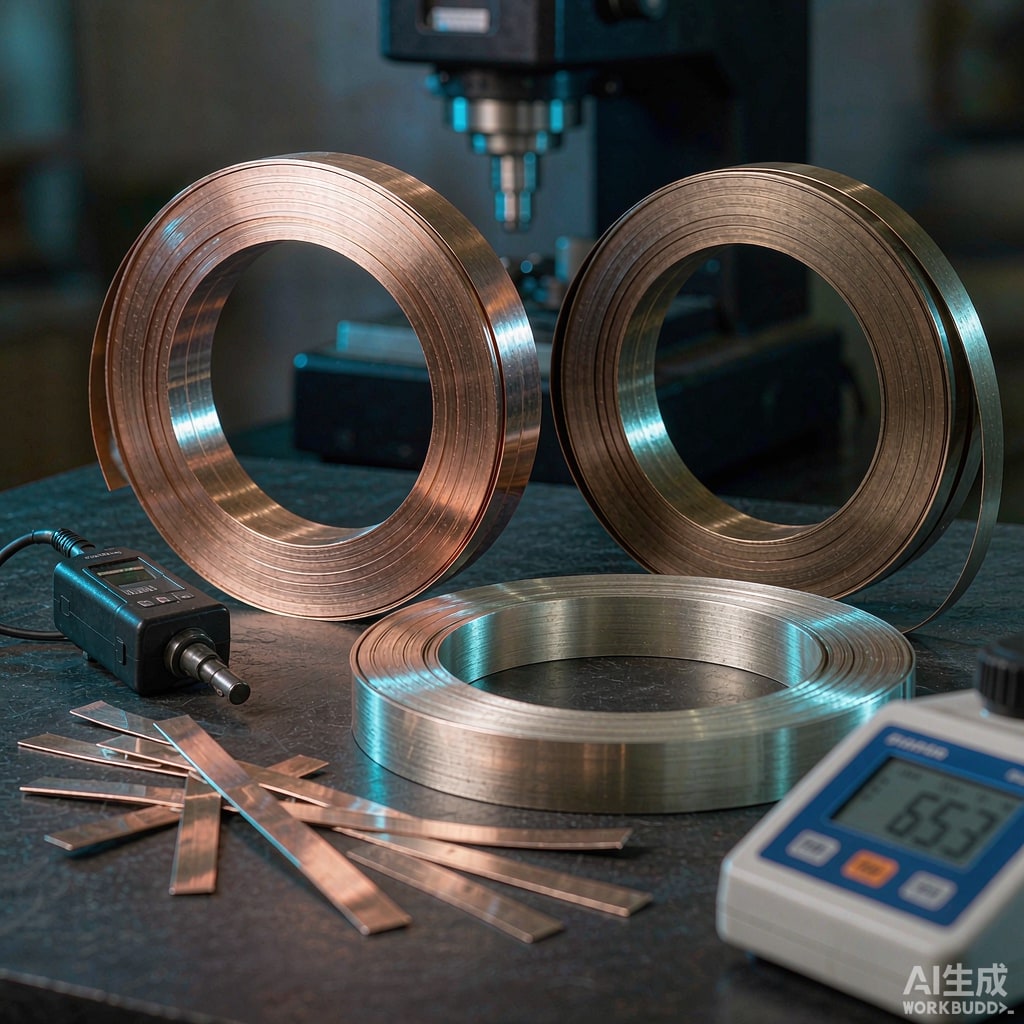
A buyer sends three quotes for the same stamped SMT contact: C11000 in H02, C19400 in H02, and C7025 in TM02. The unit prices differ by a factor of 1.8, all three are described as copper strip, and none of the quotes explains why. The answer lives on a curve that every co
ector designer works with but rarely writes down: hardness and electrical conductivity pull in opposite directions, and the alloy you choose decides how far along that curve you can afford to sit.
Why Strength and Conductivity Fight
Pure copper in the a
ealed state reaches 100 percent IACS, about 58 MS/m, and yields at only 60 to 70 MPa. It is useless as a spring. To make it stronger you introduce obstacles that impede dislocation motion, and those same obstacles scatter conduction electrons.
The physics in one paragraph
Matthiessen’s rule treats resistivity as a sum of independent scattering contributions: phonons from thermal vibration, impurities in solid solution, precipitates, grain boundaries and dislocations. Solid solution alloying is the most damaging per unit of strength because dissolved atoms distort the lattice and scatter electrons strongly. Precipitation hardening is far more efficient: fine particles pin dislocations with modest electron scattering. That is why precipitation-hardened alloys such as C7025, C18150 and C17200 deliver the best strength per point of conductivity, and why solid-solution alloys such as C26000 brass sit at the poor end.
Temper is a second, independent lever
Cold work raises yield strength through dislocation density while costing only two to four percent IACS, because dislocations scatter electrons much less than solutes do. This is the cheapest strength in the entire system. Temper designations follow EN 515 and ASTM B601: O61 a
ealed, H01 quarter hard, H02 half hard, H04 hard, plus mill-hardened tempers such as TM00 to TM08 used on precipitation alloys where the mill performs the ageing treatment.
The Practical Trade-Off Map
Above 90 percent IACS: contacts, not springs
C11000 tough pitch and C10200 oxygen-free copper sit at 100 to 101 percent IACS. Half hard gives 250 to 320 MPa yield, hard gives 350 MPa. These grades belong in current-carrying terminals, fuse clips, busbar tabs and solderable pads where the contact force comes from a separate spring or from screw torque. Do not use them as the spring element of a 500-cycle co
ector.
60 to 85 percent IACS: the co
ector sweet spot
C19400 copper-iron is the workhorse at 60 to 75 percent IACS with 400 to 500 MPa yield in H02 and excellent bend formability, which is why it dominates SMT terminals and lead frames. C7025 copper-nickel-silicon reaches 550 to 700 MPa at 40 to 55 percent IACS and holds normal force at 105 degrees C far better than brass. C18150 chromium-zirconium offers 80 to 85 percent IACS with 400 to 480 MPa after ageing, the natural choice for welding electrodes and high-current joints that must also resist softening.
Below 25 percent IACS: springs and nothing else
C17200 beryllium copper reaches 1000 to 1200 MPa at 17 to 22 percent IACS, with the best combination of fatigue life and stress relaxation resistance available in strip form. C52100 phosphor bronze lands at 700 to 850 MPa and 12 to 15 percent IACS at lower cost. Both are correct for high-cycle spring contacts with almost no current, and wrong for anything carrying more than a few amperes.
Stress Relaxation: the Spec Sheet Nobody Reads
Yield strength tells you what the contact does on day one. Stress relaxation tells you what it does after 1000 hours at 85 degrees C, and that is what causes field failures in warm enclosures. Measured as the percentage of initial bending stress lost at temperature, typical values after 1000 hours at 105 degrees C are 25 to 40 percent for brass, 10 to 20 percent for C19400, 5 to 12 percent for C7025, and under 8 percent for C17200.
Translate that into design. A co
ector specified with 1.0 N normal force and brass at 120 degrees C may relax to 0.6 N, which drops contact resistance and invites fretting corrosion. Either derate the operating temperature, raise the initial force, or change alloy. When a customer asks why a cheaper brass contact fails in a tropical installation, this curve is the answer.
Formability Constraints That Override the Numbers
Strength buys nothing if the strip cracks in the die. Express formability as minimum bend radius over thickness, R/t, measured both good way and bad way relative to rolling direction.
- C11000 O61: R/t 0.5 good way, 1.0 bad way
- C19400 H02: R/t 0.5 good way, 1.0 bad way
- C7025 TM02: R/t 1.0 good way, 2.0 bad way
- C17200 TH02: R/t 1.0 good way, 2.5 to 3.0 bad way
High-strength alloys punish tight radii. If the contact needs a 180 degree hem or a 0.15 mm inside radius on 0.20 mm strip, C7025 in a hard temper will fail inspection no matter how good its datasheet looks. Either soften the temper and accept lower yield, redesign the bend, or move the bend away from the grain direction during strip layout.
A Selection Workflow That Holds Up
Step 1: state the current
Compute the RMS current and allowable temperature rise. For 3 A in a 0.20 by 1.5 mm section, current density is 10 A/mm squared, and resistive heating plus co
ector resistance will dominate. Above 5 A, conductivity below 40 percent IACS becomes a thermal problem, not a voltage drop problem.
Step 2: state the cycles and temperature
Under 30 mating cycles and 85 degrees C, brass is viable. Above 500 cycles, or above 105 degrees C, only the precipitation-hardened and beryllium families hold normal force. Write both numbers into the drawing note, because purchasing will otherwise substitute on price.
Step 3: fix the bend geometry
Draw the worst bend and read R/t against the candidate alloys. This step usually eliminates one of three shortlisted grades immediately and saves a tooling iteration.
Step 4: price the total, not the kilogram
C7025 costs two to three times C11000 per kilogram. On a 0.15 gram contact at 20 US dollars per kilogram versus 9 US dollars, the delta is 1.65 US dollars per thousand parts. That is trivial against a field return, and often trivial against a plating re-specification, but it is real against a 5 million piece a
ual program. Run the arithmetic before negotiating.
Verification at Goods-In
Three checks catch almost every substitution. First, tensile test per ASTM E8 on a strip sample from each coil lot, comparing yield and elongation to the certified values. Second, conductivity by eddy current per ASTM E1004 on a flat coupon, which detects both wrong alloy and wrong temper. Third, a bend test to the drawing’s minimum radius, inspected at 10x for orange peel and micro-cracks. Add a 1000 hour stress relaxation test per ASTM E328 on the first article of any new alloy, then rely on certificates.
None of these tests is expensive. What is expensive is discovering in the field that the strip was brass when the drawing said copper-iron, because hardness and conductivity were never written as acceptance criteria in the first place.



