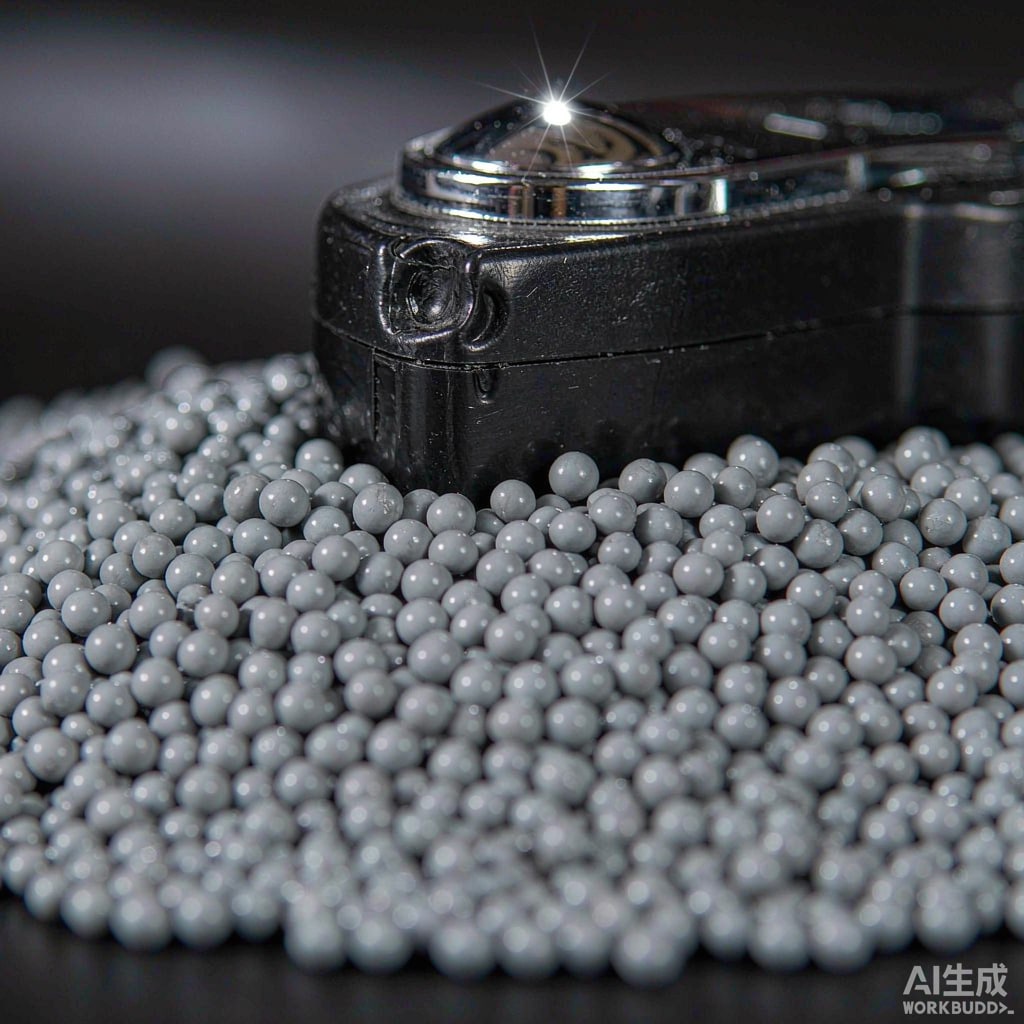
Drop performance is usually discovered late. The industrial design is frozen, the tool is cut, and the first moulded samples are dropped onto concrete from 1.2 metres in twenty-six orientations. A brittle corner crack sends the project back to the material datasheet, where the notched Izod figure looked reassuring and the ductile-to-brittle transition temperature was never printed at all.
Impact-modified nylon pellets exist precisely to close that gap. They trade a portion of stiffness and heat resistance for fracture energy, and when they are specified and moulded correctly they turn a housing that shatters at minus ten degrees into one that dents and holds. This guide covers what the modification actually does, the numbers worth asking for, and the part and process rules that decide whether the material or the mould gets the blame.
Why Standard PA6 and PA66 Crack
Unmodified polyamide is tough in thick sections and notch-sensitive in thin ones. A moulded corner with a sharp internal radius, a gate vestige, or a screw boss transition concentrates stress, and the semi-crystalline matrix has limited capacity to yield locally before a crack runs. Under a drop, strain rates reach the range of ten to a thousand per second, where polymers behave far stiffer and more brittle than the tensile curve at 50 mm per minute suggests.
Two further factors make it worse in electronics housings. Wall sections are thin, typically 1.2 to 2.0 mm, which removes the constraint that gives thick nylon its toughness. And polyamide absorbs moisture: at 50 percent relative humidity, PA6 holds roughly 2.5 percent water, which plasticises the matrix, drops modulus by 30 to 50 percent, and shifts the glass transition toward room temperature. That plasticisation helps impact but ruins dimensional stability and stiffness, which is why an unconditioned part measured in a dry lab behaves nothing like the same part after a week in Singapore.
How Toughening Actually Works
Impact modifiers are elastomer particles, typically 0.2 to 1 micrometre in diameter, dispersed in the polyamide matrix and chemically grafted to it. Common chemistries are EPDM grafted with maleic anhydride, polyolefin elastomer grafted with maleic anhydride, and SEBS grafted with maleic anhydride. The anhydride group reacts with the amine ends of the polyamide, so the rubber phase is covalently bonded rather than merely blended.
Under impact, those particles cavitate and relieve triaxial tension, allowing the surrounding matrix to shear yield instead of cleaving. The result is a large increase in fracture energy without a proportional loss of tensile strength.
Numbers worth specifying
- Notched Izod at 23 degrees C: unmodified PA6 sits near 5 kJ per square metre; a 15 percent modified grade reaches 15 to 25, and highly toughened grades exceed 40.
- Charpy notched at minus 20 degrees C: this is the number that predicts winter shipping failures. Ask for it explicitly, since room temperature data hides everything.
- Ductile-to-brittle transition temperature: the single most useful figure. Good modifiers push it below minus 30 degrees C; commodity grades sit near zero.
- Elongation at break above 50 percent and tensile modulus between 1600 and 2200 MPa, which keeps the housing stiff enough for a display bezel.
- Heat deflection temperature at 1.8 MPa of 55 to 75 degrees C for PA6, 65 to 90 for PA66. If the device runs warm, this becomes the limiting property.
Why Adding Glass Fibre Makes Drop Performance Worse
Glass fibre raises modulus and heat resistance and lowers coefficient of thermal expansion, which is why it appears in so many electronics housings. It also cuts elongation at break from several hundred percent to under three, and turns a ductile material into a brittle one at high strain rate. A 30 percent glass filled PA66 that looks excellent on a datasheet will often crack at a corner that a 15 percent rubber modified unfilled grade survives.
There is a middle path: hybrid systems with 10 to 20 percent glass plus rubber, or mineral plus rubber, which recover some stiffness while keeping elongation above 20 percent. They cost more and they mould less easily, but for a device that must pass both a drop test and a 1.0 Nm stiffness requirement they are often the only route.
Fibre also creates weld lines 30 to 50 percent weaker than the bulk, so gate position becomes a structural decision rather than a cosmetic one.
Part Design Rules That Decide the Outcome
- Wall thickness 1.2 to 2.0 mm, with gradual transitions no steeper than 1 in 3. Abrupt steps act as crack initiators.
- External corner radius at least 1.5 mm, ideally half the wall thickness or more. Sharp corners multiply stress by three to five times.
- Internal radius at ribs no less than 0.5 times wall thickness, and rib thickness 50 to 60 percent of wall to avoid sink and voiding.
- Keep weld lines out of impact zones. Move the gate to a non-critical edge, or add an overflow tab that pulls the weld line into a sacrificial region that is trimmed afterwards.
- Bosses co
ected to walls with gussets rather than standing free, and bosses never placed at a corner where two walls meet.
- Draft of at least 1 degree on all vertical faces; drag marks from insufficient draft create stress raisers on ejection.
Moulding Window
Polyamide processing is dominated by moisture control. Dry to below 0.10 percent, and preferably 0.05 percent, using a desiccant dryer at 80 to 100 degrees C for four to six hours. Damp pellets hydrolyse in the barrel, molecular weight falls, and impact strength drops by a third before anyone notices a visual defect.
For PA6, melt temperature of 240 to 270 degrees C and mould temperature of 70 to 90 degrees C; for PA66, melt 275 to 295 and mould 80 to 100. A hot mould is not optional for toughness: it raises crystallinity and relieves orientation, and a cold mould produces a part that passes dimensional inspection and fails the drop test. Injection speed should be high enough to fill before freeze-off but not so high that glass fibres or rubber domains orient along flow in a corner.
Testing That Reflects Reality
Free fall per IEC 60068-2-31 onto a rigid concrete or steel base, twenty-six orientations, from the height the product is actually dropped from in use, is the baseline. Two conditions matter more than the protocol itself. First, condition the samples before testing: 48 hours at 23 degrees C and 50 percent relative humidity per ISO 1110 for one set, and minus 20 degrees C for four hours for another. Second, instrument at least a few drops with an accelerometer inside the housing and correlate peak acceleration with the damage you observe, so the next design iteration has a target rather than an opinion.
Board level drop testing per JESD22-B111 answers a different question, namely whether the solder joints survive, and should not be confused with housing durability. Both matter for a handheld product and they fail for unrelated reasons.
Material Selection Summary
Toughened PA6 offers the best cost per unit of impact and moulds easily; toughened PA66 buys 15 to 25 degrees C more heat resistance for a modest premium and needs a hotter tool. PC/ABS delivers better dimensional stability and UV performance with no moisture conditioning, but it is notch sensitive and loses impact below minus 10 degrees C unless specially modified. Glass filled nylon should be reserved for structural parts that are not in the drop path.
The buyer checklist is short: ask for notched impact at both 23 and minus 20 degrees C, the ductile-to-brittle transition temperature, elongation at break, and the moisture content specification at the bag. A supplier who can provide those four numbers is selling an engineered compound. One who quotes only a room temperature Izod value is selling pellets.



