Why Tropical Smoking Booths Overheat
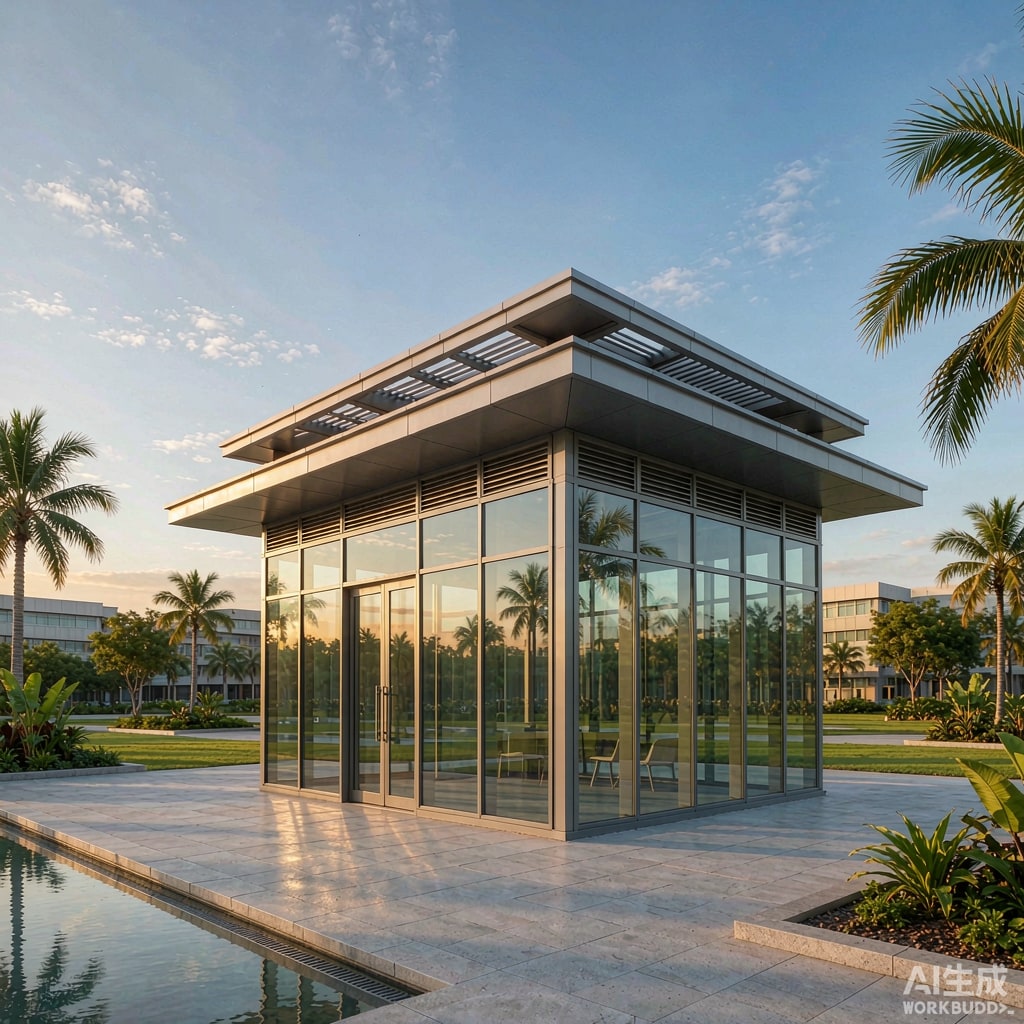
A smoking booth is a small box with a large glass area, a high occupant density per square meter, and an exhaust system that is deliberately pulling air out. Every one of those characteristics works against thermal comfort. A 6 m² booth holding four smokers has 1.5 m² per person, roughly four times the density of a normal office; add a glass facade facing west and you have a space that behaves thermally like a greenhouse with people in it.
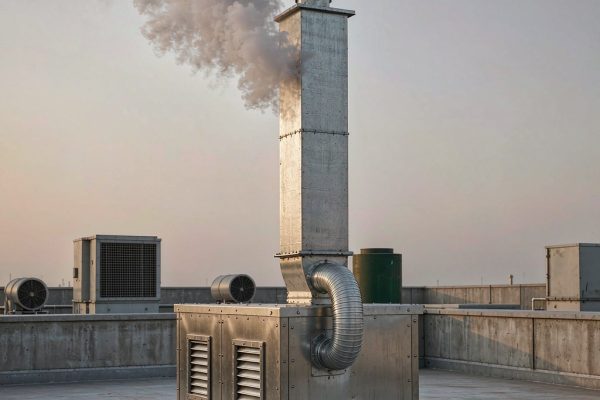
The exhaust requirement compounds the problem. Smoking rooms need 10 to 15 air changes per hour to control visible smoke and odor, which in a 15 m³ booth means 150 to 225 m³/h of air leaving continuously. If that air is replaced by untreated outdoor air at 33°C and 80% relative humidity, the booth can never be cooler than outdoors, no matter how much equipment you install.
Heat Load Calculation, Step by Step
Occupant load
A seated adult smoker releases roughly 75 to 85 W sensible heat and 55 to 65 W latent heat. For four occupants, budget 320 W sensible and 240 W latent — a latent load that ventilation alone ca
ot remove.
Solar gain through glass
This is usually the dominant term. Solar heat gain equals glass area × solar heat gain coefficient (SHGC) × incident irradiance.
Worked example: a 2.0 × 1.8 m west-facing window = 3.6 m². West facade irradiance in a tropical location peaks around 850 to 950 W/m² in the late afternoon. With ordinary 6 mm clear glass at SHGC 0.85, the gain is 3.6 × 0.85 × 900 ≈ 2,754 W. That single window can out-load four occupants by a factor of eight.
Switch to low-e glass at SHGC 0.30 and the same window contributes 972 W. Add a 900 mm horizontal overhang that shades the upper two-thirds of the glass for the critical hours and the effective load drops below 500 W. Passive measures do more than any equipment choice.
Envelope and infiltration
A thin steel sandwich panel in direct sun gains 60 to 120 W/m² of roof area if uninsulated. For a 6 m² booth that is another 360 to 720 W. A ventilated double-skin roof with 50 mm insulation cuts this by 70 to 85%.
Putting it together
A 6 m² tropical booth with clear glass on two sides, an uninsulated roof, and four occupants typically totals 3,500 to 5,000 W. With low-e glass, a shaded west facade, and an insulated ventilated roof, the same booth drops to 800 to 1,400 W. That is the difference between a 1.5 HP unit ru
ing continuously and a small unit that cycles.
Passive First: Shade, Orientation and Roof
Orientation
West-facing glass is the worst case in the tropics; east is next. If the site allows a choice, put the glazed side north or south, where incident irradiance is lower and more stable through the day. If orientation is fixed, prioritize shading on the west face over everything else.
Overhangs and vertical fins
A horizontal overhang sized at 0.6 to 0.9 times the window height blocks high-angle midday sun effectively. West sun is low-angle, so horizontal overhangs do little there; vertical fins or external louver screens on the west face work far better. Exterior shading is always more effective than interior blinds, because interior blinds absorb the heat inside the envelope.
Glass specification
Target SHGC of 0.25 to 0.35 with visible light transmission above 40%. Double-silver low-e on clear or tinted glass meets this. Reflective films applied after the fact work but degrade and can cause thermal stress cracking in tempered panes; specify coated glass from the factory instead.
Roof
Two proven options: a ventilated double roof (a second skin 100 to 150 mm above the main roof, open at the eaves and ridge) which removes most of the absorbed heat before it reaches the ceiling, or 50 mm polyurethane or PIR insulation under a light-colored metal roof. Light colors with high solar reflectance (SRI above 78) reduce surface temperature by 15 to 25°C compared with dark grey.
Airflow Strategy
Maintain negative pressure
The booth must sit at 5 to 10 Pa below the adjacent indoor space so smoke does not migrate out when the door opens. This is a code requirement in most jurisdictions and also protects the cooling strategy: positive pressure would push conditioned air into the building and pull humid outdoor air in unpredictably.
Make-up air path
Exhaust of 150 to 225 m³/h must be replaced. If the make-up air comes from outdoors, it brings the full outdoor enthalpy with it. Two options exist: draw make-up air from the adjacent conditioned building (cheap, but you are then air-conditioning the booth twice), or use a dedicated outdoor air unit with a cooling coil and dehumidification before it enters.
Short-circuiting is the most common airflow defect. If the supply diffuser is directly above the exhaust grille, most of the supply air exits without ever reaching the occupied zone. Place supply low and away from the exhaust, or use displacement ventilation from floor level.
Air movement for comfort
At 30°C, an air velocity of 0.5 to 1.0 m/s at head height raises perceived comfort by the equivalent of 2 to 3°C. Ceiling fans or low-level swirl diffusers achieve this for a fraction of the cost of cooling. Above about 1.5 m/s, ash and light papers start moving, which is unacceptable in a smoking space.
The evaporative cooling trap
Evaporative coolers look attractive in hot climates, but at 80% relative humidity the wet-bulb depression is only 4 to 6°C and the achievable temperature drop is 3 to 5°C, while the unit adds moisture to the space. In coastal Southeast Asia they usually make the booth feel clammy. Reserve them for dry inland sites.
Equipment Choices
- Split system with dedicated outdoor air is the default for enclosed booths. Size on the calculated load plus 15% margin, and specify a coil coating rated for coastal corrosion.
- Dehumidification matters as much as cooling. Latent load from four occupants plus infiltrating humid air can exceed 1.5 kW. A unit that removes sensible heat but leaves humidity at 75% will still feel oppressive.
- Corrosion protection for coastal sites: 316 stainless fasteners, epoxy-coated coils, and IP55-rated electrical enclosures. ISO 9223 category C4 or C5 environments destroy standard galvanized hardware in 18 to 24 months.
Comfort Verification in the Field
Do not accept a commissioning report that lists only supply air temperature. Measure operative temperature (a globe thermometer reading that includes radiant effects from sun-heated glass), relative humidity, and air velocity at seated head height in at least three positions. Target 26 to 28°C operative temperature at 60 to 70% RH in a tropical smoking booth. Test at 4 pm on a clear day, not at 9 am: most comfort complaints occur in a two-hour late-afternoon window.
Specification Checklist
- Glass SHGC 0.25–0.35 with exterior shading on west and east faces.
- Insulated or double-skin roof, light color, SRI above 78.
- Exhaust 10–15 ACH with 5–10 Pa negative pressure and documented make-up air path.
- Cooling sized on a written load calculation, not on floor area rules of thumb.
- Latent capacity checked explicitly against occupant and infiltration moisture.
- Air velocity 0.5–1.0 m/s in the occupied zone without draft complaints.
- Coastal corrosion package specified for all hardware, coils and enclosures.
- Commissioning performed in late afternoon with operative temperature measurement.