A smoking booth’s enclosure, filtration and ventilation get the engineering attention. The door gets ignored — until it stops closing, the seal gapes, and smoke drifts into the corridor. Then the whole installation is judged by a hinge. On a busy commercial site, a booth door can cycle 150–300 times a day, which means 100,000 cycles a year and a million over a decade. That is aircraft-grade duty on hospital-grade hardware budgets. Specifying it deliberately is the difference between a five-year asset and a five-year maintenance log.
Why the Door Is the Weak Link
A smoking booth door has three jobs that fight each other. It must self-close reliably to keep negative pressure and smoke containment. It must seal against leakage at the perimeter, because a 3 mm gap around a 2 m door is a large uncontrolled opening. And it must open easily for elderly or mobility-restricted users, which limits how hard the closer can pull.
The containment math
A typical booth holds 5–15 Pa negative pressure relative to the corridor. A door perimeter of 6 m with a 2 mm average gap has an effective leakage area of 0.012 m². At 10 Pa that leaks on the order of 100–200 m³/h of smoky air — comparable to the exhaust capacity of a small booth. Sealing is not cosmetic; it is the containment system.
Door Closers: Selecting the Right Mechanism
Spring closer with hydraulic damping
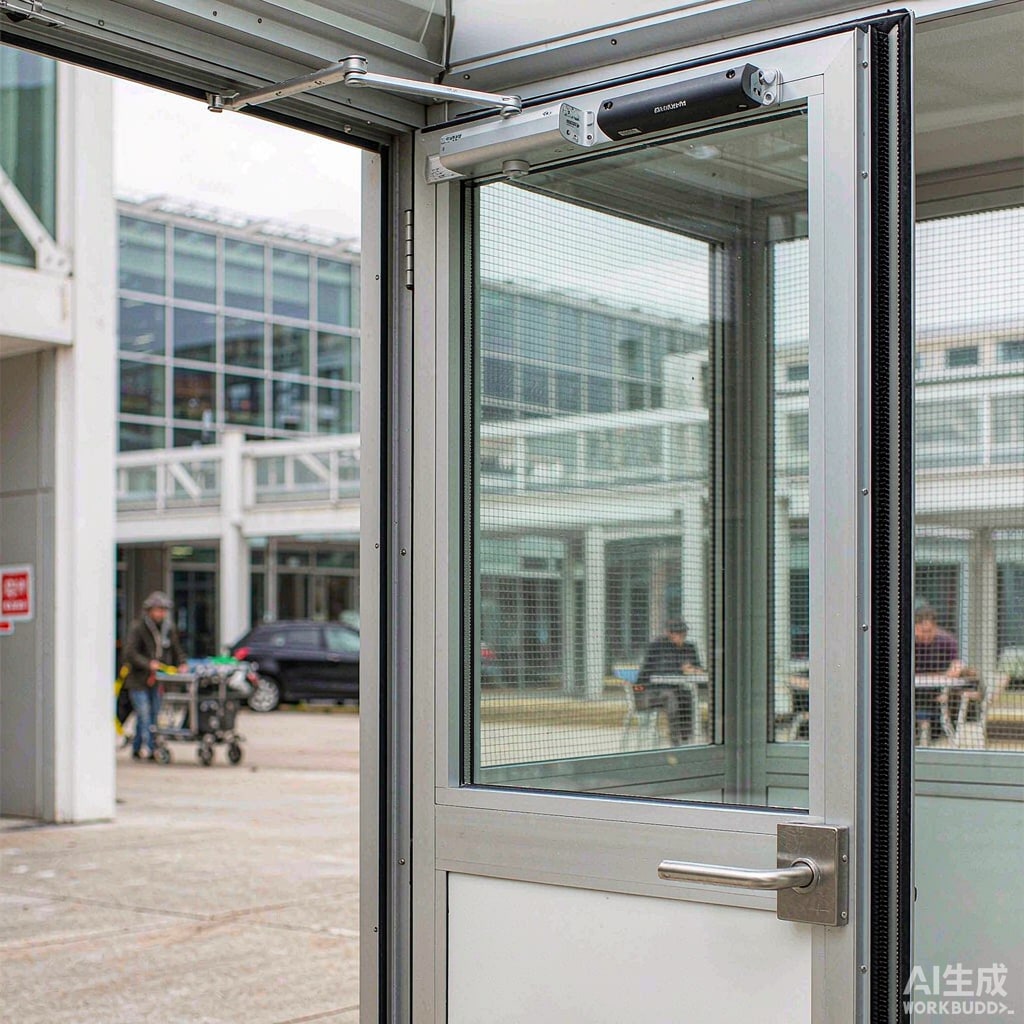
The default. Rated by door mass and width — an EN size 2 closer suits doors up to about 40 kg, size 3 up to 60 kg, size 4 up to 80 kg. Force is adjustable within a band, typically closing force classes 1–4 under EN 1154. Specify a closer with backcheck (protects the wall and hinges from slamming) and delayed action if elderly users are expected. Delayed action holds the door open for 20–30 seconds before closing, which addresses the common complaint that the door fights the user.
Hydraulic closers are the highest-maintenance item in the assembly. Oil seals harden, damping changes with temperature, and violent slamming accelerates failure. Look for closers rated to at least 500,000 cycles and specify a brand with a published cycle rating rather than an unbranded equivalent.
Concealed floor springs
Better aesthetics and vandal resistance, but floor boxes collect grit and water. In outdoor booths, water ingress into a floor spring is the classic failure. Use only sealed boxes with a drainage path, and prefer them indoors.
Overhead concealed closers in the frame
Good compromise for glass doors: the mechanism sits in the header, protected from weather and tampering. Costlier and harder to service, but cycle life is typically excellent because the mechanism is shielded from dirt.
Power-assisted and automatic doors
For high-traffic airport or mall installations, a low-energy automatic operator with activation sensors solves both accessibility and containment. Expect higher capital cost and a maintainable power path into the booth — an under-specified power drop is the usual retrofit mistake.
Perimeter Seals: Where the Leakage Is
Brush seals
Nylon or polypropylene brush strip in an aluminium or PVC carrier, fitted to the door stop or the frame. Brush seals tolerate imperfect door alignment, tolerate floor irregularities, and cost little. Their weakness is that they do not form a tight pressure barrier — they reduce leakage, not eliminate it. Excellent for the bottom of doors and for sliding elements.
Magnetic seals
A flexible magnetic strip with a mating steel or magnetic counter-strip. This forms a genuine pressure-tight barrier and self-aligns on closing, forgiving small misalignment. The magnet holds the door shut with 20–40 N per metre, which must be subtracted from the closer’s effective closing force — verify the closer can overcome magnet pull plus the negative-pressure differential, or the door will hang ajar. Magnetic seals are the right choice for negative-pressure booths and cold-climate installations.
Extruded EPDM or silicone gaskets
Hollow bulb or lip profiles provide the best airtightness when the frame is rigid and the door is well aligned. Specify silicone where the booth is cleaned aggressively or exposed to high surface temperatures; EPDM for general use. Note that gaskets add closing resistance and require a closer with more force.
Drop-down automatic door bottoms
A mechanism that lowers a seal to the floor as the door closes. Best airtightness at the floor line, but adds a moving part exposed to grit. Use where leakage matters and thresholds ca
ot be raised.
Hinges, Handles and Material Durability
Hinges
For glass doors, specify patch fittings or continuous (piano) hinges — the latter distribute load over the full leaf height, resist sagging, and can add a conductive path. For steel doors, three 100 mm ball-bearing stainless butt hinges comfortably carry a 60 kg leaf.
Handles and hardware finish
304 stainless is the baseline; 316 for coastal or heavy-cleaning sites. Powder-coated aluminium is acceptable indoors but chips at screw heads, which is where corrosion starts. Avoid zinc-plated steel hardware in any smoking booth — the combination of humidity, condensate, and cleaning chemicals attacks it quickly.
Access control and exit hardware
Where the booth has controlled access, the lock must fail-safe in the egress direction. Do not spec a magnetic lock without a break-glass or request-to-exit device and a door position switch that reports a held-open door — a booth door propped open destroys containment silently.
Commissioning Tests Worth Doing
Six checks at handover
- Close the door from a 30° open position; measure closing time. Target 4–8 seconds with no audible slam.
- Check that the closer fully latches against the seal and against negative pressure, at the maximum design exhaust flow.
- Measure gap uniformity with a feeler gauge at four points per side; variance should be under 1 mm.
- Confirm the door opens with less than the local accessibility force limit — commonly 30–50 N.
- Cycle the door 100 times and re-check the closer setting; new gaskets settle.
- With a smoke pencil, probe the perimeter at working pressure and record any visible leakage path.
Log these values. They become the reference for the maintenance contract, and a drifting closing time is the earliest signal of a failing closer.
Maintenance That Extends Life
Lubricate hinges quarterly with dry-film or silicone lubricant, never grit-trapping grease. Inspect seal compression a
ually and replace brush strips once bristle protrusion falls below 6 mm. Clean iron dust from magnetic strips — common on industrial sites and fatal to the seal. Replace closer oil seals before failure, not after.
Specify hardware with published cycle ratings, keep the seal and the closer designed as one system, and commission with measurements. A booth door specified this way costs perhaps 15% more at purchase and, in most installations, less to own every year thereafter.