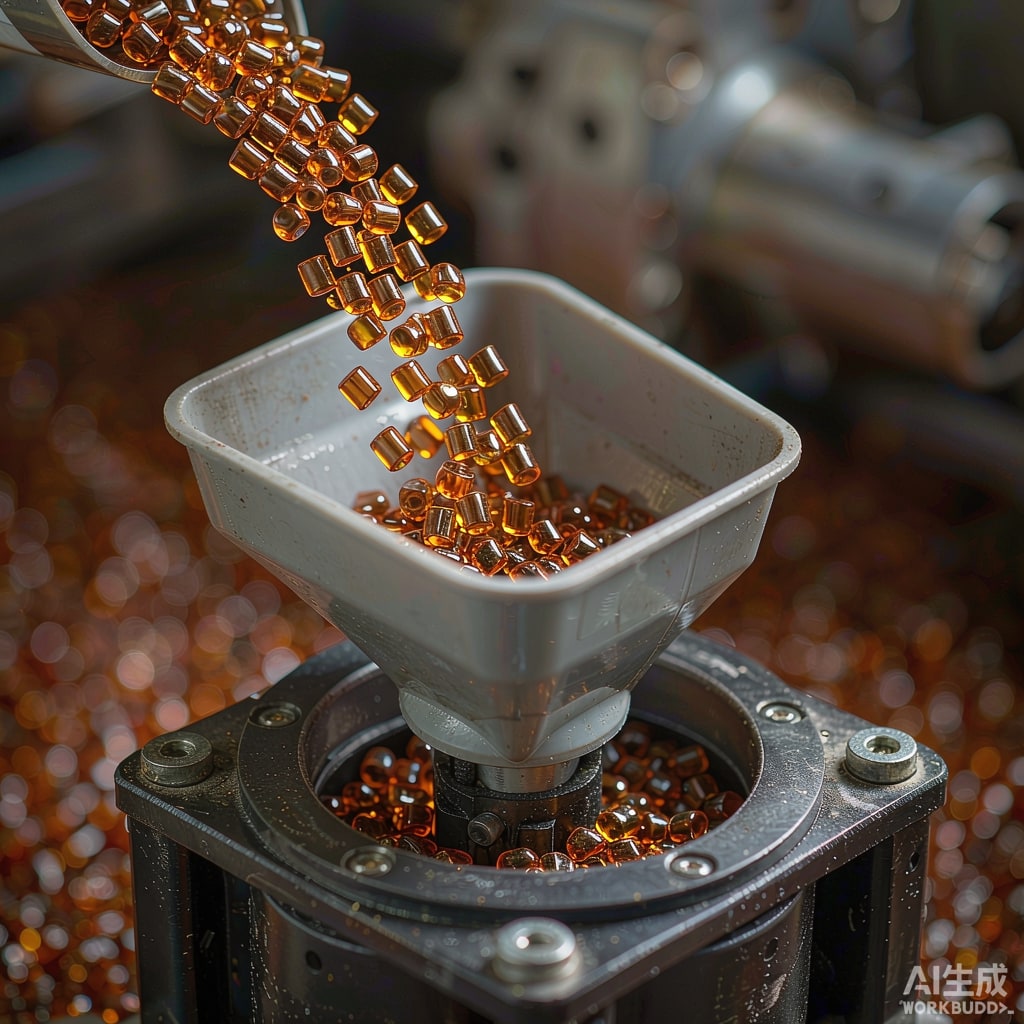
PEI: The Engineering Thermoplastic That Needs No Filler to Perform
Polyetherimide (PEI), best known under the Ultem brand, occupies a distinctive position among engineering plastics: unlike PPS, PEEK, or glass-filled nylons, PEI achieves its remarkable property profile in unfilled form. That matters for electronics manufacturing — unfilled grades mold with lower wear on tooling, deliver superior surface finish, offer natural transparency in some grades, and avoid the anisotropic warpage that glass fibers introduce. For aerospace interiors, electrical insulators, co
ector housings, and reflector components, PEI plastic pellets are often the most economical path to extreme-temperature, flame-retardant performance.
Property Profile That Matters for Electronics
PEI’s glass transition temperature of 217°C underpins a continuous-use rating around 170–200°C, comfortably above reflow-adjacent process temperatures for hand assembly and compatible with automotive under-hood electronics and industrial environments near heat sources. Inherent flame retardance is the second headline: unmodified PEI achieves UL94 V-0 at 0.25 mm and passes FAR 25.853 aerospace cabin-flammability requirements without any halogenated or phosphorus additives — meaning no additive migration, no embrittlement over time, and cleaner compliance documentation.
Electrically, unfilled PEI offers a dielectric strength around 30 kV/mm, stable dielectric constant (approximately 3.15) across frequency, and low dissipation factor — sufficient for co
ector insulators, coil bobbins, and ante
a components. Its high surface reflectivity (natural grades reflect over 90% in the visible range) makes it a favorite for LED reflectors, where an unfilled PEI competes directly with aluminum while offering molding freedom. Dimensional stability is excellent: low and uniform shrinkage (0.5–0.7%), low moisture-driven size change, and creep resistance that holds tolerances over years of loading.
Where PEI Beats — and Loses to — Its Neighbors
Compared with PPS, PEI wins on impact strength, transparency options, and inherent flame retardance; PPS wins on chemical resistance and continuous temperature (200°C+). Compared with PEEK, PEI delivers roughly 70% of the thermal performance at 20–30% of the material cost. Compared with polycarbonate, PEI survives temperatures PC ca
ot approach and carries inherent flame ratings without additive load. Choose PEI when you need V-0 at thin walls plus sustained 170°C+ service; move to PPS or PEEK only when chemistry or temperature demands it.
Processing PEI Pellets: The Non-Negotiables
Drying
PEI is hygroscopic enough to punish sloppy drying. Moisture above roughly 0.02% causes hydrolytic chain scission at melt temperatures, dropping impact strength and generating splay. Dry at 150°C for 4 hours minimum (desiccant dryers preferred), and keep the hopper sealed with dry air or nitrogen. Parts that splay or show brittle failure in drop tests are usually traceable to wet resin or resin that sat at melt temperature too long.
Molding Window
Melt temperature for standard grades runs 340–400°C with mold temperatures of 140–170°C. The high mold temperature is not optional — it develops surface gloss, reduces residual stress, and is essential for parts that will be metallized or see thermal cycling. Injection pressure requirements are moderate, but PEI’s melt viscosity is high; generous ru
ers, vents, and gate sizing prevent fill problems on thin walls. Reinforced grades (PEI GF30 and similar) exist when stiffness dominates the requirement, at the cost of anisotropic shrinkage and tool wear.
Tooling should anticipate PEI’s low shrinkage and the possibility of sticking in deep cores; draft angles of 1–2 degrees and polished cores prevent ejector marking. Because unfilled PEI is abrasive-light, standard P20 or H13 tool steels give long life — a genuine cost advantage over glass-filled resins.
Electronics Applications Where PEI Excels
Reflector and lighting components: natural PEI’s reflectivity plus thermal stability makes it the standard for LED lighting reflectors and socket components that sit close to the source. Aerospace interiors and avionics: FAR 25.853 compliance without additives, plus low smoke and toxicity, make PEI the default for co
ector bodies, latch housings, and cabin electronics fixtures. Electrical insulation: high dielectric strength and tracking resistance suit busbar insulators, terminal blocks, and high-voltage components. Fluid-contact electronics: PEI’s FDA-compliant grades and steam-autoclave survivability suit sensors and co
ectors in food, medical, and industrial processing equipment where repeated sterilization is routine.
Specification Checklist
When qualifying a PEI pellet supplier, pin down: UL94 rating and wall thickness at which it is certified (V-0 at 0.25 mm vs 1.5 mm is a real difference), the continuous use temperature rating with supporting RTI (relative thermal index) from UL 746B, dielectric strength test method, lot-to-lot melt flow consistency, and drying/delivered moisture guarantees. For aerospace work, verify material certification traceability (e.g., conformity to specific Ultem 1000/1010/1100 equivalents) — the PEI family has enough grade variation that a datasheet headline is not a specification.
For electronics manufacturers balancing temperature, flame, and cost, PEI pellets hit a productive middle path: more thermal headroom than PC, PPS, or PA66, inherent compliance without additive chemistry, and processing that rewards attention to drying and mold temperature with stable, dimensionally precise, cosmetically clean parts.



