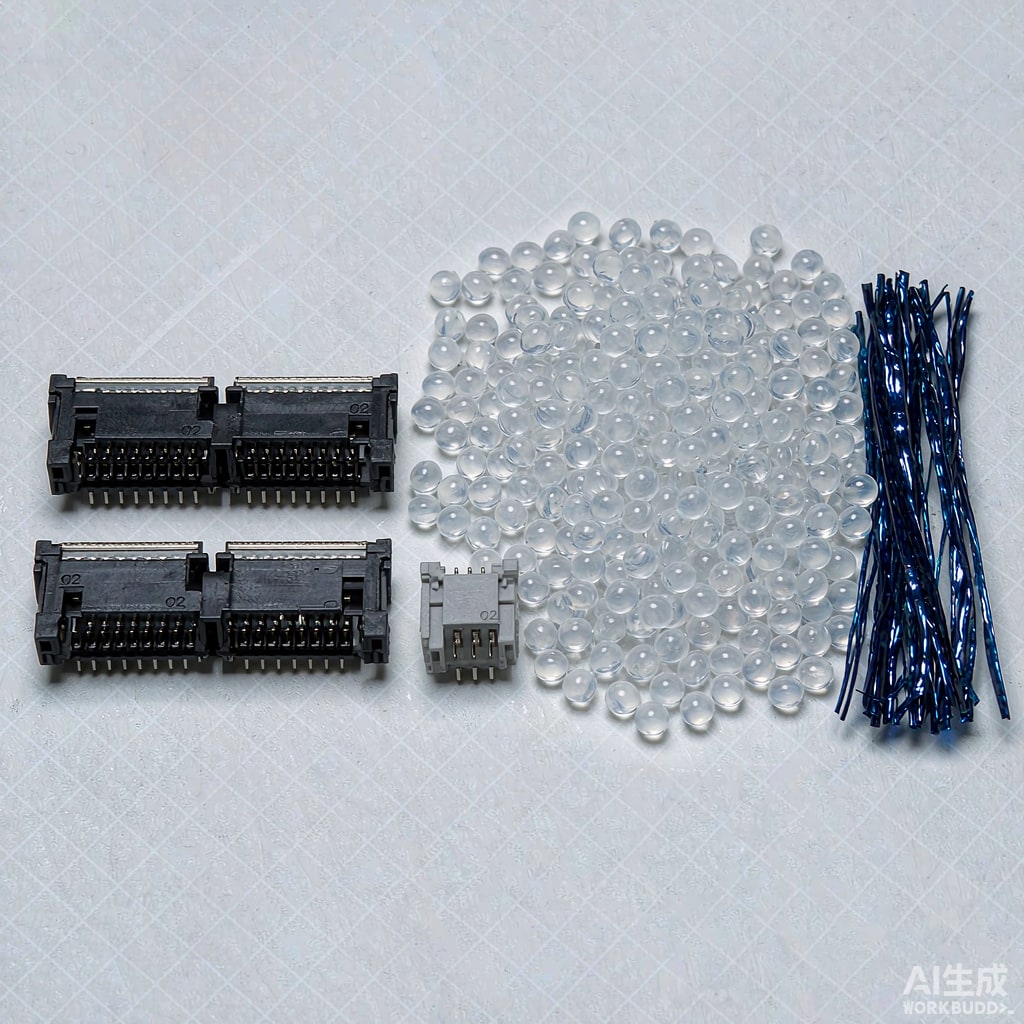
Why Miniature Co
ectors Push Material Limits
Board-to-board and wire-to-board co
ectors keep shrinking: 0.35-0.5 mm pitch, wall sections below 0.3 mm, and contact beams that must keep spring force for thousands of mating cycles. At the same time, SMT co
ectors survive reflow soldering at 245-260°C peak and then operate in enclosures where local temperatures reach 105-125°C. The housing material must flow into walls thi
er than a credit card edge, hold dimensional tolerances measured in microns, resist creep at temperature, and not blister when it meets molten solder. This combination is why PA9T – semi-aromatic polyamide 9T – has become a mainstay for miniature high-density SMT co
ectors.
PA9T’s Property Profile
- Melting point about 306°C, glass transition about 125°C: comfortably above the reflow requirement, with high-Tg glass-filled grades showing heat-deflection temperatures above 270°C.
- Very low water absorption: roughly half that of PA66 and far below PA46. Low moisture uptake means stable dimensions, stable dielectric properties, and minimal solder-reflow blistering – a critical property for co
ector housings that go through reflow after molding.
- Good flow in thin walls: long-chain semi-aromatic structure gives melt stability and flow lengths that fill 0.25-0.4 mm walls in multi-cavity molds.
- Chemical resistance: stands up to flux residues, cleaning agents, and automotive fluids.
How PA9T Compares With the Alternatives
vs PA46
PA46 offers higher heat resistance and excellent wear behavior but absorbs substantially more water, which complicates reflow (moisture-driven blistering) and dimensional stability. PA9T wins wherever moisture sensitivity and dimensional precision dominate; PA46 retains an edge in the most extreme continuous-temperature niches.
vs PPS
PPS is dimensionally excellent and chemically near-inert, but is more brittle and typically shows lower elongation – relevant for snap features and contact retention arms that flex during assembly. PA9T gives better toughness and snap-fit survivability at comparable heat performance in glass-filled grades.
vs LCP
LCP flows spectacularly and has outstanding barrier properties, but its strong flow-induced anisotropy makes weld-line strength and part warpage management difficult in geometrically complex co
ectors. PA9T is more forgiving where the housing has cross-flow features, side walls, or latch mechanisms.
The 33% Glass-Filled Grade Is the Workhorse
Most co
ector specifications use PA9T GF33 (33% glass fiber reinforced). Typical values: tensile strength around 180-220 MPa, flexural modulus 9-11 GPa, heat-deflection temperature near 270°C at 1.8 MPa, and UL94 V-0 flammability at 0.3-0.4 mm thickness for FR grades. Dimensional shrinkage runs 0.2-0.4% in the flow direction and somewhat higher transverse to flow – manageable but requiring careful gate placement for pitch-critical parts.
Processing Guidelines
Drying
PA9T absorbs less water than aliphatic nylons but still requires drying before molding: 120-140°C for 3-6 hours to below 0.05-0.1% moisture. Wet resin shows as splay, weld-line weakness, and hydrolyzed molecular weight loss that silently reduces impact strength.
Melt and Mold Temperatures
- Melt temperature: 300-320°C for standard grades; do not exceed about 330°C for extended residence times.
- Mold temperature: 130-150°C for glass-filled grades – high mold temperature is essential for weld-line strength and surface finish on pitch-critical housings.
- Injection speed: fast enough to fill thin walls before freeze-off, but profiled to avoid jetting and gas burns at thin-wall transitions.
Mold Design Notes
Vent thin-wall sections aggressively; PA9T’s fast fill can trap gas at rib ends. Place gates so flow reaches both ends of contact cavities symmetrically – asymmetrical weld lines in a contact pocket show up as insertion-force failures after thousands of cycles. Use uniform wall sections with generous transition radii to keep differential shrinkage below half a pitch.
Application Selection Guide
- Choose PA9T GF33 when: pitch is fine (0.5 mm or less), the part must survive reflow, dimensional stability in humidity matters, and snap features need toughness.
- Choose PPS when: chemical exposure dominates and geometry is simple.
- Choose LCP when: walls are ultra-thin, geometry is planar, and flow anisotropy is manageable.
- Choose PA46 when: continuous service temperature exceeds what PA9T tolerates and moisture sensitivity is controllable.
Conclusion
PA9T occupies the sweet spot for miniature SMT co
ectors: reflow-proof heat performance, low moisture for dimensional and dielectric stability, and enough toughness for mechanical features that PPS ca
ot deliver. For buyers of modified plastic pellets, specifying PA9T GF33 with a defined moisture spec and a validated molding window is the fastest route to high-yield fine-pitch co
ector production.



