The Tropical Design Point Is Not the Datasheet Ambient
Indoor products are designed around 25-35°C ambient. Outdoor telecom cabinets in Southeast Asia face a different reality: 40-45°C afternoons, solar radiation adding 15-30 °C of surface heating on dark enclosures, and humidity near saturation for months. An enclosure left in direct sun can reach 70°C on its outer skin; a poorly designed cabinet’s internal air can exceed 60°C. Designing to ‘ambient’ without accounting for solar gain and humidity is the most common failure of first-generation tropical deployments.
Establish the Real Thermal Budget
Start with three numbers, not one:
- Design ambient: use 45°C as the air temperature for a shaded or ventilated cabinet, and add solar gain explicitly for sun-exposed installs.
- Solar load: peak insolation of 900-1,100 W/m² on the sun-facing surfaces. Absorptivity depends on finish – light colors absorb 0.3-0.5, dark powder coat 0.7-0.9. Reflective or light-colored finishes cut solar input dramatically.
- Component derating ceiling: most SMT electrolytic capacitors and power semiconductors want case temperatures at or below 85-105°C. Work backward from the most sensitive part to define the allowed internal air temperature.
Electrolytic capacitor life roughly doubles for every 10 °C reduction – in tropical service, capacitor temperature is frequently the product’s true life limiter, ahead of semiconductors.
Sealed vs Filtered Airflow: The Humidity Decision
Sealed (Heat Exchanger or Passive)
A fully sealed enclosure with an internal air-to-air heat exchanger (or pure passive dissipation for loads under about 100 W) keeps humid, salty air out of the electronics bay. This is the default choice for coastal and high-pollution sites. Costs: added hardware, exchanger thermal resistance (typically 0.02-0.05 °C/W for a 200 W unit), and internal fans that still see the humid environment but at least avoid direct salt fog.
Filtered Forced Air
Drawing filtered ambient air through the cabinet is cheaper and removes heat efficiently, but it pulls humid air across every board. Condensation risk appears during rapid temperature swings – a rain shower cooling the enclosure skin while internal air stays warm produces condensate on boards. If forced air is chosen, conformal coating on SMT assemblies becomes mandatory, filters need a service schedule the site will actually follow, and the enclosure should maintain slight positive pressure to avoid ingesting unfiltered leakage.
Solar Gain Control That Actually Works
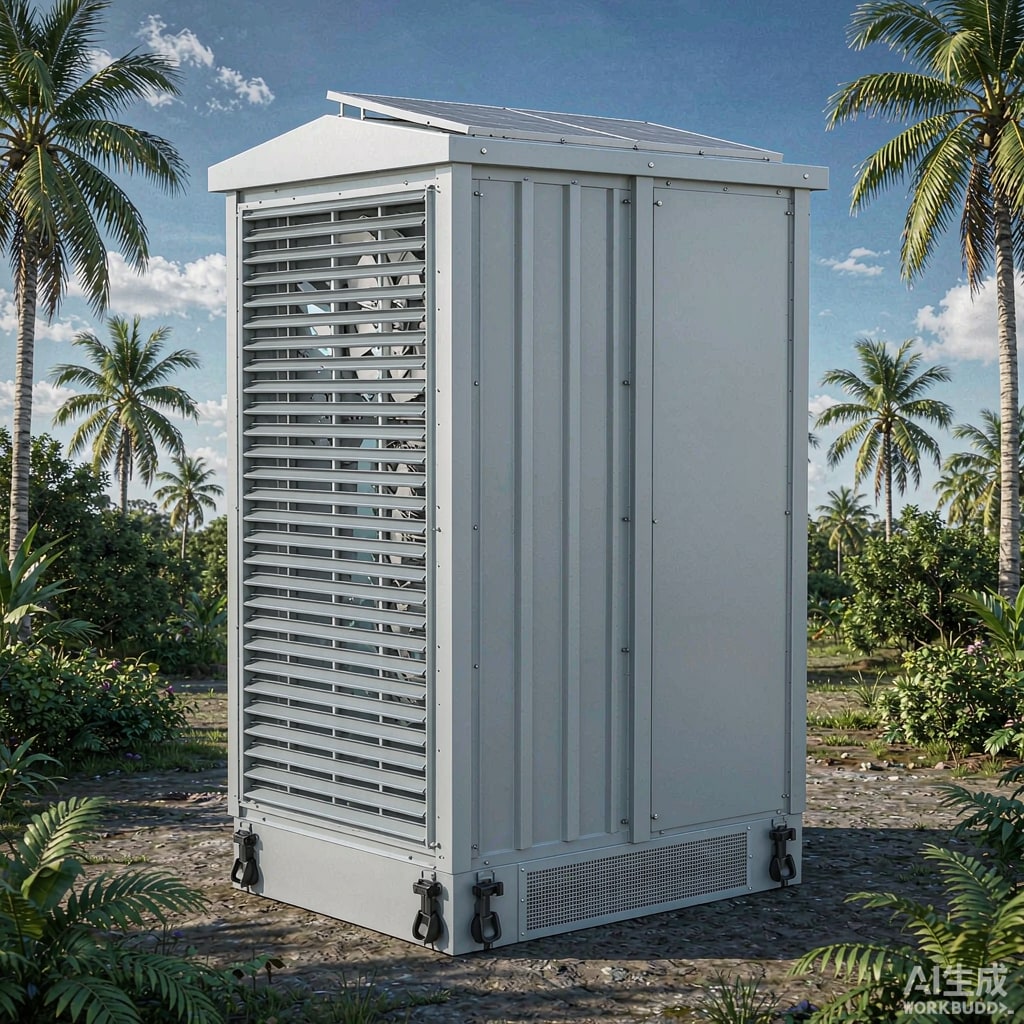
- Double-skin or sunshield architecture: an outer shield 20-50 mm off the main enclosure, ventilated top and bottom, intercepts most direct radiation. This is the single most effective passive measure in tropical service.
- High-reflectance finish: light gray or white powder coat with solar absorptivity below 0.4 can drop skin temperature 10-15 °C versus dark paint.
- Orientation and shading: mount under eaves or shade structures where possible; minimize west-facing exposure, which coincides with peak afternoon air temperature.
Component-Level Derating for 45°C Service
Derating policy should be written, not improvised:
- Power semiconductors: limit junction temperature to 80% of the absolute maximum in the design point, and verify at 45°C ambient plus solar case worst case.
- Electrolytic capacitors: specify 105°C-rated, 2,000-5,000 hour parts, then calculate life at actual predicted case temperature – not the 105°C catalog condition.
- Magnetics and co
ectors: check temperature-rise ratings against 45°C ambient, since most standards assume 40°C.
- PSU derating curves: many catalog power supplies derate above 40°C or at altitude; verify margin at the real operating point.
Humidity and Corrosion: The Second Failure Mode
Thermal margin means little if the boards corrode. Tropical-coastal deployments need: conformal coating (acrylic for reworkability, silicone for flexibility and wide temperature), ventilation design that avoids stagnant humid pockets, desiccant or heater strategies for sealed units that cycle thermally (breathing draws moisture in as the internal air cools and contracts), and co
ector plating choices that resist fretting corrosion in constant humidity. Galvanic compatibility between enclosure hardware, fasteners, and grounding straps matters more at 90% RH than in any office environment – 316 stainless or coated steel hardware is worth the premium.
Verification Testing Before Deployment
- Thermal soak test: run the loaded unit in a chamber at 45°C, 90% RH for 24-72 hours with telemetry on the hottest capacitor and semiconductor case temperatures.
- Solar simulation: lamp array or calculated offset – verify internal air stays within budget with the sun-exposure penalty included.
- Condensation cycle: temperature/humidity cycling from 25°C/90% RH to 45°C to force condensation events, followed by functional test and insulation-resistance checks.
- Field pilot: instrument one installed unit at a real site through at least one full monsoon season before fleet rollout.
Conclusion
Tropical outdoor electronics fail from the combination of heat, sun, and humidity, not from any single one. Budget 45°C plus solar gain, prefer sealed architectures for coastal sites, apply written derating to capacitors and semiconductors, and test with humidity cycling – not dry heat alone. Designs that respect all three stressors routinely achieve field lives measured in decades rather than seasons.