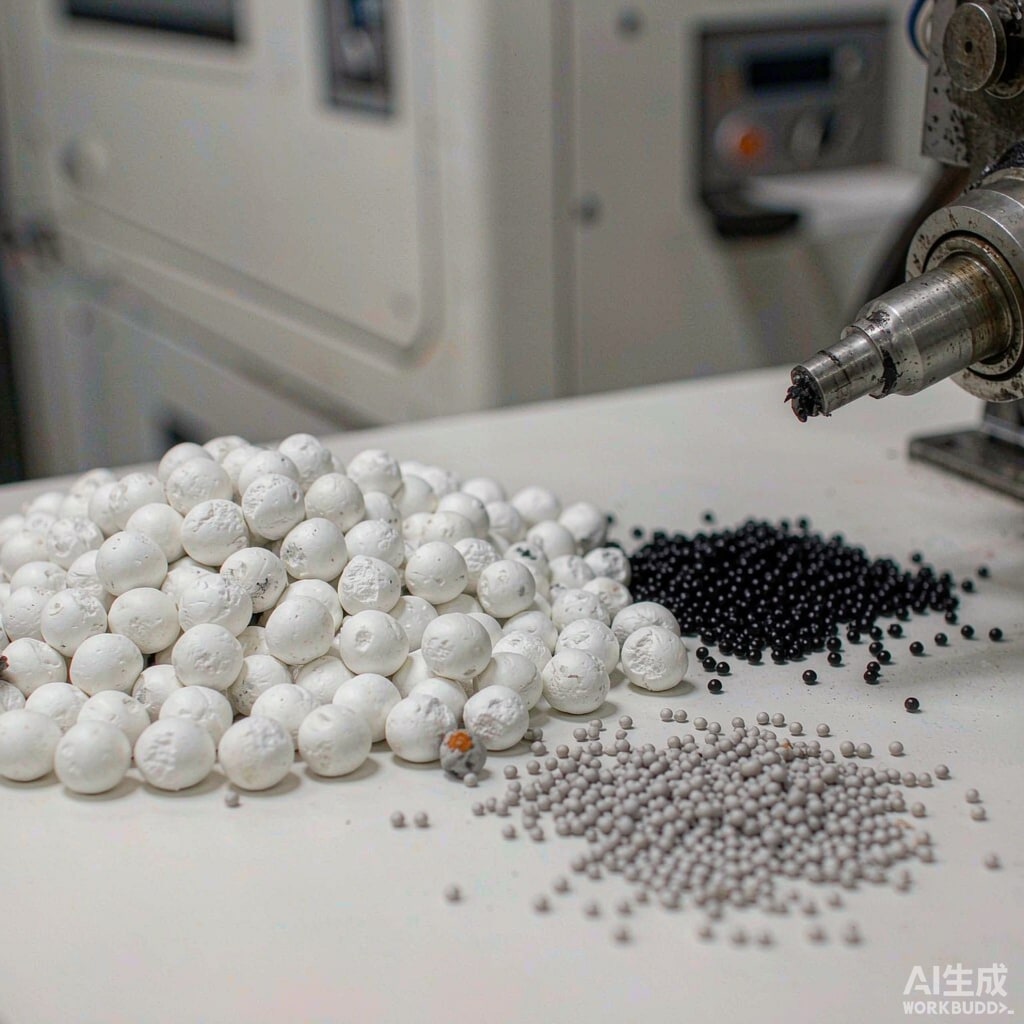
A moulder buying plastic pellets for electronics housings, co
ectors, or trays faces a quiet decision early in the project: use a fully pre-compounded pellet with the colour and additives already built in, or buy natural or base resin and add a masterbatch at the machine. The two routes draw on different supply chains, different equipment, and different failure modes. For high-temperature engineering plastics, the choice often decides whether a moulded part meets its tolerance and certification targets at all.
What Each Route Actually Is
Pre-compounded pellets
The compounder melts the base resin, disperses pigments, fillers, stabilisers, and flame retardants under controlled shear, extrudes it, and pellets the strand. Every pellet has essentially the same composition. Compounding is capital-intensive and the material is bought as a finished, specification-backed product with datasheet values measured on the real blend.
Masterbatch let-down
A masterbatch is a concentrate, typically 20 to 60 percent pigment or additive in a carrier resin, diluted at the moulding machine into natural resin at 1 to 5 percent. It moves colour and some additive functions downstream, requires a dosing and mixing system, and shifts dispersion work from the compounder to the screw.
The Dispersion Problem
Dispersion quality is where the two routes diverge most for engineering plastics. In a twin-screw compounder, pigment agglomerates are broken down with high specific energy in a melt of known viscosity. In an injection unit, you have 30 to 60 seconds of residence time, a screw that was designed for plasticating, not for mixing, and a shot size that may be only a few grams.
Where masterbatch struggles
- Pigment agglomerates in thin walls: streaks and colour specks appear in 0.8 mm walls and are invisible in the shot-pot sample.
- Glass-fibre reinforcement: a 30 percent glass-filled compound has a very different melt viscosity from the masterbatch carrier, so let-down uniformity collapses.
- High processing temperatures: a low-cost carrier such as PE or wax degrades in a 300 °C PPS or PPA barrel, leaving black specks and voids.
- Flame retardants and impact modifiers: these are not practically dosed as masterbatch at the machine; they belong in the compound.
Colour Consistency and Batch-to-Batch Repeatability
Customer-facing parts, such as enclosures and co
ector housings, live or die on colour consistency. Pre-compounded colour is measured by the compounder on a spectrophotometer and delivered with a delta-E tolerance, commonly under 1.0 for industrial parts. With masterbatch, the same concentrate dosed at slightly different rates, into resins with slightly different natural colour, produces a visible drift between moulding runs.
If a project needs several colours from one base resin, masterbatch is genuinely efficient: one natural resin inventory plus four concentrates is far cheaper than four compounded lots, provided the parts are thick-walled and colour tolerance is moderate.
Moisture and Drying Before Moulding
Hygroscopic engineering resins, PA, PBT, PC, and PPA, must be dried before processing. Masterbatch carriers vary widely in moisture pickup, and a concentrate that absorbs water can re-introduce moisture after the resin has been properly dried. This is a common cause of silver streaks in PA66 or PBT parts and is very hard to trace once it happens. Pre-compounded pellets have a documented drying curve; masterbatch requires the supplier to state carrier dryness and the drying conditions.
Cost Structure: Not Just Price per Kilogram
Pre-compounded
Higher unit price, but the price already includes compounding energy, quality control, and additive dispersion. No dosing equipment, no mixing validation, no extra inventory line. For a part with a certified flame rating or precise mechanical properties, this is usually the cheapest total route.
Masterbatch
Lower material cost per coloured kilogram, plus the cost of a gravimetric doser, colour measurement, and process validation. Break-even is typically reached when a
ual volume is significant and the part is simple, thick-walled, and colour-tolerant. Below that, the administrative and validation burden dominates.
A useful check is to compute total material cost per thousand parts, including drying, start-up scrap, and colour-change purging. Masterbatch often loses on colour-change purging alone in high-mix plants.
Inventory and Supply Chain
Pre-compounded material locks you into a specific formulation, which is good for quality and awkward during a shortage. Single-source concentrates supplied regionally can be substituted quickly, provided the carrier and pigment chemistry are qualified. For plants in Southeast Asia where resin shipments arrive by sea freight, having natural resin plus masterbatch can improve resilience, but only if the qualification work has already been done.
Qualification Checklist Before You Commit
- Mould a full shot at production wall thickness and inspect under low-angle light for streaks and specks.
- Measure colour delta-E across the first, middle, and last third of the run.
- Verify mechanical properties on the actual let-down ratio: tensile, impact, and HDT, not the neat resin datasheet.
- Re-test flame rating with the exact formulation used in production, since let-down ratio shifts the effective additive loading.
- Confirm thermal stability by holding material in the barrel for the maximum expected residence time and inspecting for black specks.
- Document the dosing rate and verify it with a gravimetric check, not a volumetric setting.
A Simple Decision Rule
If the part must hold a certification, a tight tolerance, or an exact colour, use pre-compounded pellets. If the part is a housing, tray, or cover where colour is decorative and walls are thick, and the volume justifies a doser, masterbatch is a legitimate cost lever. Mixing the two approaches on the same resin family, one product compounded and the next let down from the same natural resin, is where most plants get into trouble: the two lots behave differently in the mould and the process window has to be re-learned each time.
Neither route is better in the abstract. The right question is where you want to spend your quality effort: at the compounder, with documented data, or on your own shop floor, with statistical process control and patience.



