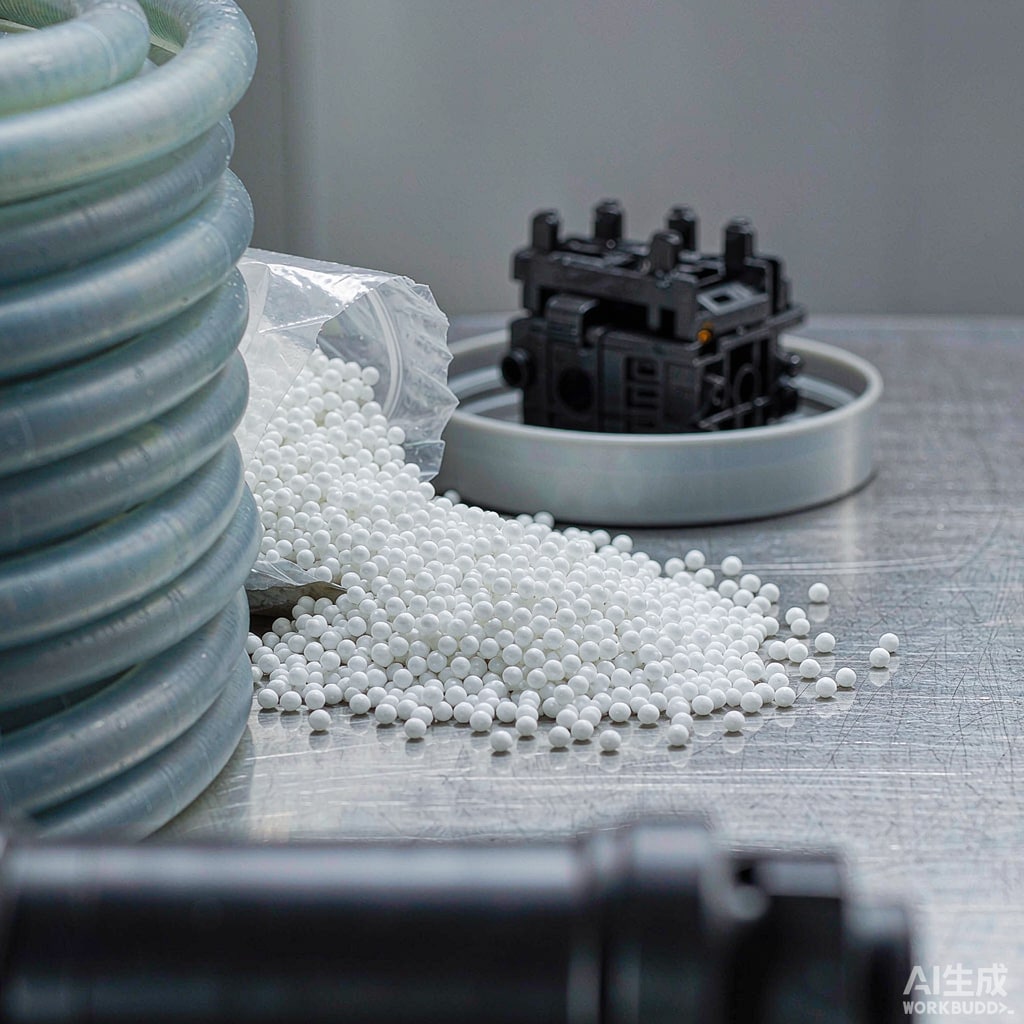
Electronics manufacturing has its own chemical war zone: wet benches etching wafers with hot acids, battery lines handling electrolyte, and coastal telecom cabinets breathing salt fog. For hardware in those environments, ordinary engineering plastics fail slowly but surely. Polyvinylidene fluoride — PVDF — is the polymer that keeps working. Sold as pellets for injection molding and extrusion, it occupies a sweet spot between the chemical immortality of PTFE and the processability of commodity thermoplastics.
Property Profile That Earns Its Niche
PVDF is a semi-crystalline fluoropolymer, roughly 60 percent fluorine by mass, with a melting point near 170 degrees Celsius and continuous service ratings up to 150 degrees Celsius. Its chemical resistance is outstanding across the wet-process spectrum: it shrugs off concentrated hydrochloric, sulfuric, and nitric acids at room and elevated temperature, withstands halogens and most salt solutions, and tolerates repeated steam and CIP cleaning cycles. Its weaknesses are specific, not general: strong amines, hot concentrated alkali above 10 percent concentration, some ketones and esters, and fuming acids at high temperature will attack or swell it.
Mechanically, PVDF delivers tensile strength of 35 to 50 MPa with useful impact resistance and much better abrasion resistance than PTFE, which is soft and creep-prone. Its melt viscosity is two to three orders of magnitude lower than PTFE’s — PTFE ca
ot be melt-processed at all, while PVDF runs in standard injection molds and extruders. That single processing fact is why PVDF dominates wet-bench hardware: complex tanks, valve bodies, pump impellers, and fittings are molded in the same equipment that runs PP and PVC.
Two bonus properties matter in electronics. PVDF is inherently flame resistant with a UL94 V-0 rating in many grades and an oxygen index above 40, meeting enclosure flammability requirements without additive packages that might compromise chemical resistance. And the polymer is piezoelectric in its stretched beta-phase form — niche, but it enables PVDF films as stress and acoustic sensors inside instruments the same plastic builds.
Grades and What to Ask Suppliers
Suppliers offer homopolymer grades for maximum crystallinity and chemical resistance, copolymer grades with improved flexibility and impact at low temperature, and filled grades with glass beads or carbon fiber. For semiconductor wet-process hardware, insist on high-purity grades with documented low extractable ionic content — sodium, chloride, and iron leachables below the parts-per-billion thresholds your process owners specify. For battery tab and module hardware, grades with ESD control via carbon loading around 2 to 5 percent keep surface resistance in the 10⁴ to 10⁸ ohm range without metal fillers that could puncture separator films. Always request the supplier’s chemical resistance chart for the exact chemicals and temperatures of your process; resistance tables differ between grades and the differences matter.
Processing Windows and Practical Cautions
PVDF pellets process like a stiff polyamide. Injection molding barrel temperatures run 200 to 240 degrees Celsius with mold temperatures of 80 to 110 degrees for good crystallinity; extrusion of tubing and rods uses melt temperatures around 220 to 250 degrees. Drying is mild — 2 to 4 hours at 80 degrees Celsius — because moisture absorption is low, but skip it and you get silver streaks on glossy surfaces.
Thermal degradation is the serious hazard: above roughly 300 to 320 degrees Celsius PVDF decomposes, releasing hydrofluoric acid. Keep melt temperatures in window, purge thoroughly when switching resins, never let PVDF stagnate against hot metal overnight, and use corrosion-resistant barrel hardware; trace HF will attack standard tool steel over time. Vent the molding cell adequately and follow supplier safety data — this is the one PVDF processing rule with teeth. Shrinkage runs 1.5 to 3 percent depending on grade and thickness, and crystallinity continues to develop for days after molding, so dimension-critical parts should be a
ealed at 100 to 140 degrees Celsius before final machining.
Where PVDF Beats PTFE, PFA, and PP
Against PTFE: PVDF is far stiffer, weldable, melt-processable, and much cheaper, with comparable broad-acid resistance; PTFE wins only at extreme temperatures and with the most aggressive chemicals. Against PFA: PVDF costs a fraction as much and molds into thick-walled structural parts that PFA’s high viscosity resists; PFA wins above 150 degrees and in ultra-high-purity lines where even PVDF’s trace extractables are too much. Against PP and PVC: PVDF wins on every chemical and thermal measure but costs three to eight times more — so the engineering rule is to use PVDF exactly where polypropylene failures have been observed, and nowhere else.
For an electronics manufacturer buying pellets, PVDF is insurance sold by the kilogram. Specify it for wet-process hardware, corrosive-atmosphere enclosures, and battery contact insulation, and it will quietly outlast every alternative you considered.



