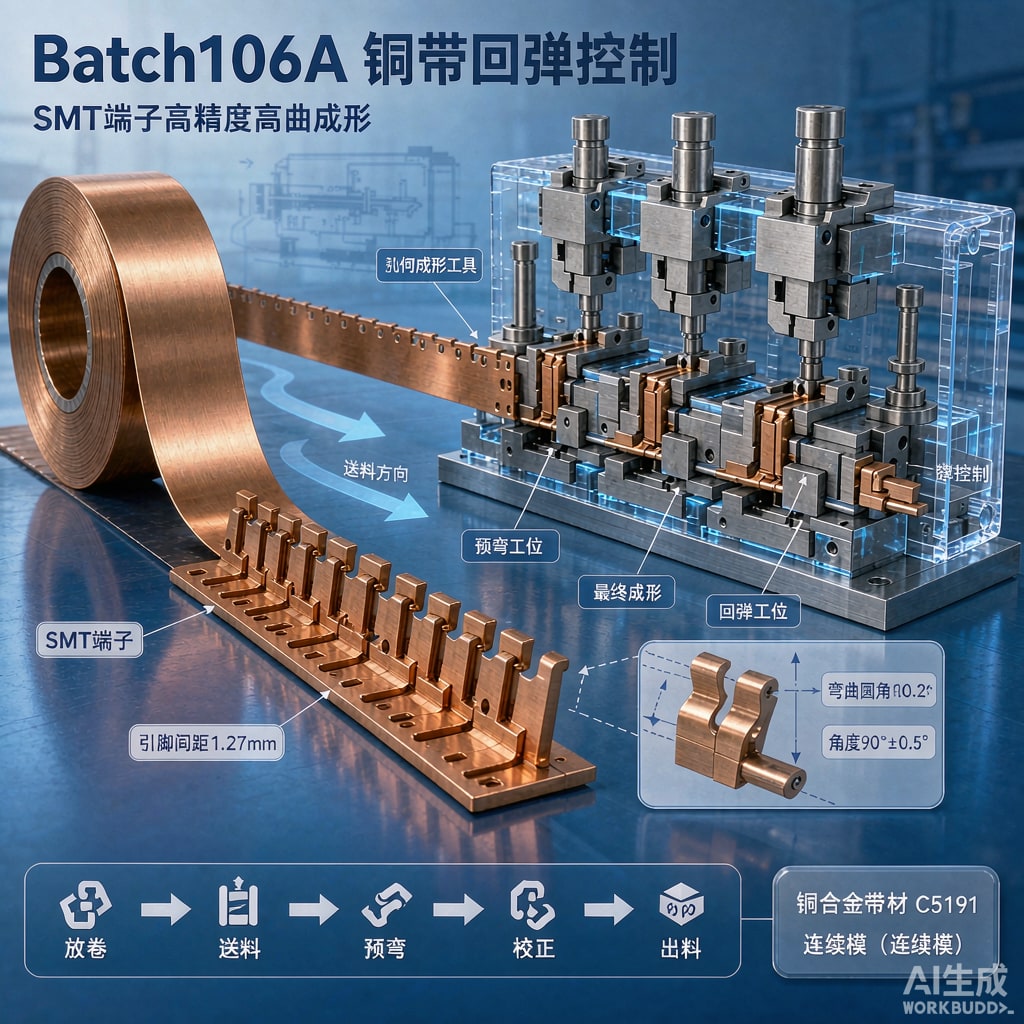
Why Springback Matters in SMT Terminal Forming
When copper strip is bent into SMT terminals, springback determines whether the final contact angle, height, and normal force fall inside the narrow tolerances demanded by co
ectors, fuse clips, and battery tabs. Even a one-degree deviation can shift contact resistance, weaken retention, or cause assembly interference on crowded PCBs. Understanding and controlling springback is therefore not a secondary forming issue—it is a quality gate for high-reliability SMT interco
ects.
What Drives Springback in Copper Strip
Springback is the elastic recovery that occurs after a bend is released. In ductile copper alloys, it is governed by the ratio of yield strength to elastic modulus. C11000 soft a
ealed strip may spring back only a few degrees, while work-hardened C19400 or C7025 in hard temper can spring back 8–15° on a 90° bend. Key drivers include:
- Strip thickness and bend radius: Thi
er strip bent to a larger inside radius experiences more springback because plastic strain is lower relative to elastic strain.
- Temper and grain size: Higher temper raises yield strength and increases springback. Recrystallized, fine-grained strip is more stable.
- Bend angle and tooling overbend: Acute bends store more elastic energy; overbending is the simplest compensation strategy.
- Lubrication and punch speed: Consistent friction prevents localized thi
ing; high speed can raise temperature and reduce springback slightly.
Process Parameter Windows for Common Alloys
For most SMT terminals, the practical bend radius is 0.3–1.0× strip thickness. In this range, C11000-O typically shows 2–4° springback, C19400-H 5–9°, and high-strength C7025-TM08 up to 10–14°. Engineers should test springback at the nominal radius using a gauge-bend fixture before committing to production tooling. Recording the relationship between bend angle and springback angle for each lot establishes a correction curve that the press shop can apply during setup.
Die Compensation and In-Process Correction
Progressive dies for SMT terminals usually include two compensation methods. First, the forming punch is designed with an overbend angle equal to the expected springback, so the part relaxes to the target geometry. Second, coining or bottoming at the bend line introduces higher plastic strain and reduces elastic recovery. Bottoming force must be controlled to avoid cracking the outer bend surface, especially in high-strength alloys.
For very tight tolerances, servo presses with real-time angle feedback can adjust the bottom-dead-center position based on in-line measurement of the first few parts. This closed-loop approach is particularly valuable when strip thickness varies ±0.01 mm or when multiple lots with different temper enter the same line.
Measurement and Acceptance Criteria
Springback is best measured on a shadowgraph or optical comparator by comparing the formed angle to the die angle immediately after ejection. Acceptance limits depend on the terminal function: signal contacts often allow ±1°, while power contacts carrying high normal force may allow ±2°. If springback drift exceeds half the tolerance band, the root cause—strip temper, tooling wear, or lubrication—should be corrected before continuing production.
Conclusion
Controlling copper strip springback in SMT terminal forming starts with material selection and continues through bend-radius design, die overbend, and in-process monitoring. A disciplined approach keeps contact geometry stable across lots, reducing downstream insertion force issues and improving long-term co
ector reliability.



