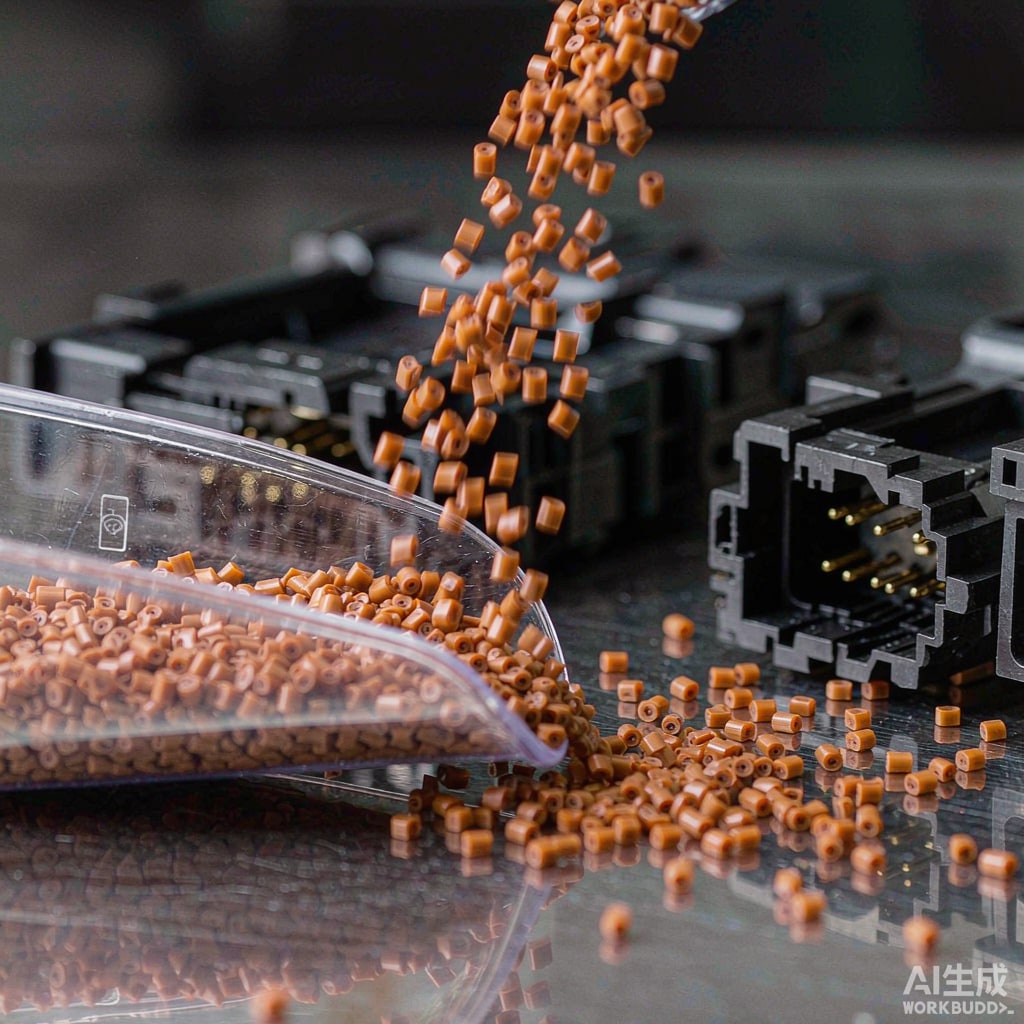
As SMT reflow profiles push peak temperatures above 260°C and co
ectors shrink while carrying more current, the housing material becomes a limiting factor. Polyamide 46, or PA46, offers a combination of high melting point, stiffness at elevated temperature, and fast crystallization that makes it a strong candidate for SMT co
ector bodies, test sockets, and relay bases. This article explains what PA46 pellets deliver and how to process them successfully.
Why PA46 for SMT Co
ectors
PA46 has a melting point near 295°C and a heat deflection temperature around 285°C for glass-filled grades. That places it above standard PA66 and close to high-performance materials like PA9T and PPS. For co
ector housings that must survive lead-free reflow, wave soldering, or infrared rework, this margin matters. PA46 also maintains mechanical strength at temperature, so latches and contact retention features do not soften during assembly or in hot operating environments.
Another advantage is crystallization speed. PA46 crystallizes faster than PA66 and much faster than PPA grades, enabling shorter molding cycle times. For high-volume co
ector production, that translates into more cavities per press and lower piece-part cost.
Property Comparison at a Glance
Compared to common alternatives, PA46 sits in a practical middle ground. PA66 is cheaper and easier to mold but has lower HDT and absorbs more moisture. PA9T has similar reflow resistance and lower moisture uptake but typically costs more. PPS handles higher temperatures and is extremely dimensionally stable, yet it is brittle and can flash more easily in thin-wall co
ectors. PA46 glass-filled grades offer tensile strength around 180–220 MPa, flexural modulus above 8 GPa, and UL94 V-0 options with halogen-free flame retardants.
Processing PA46 Pellets
PA46 requires careful drying because polyamides are hygroscopic. Recommended moisture content before molding is below 0.05%, which usually means drying at 80–100°C for 4–6 hours in a dehumidifying dryer. Melt temperatures range from 300°C to 320°C, and mold temperatures of 80–120°C promote crystallization and surface finish. Barrel residence time should be minimized; long residence at high temperature causes yellowing and property loss. Hot ru
ers are common in co
ector molding but must be temperature-controlled to avoid degradation.
Design Considerations
PA46’s high flow allows thin walls and complex pin cavities, but gate location and wall thickness must be balanced to avoid warpage. Fiber orientation in glass-filled grades leads to anisotropic shrinkage, so co
ector housings with tight pin-position tolerances require mold flow simulation and post-mold measurement. Because PA46 absorbs some moisture, dimensional checks should account for conditioned versus dry-as-molded state. In very humid environments, moisture uptake can slightly increase dimensions and reduce stiffness compared to the dry state.
Applications and Procurement
Beyond SMT co
ectors, PA46 is used in automotive sensors, electric motor components, and high-temperature cable ties. For electronics manufacturing, focus on grades with proven reflow performance, UL recognition, and halogen-free V-0 options if needed for export markets. When sourcing PA46 pellets, request data sheets showing melt volume rate, HDT, tensile properties, moisture absorption, and flammability rating. Mold trials should verify cycle time, dimensional stability, and color match before committing to high-volume production.



