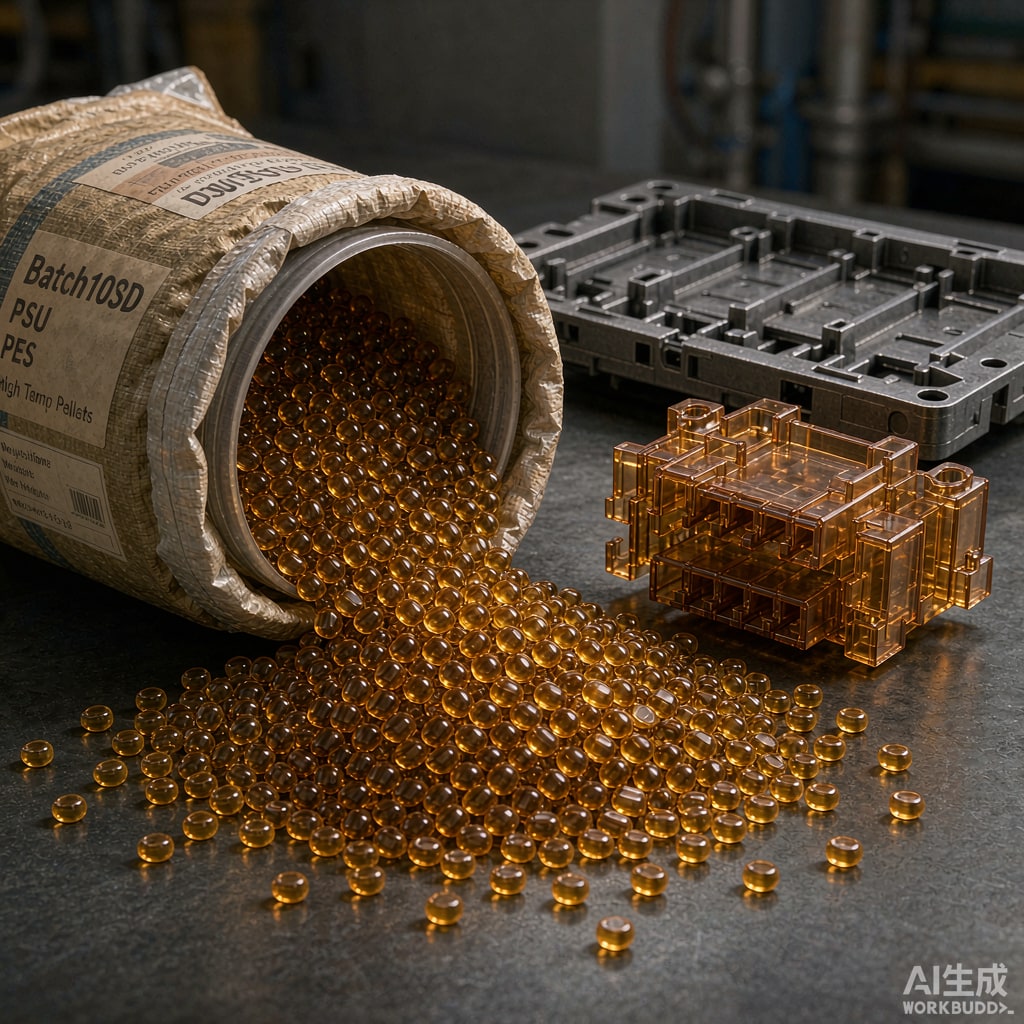
Most engineering thermoplastics give up somewhere between 100 and 150 °C. Polysulfone (PSU) and polyethersulfone (PES) keep their mechanical properties beyond that range, which makes them standard choices wherever molded parts must survive lead-free SMT reflow temperatures or continuous service near 180 °C. This article compares the two resins, outlines processing requirements for molders working with their pellets, and maps typical SMT applications.
Chemistry and Key Properties
Both resins are amorphous, sulfur-containing thermoplastics with aromatic backbones. Amorphous structure means transparent, isotropic shrinkage, and no crystalline melting point—only a glass transition, which sits at about 185 °C for PSU and 225 °C for PES. Key figures:
- PSU: Tg ~185 °C, continuous use temperature ~160 °C, notched Izod ~70 J/m, dielectric constant 3.1 at 1 MHz, naturally translucent amber.
- PES: Tg ~225 °C, continuous use temperature ~180 °C, higher modulus (~2.4 GPa vs 2.5–2.7 GPa comparable), better creep resistance at temperature, slightly lower impact strength, deep amber transparent.
Both are inherently flame retardant to UL94 V-0 at typical wall thicknesses without halogen additives, a genuine advantage for co
ector housings. Both are also hydrolysis-resistant in hot water and steam, allowing steam autoclave cycles above 130 °C—useful for reusable SMT carrier tooling in assembly plants.
Reflow Survival Logic
Lead-free reflow profiles peak at 245 to 260 °C for 30 to 60 seconds. A molded component riding through that profile needs Tg comfortably above the peak, or it will warp. PES, with Tg at 225 °C, stays fully glassy through reflow and is the standard for reflow-compatible co
ector bodies and SMT carrier trays that pass through the oven with the board. PSU sits closer to the line: brief excursions to 200 to 210 °C are tolerated, but full 260 °C reflow will soften PSU parts. The practical rule: PES for in-oven components, PSU for components adjacent to, but not inside, the reflow thermal zone.
Processing Pellets: What the Molder Must Respect
Drying
Both resins are hygroscopic and degrade by hydrolytic chain scission if molded wet. Dry at 150 to 165 °C for 3 to 4 hours to below 0.05 percent moisture. Desiccant dryers with dew point monitoring below -30 °C are preferred; a single wet batch shows up as silver streaks and a measurable drop in impact strength.
Melt Temperature and Mold Control
PSU processes at 340 to 400 °C melt, PES at 340 to 380 °C with recommended barrel capability to 400 °C. Mold temperatures of 140 to 160 °C are needed for good surface replication and low residual stress; ru
ing a cold mold produces brittle, highly stressed parts even when the melt window was correct. Screw compression ratio around 2:1 with low shear avoids darkening; residence time above 10 minutes at temperature begins to degrade either resin.
Shrinkage and A
ealing
As amorphous resins, both shrink uniformly at 0.5 to 0.7 percent—predictable and anisotropy-free, unlike semi-crystalline competitors such as PPS. High-temperature parts that will see sustained service near Tg benefit from a post-mold a
eal at 160 °C (PSU) to relieve molded-in stress and prevent dimensional drift in service.
Typical SMT and Electronics Applications
- Reflow carrier trays and bake trays: PES dominates; thousands of autoclave and oven cycles without warping, dimensional stability where PCB cavities must locate precisely.
- High-temperature co
ector insulators:
PES bodies for board-to-board and memory card coectors in automotive under-hood and aerospace environments, where 150 °C continuous exposure disqualifies PA66 and PBT.
- Membrane switch and display windows: the transparency and V-0 rating together suit illuminated industrial control panels.
- Healthcare electronics housings: steam-sterilizable enclosures for devices that must survive repeated autoclaving.
- Coil formers and sensor bobbins: PSU at lower cost where the temperature requirement stops below 160 °C.
Cost Position and Alternatives
PSU and PES pellets cost a multiple of PA66 or PBT, so they should be selected only when the temperature or sterilization requirement genuinely demands them. Below 150 °C continuous, PA66 GF30 or PBT GF30 deliver the needed performance at far lower cost. Between 150 and 180 °C, PPS or PEEK enter the comparison—PPS offers chemical resistance and lower cost but is filled and opaque, while PEEK raises the ceiling to 250 °C at a much higher price. PSU and PES occupy the transparent, V-0, mid-170s °C niche that none of those fill cheaply.
Conclusion
PSU and PES pellets solve a narrow but critical problem: molded parts that must survive reflow ovens, autoclaves, or continuous 180 °C service while staying dimensionally precise and flame retardant. Molders who respect the drying and high mold temperature requirements get transparent, stable parts; anyone who treats them like ordinary resin will fight silver streaks and brittle parts. Choose PES for in-oven and highest-temperature roles, PSU where 160 °C suffices and cost matters more.



